
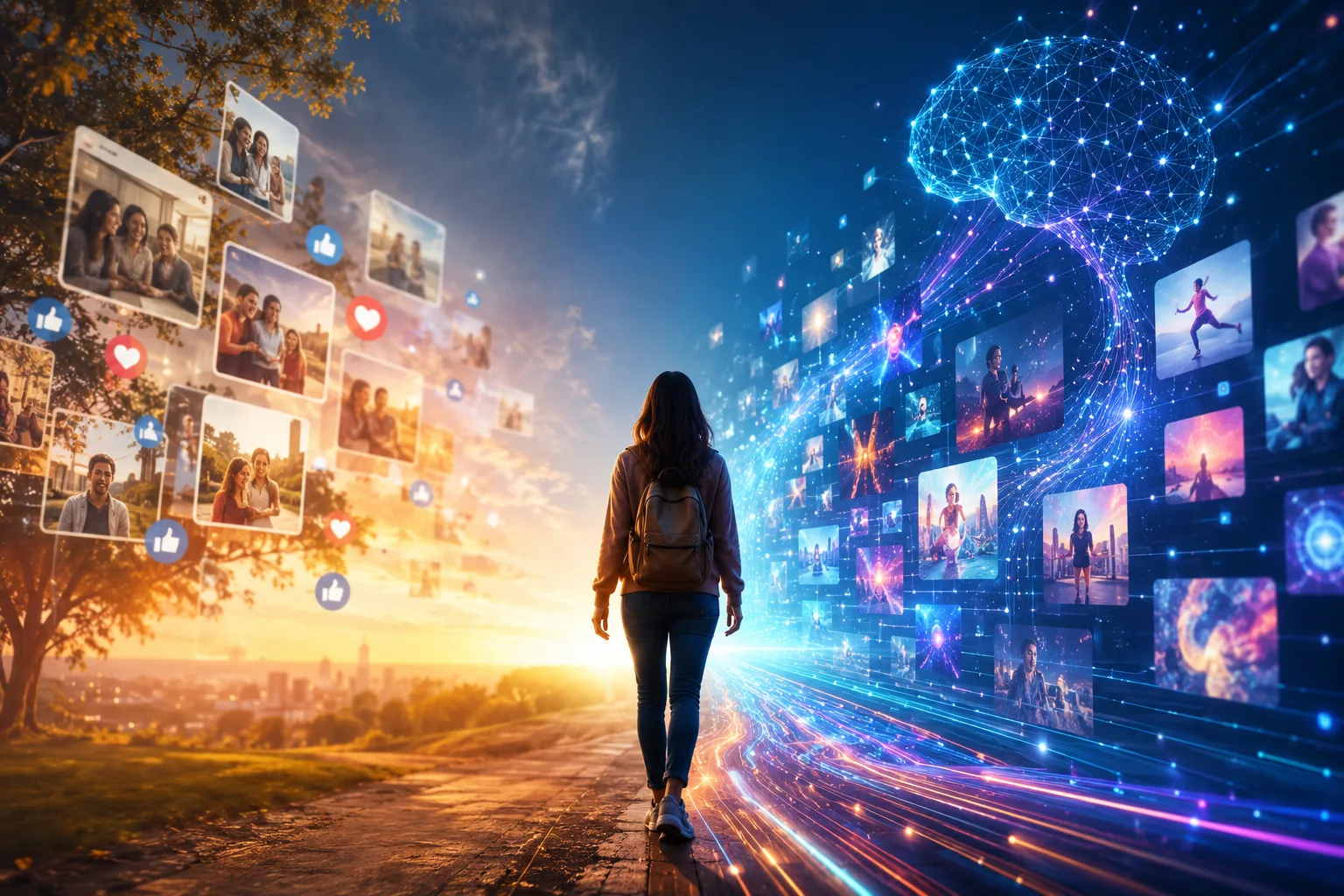
Social media is moving through its third major era. The first was the social graph, where feeds revolved around friend connections. The second was the engagement algorithm, where platforms like TikTok proved networks were optional if recommendations were good enough. The third, now underway, is LLM-powered semantic discovery. Meta has already publicly described its Adaptive Ranking Model, an LLM-scale recommendation system that understands user intent, not just behaviour. This shift rewards expertise, topical depth, structure, and clarity over outrage and hooks, which flattens the structural advantage massive followings once had. A creator with 5,000 followers can outperform one with 5 million if the content is genuinely relevant to the right audience. Social feeds are starting to behave less like friend networks and more like AI-curated discovery engines, which means creators are increasingly optimizing for AI interpretation systems alongside human readers.
I joined Facebook in 2008.
It felt revolutionary because it was simple. You saw updates from your friends. Photos, status updates, events, relationship drama, vacation albums. Your feed was a digital extension of your social circle.
Then something changed.
The feed slowly stopped being about people I knew.
At first it was subtle:
- suggested posts
- recommended pages
- viral content
- posts “liked by” friends
Then the feed became something else entirely:
an algorithmically curated stream of content designed to keep me engaged.
I was genuinely shocked by it.
Why was I seeing content from strangers? Why was Facebook deciding what I should care about?
Years later I found TikTok.
The strange thing? I had no friends there. And I found the experience incredibly engaging.
That was when I realized social media had fundamentally changed.
The old social web was built around relationships. The new one is built around recommendation systems.
And now we’re entering the next phase:
LLM-powered semantic discovery.
The First Era: The Social Graph
Early social media platforms revolved around what Silicon Valley called the “social graph.”
The logic was simple. Follow people. See their content. Interact with your network.
Ranking systems existed, but they were lightweight. The primary signal was who you knew.
Platforms optimized for friend connections, follower relationships, chronological updates, and network expansion.
If you wanted reach, you built followers. Big audiences had massive structural advantages.
The Second Era: The Algorithm Feed
Then came the engagement era.
Platforms realized they could increase session length, ad revenue, and user retention by optimizing feeds around engagement instead of relationships.
This was the rise of Facebook News Feed optimization, YouTube recommendations, Instagram Explore, and TikTok’s “For You” feed.
The core idea became:
show users whatever keeps them scrolling.
Traditional recommendation systems used watch time, click-through rates, shares, comments, interaction velocity, and behavioral similarity.
In other words:
“Users like you engaged with this.”
This worked extremely well. Especially for TikTok.
TikTok proved something important. People did not actually need friend networks to become deeply engaged. The algorithm itself became the product.
The Third Era: LLM-Powered Discovery
Now we’re seeing another shift.
Platforms are integrating transformer models, semantic ranking systems, generative AI, and LLM-scale recommendation models into feed ranking and content discovery.
This changes everything.
Traditional algorithms understood engagement, behavior, and probabilities.
LLM-enhanced systems can increasingly understand meaning, expertise, tone, narrative, intent, conversational context, and topical relevance.
The feed is evolving from:
“What performs well?”
to:
“What is this actually about, and who would genuinely care about it?”
That is a massive change.
Meta Has Already Publicly Discussed This
Meta Engineering recently published details about its “Adaptive Ranking Model,” describing LLM-scale recommendation infrastructure, deeper understanding of user intent, and large-scale semantic ranking systems.
Meta also disclosed measurable improvements including increased click-through rates and improved ad conversions.
This matters because it confirms one thing:
LLM-driven recommendation systems are not theoretical anymore.
They are already shaping what billions of people see.
Why This Is Great News for Small Influencers
This is the part I find most exciting.
The old social media world heavily favored large followings, celebrity status, massive networks, and established creators.
AI-driven semantic discovery changes the playing field.
Why? Because LLM-powered systems can increasingly understand niche expertise, topical depth, conversational relevance, educational value, and semantic clarity.
A creator no longer needs millions of followers, years of audience building, or a massive social graph.
Instead, the platform can ask:
“Is this content highly relevant for this specific user?”
That creates real opportunities for niche experts, technical creators, educators, local voices, independent researchers, and thoughtful long-form creators.
We are entering a world where relevance can outperform popularity.
Honestly, that’s a much healthier internet.
Why Creator Behavior Is Already Changing
You can already see creators adapting to this new reality.
The earlier algorithm era rewarded outrage, emotional spikes, clickbait, rage bait, and hyper-short hooks.
LLM-enhanced recommendation systems increasingly reward expertise, structure, explanation, context, clarity, and topical consistency.
This is why we’re seeing longer captions return, educational content explode, niche creators grow rapidly, “deep dive” content perform better, and technical explainers gain reach. Storytelling has become the most valuable creator skill precisely because semantic systems can finally tell the difference between a narrative and a hook.
The feed can now understand what content means, not just whether people reacted to it.
That’s a real shift.
Social Media Is Starting to Feel More Like Search
Another side effect: social feeds increasingly behave like discovery engines.
Users are no longer just following creators.
They are effectively querying platforms for ideas, explanations, expertise, recommendations, identity, belonging, and learning.
The algorithm increasingly acts like:
an AI curator for your interests.
This is why semantic structure matters more. Topic authority matters more. GEO (Generative Engine Optimization) matters more. AI readability matters more. It is the same shift driving the rise of Agent Experience (AX) analytics: machines are now part of the audience, and they need content they can interpret.
Creators are no longer optimizing only for humans. They are optimizing for AI interpretation systems too.
The Opportunity Ahead
I think we’re entering one of the most interesting eras in social media.
For years, creators complained that platforms favored massive influencers, established brands, celebrity accounts, and engagement hacks.
LLM-powered discovery may flatten some of that advantage.
If platforms become better at understanding meaning, usefulness, expertise, and relevance, then smaller creators suddenly become much more competitive.
A highly relevant creator with 5,000 followers may outperform a creator with 5 million followers for the right audience.
That changes everything.
As someone who watched social media evolve from Facebook friend updates in 2008 to fully AI-curated discovery feeds today, it feels like we’re only at the beginning of this next chapter.
Frequently Asked Questions
What is LLM-powered semantic discovery?
It is the use of large language models inside social media ranking and recommendation systems to understand what content is actually about, not just how users behave around it. Instead of relying on watch time, clicks, and engagement signals alone, the platform interprets meaning, intent, expertise, and topical relevance, then matches content to users based on what they would genuinely care about.
How is this different from the recommendation algorithms TikTok already uses?
Traditional recommendation systems are behavioural. They look at engagement patterns, watch time, similar users, and probability of interaction. LLM-enhanced systems add semantic understanding on top of those signals, so the model can reason about what the content means, who the natural audience is, and whether the topical match is genuine, rather than just chasing the highest-engagement guess.
Why does this favour small creators?
Reach in the engagement era was heavily tied to follower count, network effects, and content that hit emotional spikes. Semantic discovery cares more about whether a piece of content is genuinely the best match for a given user’s interest. A niche creator with 5,000 followers who covers a specific topic deeply can outperform a generalist with 5 million followers in the audiences that actually care about that topic.
What is Meta’s Adaptive Ranking Model?
It is the LLM-scale recommendation infrastructure Meta described publicly in 2026. The architecture is designed to serve very large semantic ranking models efficiently and is used in production for ads ranking. Meta reported measurable improvements in click-through rates and ad conversions, which is the practical confirmation that LLM-driven recommendation systems are already shaping what billions of people see.
What does this mean for creators and brands practically?
Optimize for clarity and topical depth, not just engagement hooks. Pick a focused subject and stay consistent. Write captions and descriptions that explicitly state what the content is about so a language model can interpret it correctly. Treat AI interpretation as a second audience alongside human viewers, the same way SEO once treated search engines. The same principles that make content useful to AI search systems, sometimes called Generative Engine Optimization or GEO, also make it more discoverable on social feeds that now rank semantically.
