
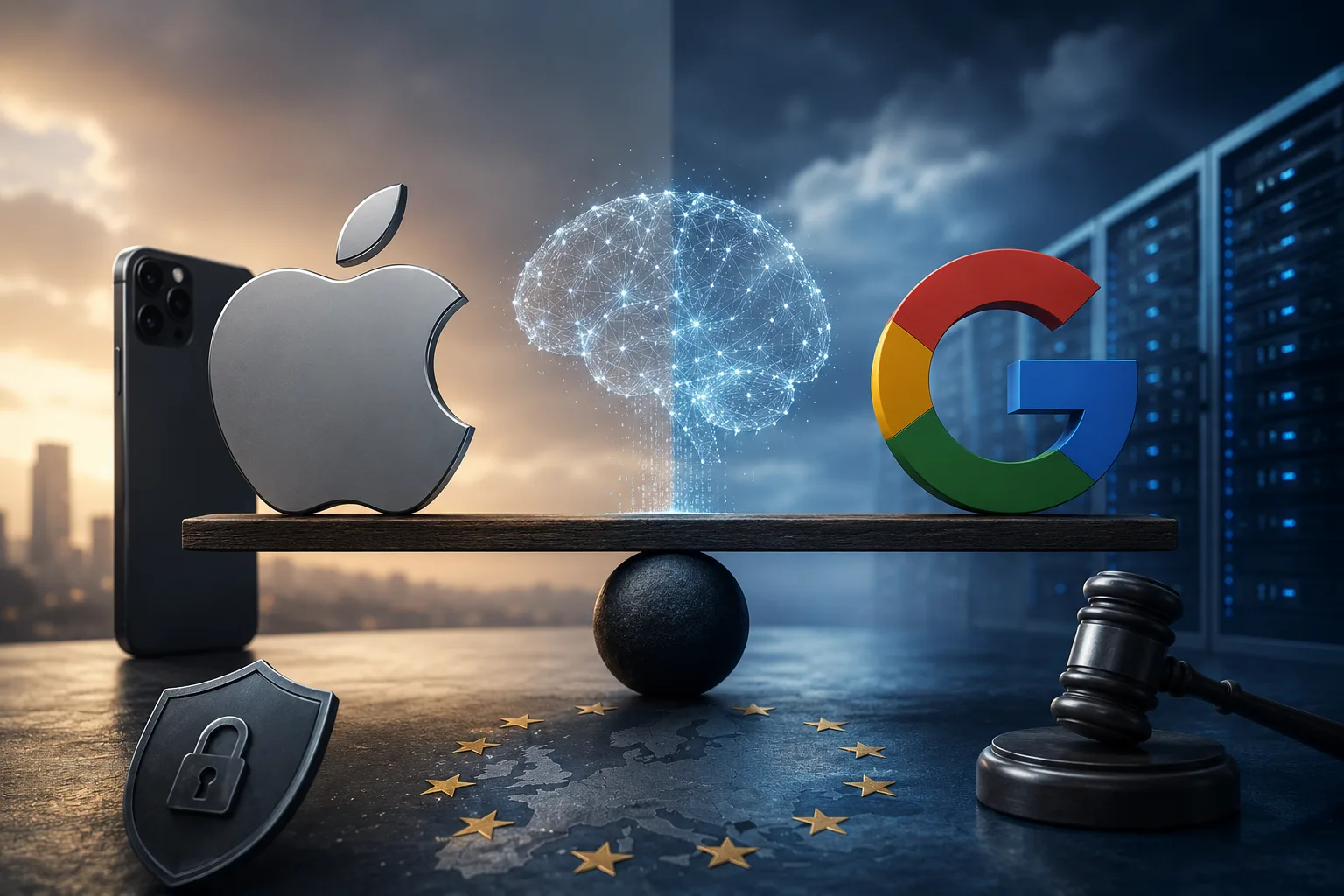
Apple’s WWDC 2026 announcement of a new Siri running on Apple and Google Gemini models is being held back from EU iPhone and iPad users over regulatory concerns. The signal is bigger than the launch delay. The hard part of AI has shifted from building it to governing it, especially when the company that owns the device and the company that owns the model are not the same. The EU is stress-testing AI accountability through the AI Act, GDPR, and the DMA, and a new layer of AI infrastructure is forming around data lineage, audit trails, consent, jurisdiction-aware processing, and decision traceability. The next era of AI competition is about proving what the AI did, not just how smart it is.
Apple’s WWDC 2026 announcement may be remembered for something nobody expected.
Not because Siri got dramatically smarter. Not because Apple partnered with Google. But because one of the world’s most valuable companies showed off a flagship AI experience it can’t immediately ship to hundreds of millions of users in Europe.
Apple introduced a new generation of Siri running on a mix of its own models and Google’s Gemini. The experience promises what people have been waiting for: personal context, multi-step actions, persistent memory, conversations that follow you across devices. (I wrote about how this direction was visible months ago in Apple’s AI Strategy May Be Simpler Than We Think.)
In a lot of ways it’s the future of personal computing.
And Apple says it won’t launch on iPhone and iPad in the European Union at first, citing regulatory concerns.
That should get your attention.
The hard part isn’t building the AI
For three years the industry has been obsessed with model capability. How many parameters. How many benchmarks. How many tokens per second. The assumption was that whoever built the smartest model would win.
The Apple-Google partnership points at a different reality. Building the AI is now easier than governing it.
A modern assistant doesn’t just answer questions. It reaches into your calendar, messages, notes, contacts, photos, documents, and location history, and it increasingly acts on your behalf.
Generating an answer is no longer the challenge. The challenge is proving what data was accessed, why, by which system, where it was processed, what actions were taken, what got retained, and what got rejected.
The more autonomous the AI becomes, the harder all of that gets.
When one company owns the user and another owns the model
The Apple-Google relationship creates a governance problem that didn’t exist before.
Apple’s privacy story used to be simple. Apple built the device, controlled the operating system, ran the user experience, and owned most of the processing environment. AI breaks that.
Picture a request like this: “Find the email from my wife about summer vacation, compare it with my calendar, book the open dates, and add the itinerary to my notes.”
To pull that off, the assistant might touch email, calendar, notes, contacts, a travel service, and a payment system. Possibly across several providers.
The user sees one assistant. Behind it, several systems are doing the work.
So who’s responsible for the decision? For the data? For the cleanup when something goes wrong?
Those questions get a lot harder when the company that owns the operating system and the company that owns the model aren’t the same. (Microsoft is wiring its own version of this stack together as Agent 365: Microsoft’s AI Strategy Is Becoming Clear, And It’s Much Bigger Than Copilot.)
Europe is stress testing the future
You can like European regulation or hate it. Either way, the EU is running a large-scale experiment on AI governance right now.
The AI Act, GDPR, and the Digital Markets Act all converge on the same set of issues: transparency, accountability, competition, personal data.
They add up to one blunt question. Can you prove what your AI system actually did? Not what you intended. Not what your policy says. What happened.
Old-school software compliance was manageable because applications followed deterministic logic. Auditors could read the code, review the controls, trace a decision from input to output.
Generative AI puts probabilistic behavior inside systems that touch personal information. At that point the problem stops being software engineering and starts being evidence.
The rise of AI accountability infrastructure
This is why a new category of technology is starting to show up.
Most organizations have poured money into model performance. Far fewer have spent anything on model accountability.
The next wave of AI infrastructure is going to be the unglamorous stuff: data lineage, access controls, policy enforcement, audit trails, consent management, jurisdiction-aware processing, cryptographic verification, decision traceability.
Systems that help you answer hard questions after an AI interaction. Or better, stop the bad interaction before it happens.
I know this sounds dull next to billion-parameter models and multimodal assistants. It’s the opposite of dull. It’s where the money is going to be.
Whole technology markets have been built on trust before. Cybersecurity became a trillion-dollar industry because organizations needed proof their systems were secure. Identity management became a category because organizations needed proof their users were authorized.
AI governance is heading down the same road.
The new competitive advantage
The real lesson from Apple’s announcement is that AI competition has entered a new phase.
For a few years the question was “Can you build the AI?” Now it’s becoming “Can you prove what the AI did?”
The companies that answer that second question may end up mattering as much as the companies building the models. In a world where AI can read your messages, your calendar, your photos, your finances, and your personal history, raw capability isn’t enough.
Trust, accountability, and governance are turning into product features.
And as Apple just showed, even the best AI experience on earth is only as deployable as the governance behind it.
Frequently Asked Questions
Why is Apple delaying its new Siri in the European Union?
Apple introduced a next-generation Siri at WWDC 2026 built on a mix of Apple’s own models and Google’s Gemini, with personal context, multi-step actions, persistent memory, and cross-device continuity. It said it will not launch on iPhone and iPad in the EU at first, citing regulatory concerns tied to how the new experience handles personal data, partner model access, and platform competition obligations under the EU’s overlapping rules.
What is AI governance, in plain terms?
AI governance is the set of rules, controls, and evidence trails that prove what an AI system actually did. It covers what data the system accessed, where it was processed, which model handled it, which actions were taken on the user’s behalf, what got retained, and what got rejected. As assistants become autonomous and reach into personal data, those questions get a lot harder to answer.
Why does the Apple-Google partnership create a governance problem that didn’t exist before?
Apple’s privacy story used to be vertical: Apple built the device, owned the operating system, and ran most of the processing. When the assistant routes work to a third-party model and orchestrates across email, calendar, contacts, travel, and payment systems, the operating-system owner and the model owner are not the same company. Responsibility for the decision, the data flow, and the cleanup gets distributed, and so does the legal exposure.
How are the AI Act, GDPR, and DMA pushing in the same direction?
Each one targets a different surface but they converge on the same core question. Transparency: was the user told what the AI was doing. Accountability: can the operator prove what the AI actually did. Competition: is one platform locking out alternatives. Personal data: was sensitive information processed lawfully and minimally. Together they put AI operators on the hook for evidence, not just intent.
What is AI accountability infrastructure?
It’s the unglamorous layer of technology that makes AI behaviour auditable: data lineage, access controls, policy enforcement, audit trails, consent management, jurisdiction-aware processing, cryptographic verification, and decision traceability. Most organizations have poured money into model performance. Far fewer have spent anything on the evidence layer underneath, and that’s the gap regulators and enterprise buyers are about to close.
Why is AI governance the next big technology market?
Whole industries have been built on trust before. Cybersecurity became a trillion-dollar market because organizations needed proof their systems were secure. Identity management became a category because organizations needed proof users were authorized. AI now needs proof of what the model did with personal data, what actions were taken on the user’s behalf, and which provider was responsible. That demand is structural, and it’s where a meaningful share of the next decade of enterprise spend is heading.
What’s the takeaway for organizations deploying AI right now?
Even the best AI experience on earth is only as deployable as the governance behind it. Treat data lineage, audit trails, consent, and jurisdiction-aware processing as load-bearing product requirements, not paperwork. The competitive question is no longer “can we build it?” but “can we prove what it did?” Organizations that answer the second question well are going to ship into more markets, more verticals, and more sensitive workloads than the ones that don’t.
