
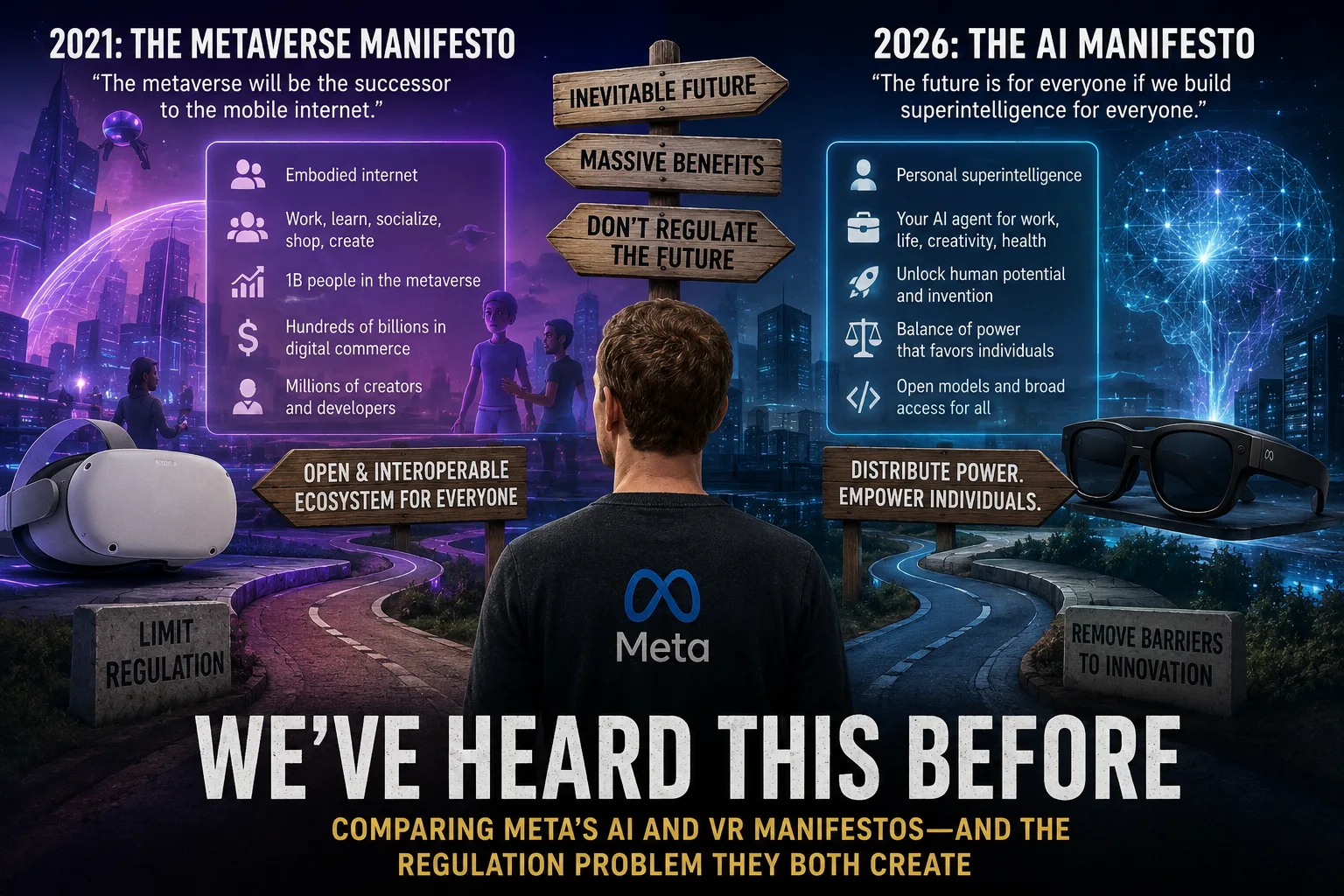
Zuckerberg’s 2026 superintelligence manifesto runs the same play as his 2021 metaverse letter: an inevitable future, enormous benefits, a warning about concentrated power, and a quiet case against regulating any of it too early. The metaverse version cost Reality Labs more than $80 billion and never hit the timeline it promised. The contradiction this time is sharper, because Meta warns that AI power shouldn’t sit with a few giant companies while spending well over $100 billion a year to become one of the few companies that can supply it. Open model weights are not the same thing as distributed economic power, and the fact that a technology matters doesn’t mean the companies building it should get to write the rules governing it.
Yesterday, Mark Zuckerberg published The Future Is for Everyone, a sprawling vision for a world remade by superintelligent AI.
It’s ambitious, optimistic, and in places genuinely interesting.
It also sounds very familiar.
Almost five years ago, on October 28, 2021, Zuckerberg published his Founder’s Letter announcing Facebook’s transformation into Meta, and explaining why the metaverse was the next chapter for the internet.
The technology is different this time. The argument is not.
In 2021, Meta told us the metaverse would change how we work, learn, socialize, shop, and create. In 2026, Meta tells us superintelligence will change how we work, learn, create, run businesses, and live our lives.
In both cases, Meta argues this kind of power shouldn’t sit with a handful of gatekeepers. It should be open, accessible, built for everyone. And in both cases, there’s a quiet subtext underneath: governments should be careful not to regulate the future before Meta gets a chance to build it.
The Metaverse Was Going to Change Everything
Zuckerberg’s 2021 letter wasn’t shy about what was coming. He described the metaverse as the successor to the mobile internet, an “embodied internet” where we’d feel physically present with other people. We’d work there, learn there, shop there, attend concerts there, socialize there, build businesses there. Physical TVs and monitors would give way to holograms.
Meta put numbers behind the prediction too. Zuckerberg hoped the metaverse would reach a billion people within a decade, generate hundreds of billions in digital commerce, and support millions of creators and developers. Meta changed the company’s name around this bet.
But there was another piece of the argument worth remembering. Meta insisted it wasn’t trying to own the metaverse. “The metaverse will not be created by one company,” Zuckerberg wrote. Instead it would be an interoperable world built by developers and creators, with open standards, low developer fees, and hardware sold near cost. Even before the rebrand, Meta was publishing material on “building the metaverse responsibly,” full of language about cooperating with governments, academics, and civil society.
The message was reassuring. This technology is coming. It will create enormous benefits. Meta wants to help build it. But Meta won’t control it.
Five years later, that’s not quite how it played out. Reality Labs has racked up more than $80 billion in operating losses. Meta has scaled back parts of its metaverse operation and shifted enormous amounts of capital toward AI. VR hasn’t disappeared, Quest is a real product, and the smart glasses work may end up mattering a great deal. But the billion-person embodied internet from 2021 hasn’t shown up anywhere close to on schedule.
Now there’s a new future to build.
This Time It’s Superintelligence
The Future Is for Everyone makes an even bigger claim than the metaverse letter did. Zuckerberg isn’t just predicting another computing platform. He’s describing a restructuring of the relationship between individuals, companies, governments, and intelligence itself.
Meta believes everyone should eventually have a personal superintelligence, an AI that understands your goals and context and helps with work, learning, creativity, finances, health, relationships, everyday life. Small teams could run businesses that used to need hundreds of employees. Individuals could build products that once required whole organizations.
And once again, Meta says the real danger is concentration, this power ending up in too few hands. Zuckerberg writes:
“If the power of superintelligence is held by a small number of individuals, businesses, governments, or AI itself, then that will naturally lead to outcomes that are less favorable for everyone else.”
His answer is a “balance of power that favors individuals”: broadly distributed AI capability, open models, powerful personal agents for regular people. It’s a genuinely compelling idea.
But there’s a contradiction sitting right in the middle of it.
Who Exactly Is Giving Power to the Individual?
Meta argues we shouldn’t let a handful of giant corporations control superintelligence. Meta is also one of the handful of giant corporations capable of spending well over $100 billion a year to build the infrastructure that superintelligence requires. And Meta says so directly: “Meta is the company primarily focused on building personal superintelligence for everyone.”
So the fix for concentrated AI power turns out to involve Meta becoming one of the main companies through which billions of people get access to that power.
We’ve heard a version of this before. The metaverse wasn’t supposed to belong to Meta either. It was supposed to be open, interoperable, built by everyone, with Meta conveniently supplying the hardware, the platform, the social spaces, and the developer tools needed to get in the door. Now AI shouldn’t belong to Meta either. It should belong to individuals. Meta just happens to want to provide the models, the agents, the glasses, the data centers, and the platforms people use to reach it.
None of that automatically makes Zuckerberg wrong. But it’s a good reason to be skeptical when an argument about individual freedom lands on regulatory conclusions that line up perfectly with the arguer’s commercial interests.
Regulation Is Where This Gets Interesting
The most consequential part of Zuckerberg’s essay probably isn’t the predictions about superintelligence. It’s the political framing around them.
Meta argues that heavy-handed restrictions could cost the United States the global AI race. America needs more energy, more data centers, more chips, faster infrastructure approvals, faster model development, fewer barriers to deployment. There’s a real argument buried in there. AI is increasingly an infrastructure problem, China is a serious competitor, and regulatory fragmentation genuinely can slow innovation.
But watch the rhetorical move happening underneath it. First, establish that a technology is the inevitable future. Then establish that access to it is fundamentally about individual freedom. Then establish that slowing it down threatens innovation, prosperity, and national security. By the time you reach the end of that chain, regulation doesn’t look like democratic oversight of an enormously powerful company anymore. It looks like something being done to the future itself.
That framing deserves more scrutiny than it usually gets.
We’re Bad at Predicting Technology, and We Should Remember That
The metaverse is a useful warning here. Meta didn’t just predict VR would get better. It built an entire social and economic future on assumptions about how billions of people would choose to use the technology. Those assumptions haven’t held up on anything close to the timeline Meta promised.
That matters for how we think about AI regulation, not because AI is another metaverse (it isn’t, adoption and real economic impact are already far ahead of where VR ever got), but because policymakers shouldn’t set rules, loose or strict, based mainly on projections from the same companies spending billions trying to make those projections come true.
There’s a real gap between “this technology could produce extraordinary benefits” and “therefore we should clear away whatever stands in the way of building it as fast as possible.” The first doesn’t automatically get you to the second.
Openness Doesn’t Eliminate Concentrated Power
The balance-of-power argument is honestly the most interesting part of Zuckerberg’s paper. A world where intelligence is spread across millions of people probably beats a world where a handful of corporations control the most capable systems. Open models can create real competition. Personal AI could genuinely shift leverage toward individuals. Distributed intelligence could stop any single provider from deciding what counts as acceptable thought.
Those are worthwhile goals. But open models don’t automatically add up to an open AI economy. Training frontier models takes an extraordinary amount of capital, energy, chips, data, and infrastructure, and Meta’s own spending proves it: the company is currently pouring well over $100 billion a year into building AI infrastructure. Being able to download a set of model weights doesn’t change who owns the data centers. It doesn’t change who controls the social networks with billions of users, the advertising machine paying for all of it, or the hardware people will increasingly use to reach AI in the first place.
Open technology and distributed economic power are not the same thing, and it’s worth being precise about that difference.
The Real Lesson From the Metaverse Isn’t That Zuckerberg Is Wrong
It would be easy, and probably unfair, to conclude that because Zuckerberg badly overestimated the metaverse, we should discount his predictions about AI too. That’s not the lesson.
Technology bets fail. Timelines slip. Some of the metaverse investment, the smart glasses especially, may end up paying off precisely because of AI. The real lesson is about how we read manifestos written by companies with hundreds of billions of dollars riding on the outcome.
Meta’s 2021 letter asked us to imagine the metaverse transforming society. Meta’s 2026 letter asks us to imagine superintelligence transforming society. Both promise to empower individuals. Both warn against concentrated platform power. Both cast Meta as an unusually important builder of the open alternative. And both happen to point toward a regulatory environment that suits Meta building exactly the thing it wants to build.
That doesn’t make the vision false. It just means three different questions deserve three different answers.
Is the technology important? Almost certainly.
Could broadly distributed AI produce real social benefit? Absolutely.
Does that mean the companies building it should get to write the rules governing it? That’s where I get a lot less convinced.
The future may well be for everyone. Which is exactly why deciding how it gets built shouldn’t belong only to the companies building it.
Frequently Asked Questions
What is “The Future Is for Everyone”?
It’s the manifesto Mark Zuckerberg published on August 10, 2026, laying out Meta’s vision for superintelligent AI. The core argument is that everyone should eventually have a personal superintelligence, that open models and broadly distributed AI capability protect against power concentrating in too few hands, and that the United States should avoid regulation heavy enough to slow the build-out.
How is it similar to Zuckerberg’s 2021 metaverse letter?
The structure is nearly identical. Both letters present a technology as the inevitable next chapter of computing, promise it will transform how we work, learn, socialize, and build businesses, insist the platform should be open rather than owned by any one company, and warn that concentrated control is the real danger. Both also arrive at a regulatory position that happens to suit Meta’s own build plans.
How much has Meta lost on the metaverse?
Reality Labs has accumulated more than $80 billion in operating losses. Quest is a real product and the smart glasses work may still matter a great deal, but the billion-person embodied internet Zuckerberg described in 2021 has not arrived anywhere close to the promised timeline.
Do open models actually distribute AI power?
Only partly. Open weights create real competition and give people capability they would otherwise have to rent. But downloading a model doesn’t change who owns the data centers, who controls the social networks with billions of users, who runs the advertising machine paying for the infrastructure, or who makes the hardware people use to reach AI. Open technology and distributed economic power are not the same thing.
Is AI just another metaverse-style overhype cycle?
No. Adoption and measurable economic impact are already far ahead of anything VR achieved. The comparison isn’t about whether the technology is real. It’s about how much weight policymakers should give to projections written by the companies spending hundreds of billions of dollars trying to make those projections come true.
