
Toronto now has more than 100 Traffic Agents, heading to 127 by early 2027, at an estimated $10.5 million a year. The City says they eliminate intersection blocking 96 per cent of the time and cut travel times by up to 33 per cent, but publishes no intersections, no measurement period, no sample size and no methodology behind either number. The dramatic King Street result, streetcar trips falling from 45 to 65 minutes down to 17 to 21, came while a transit priority corridor, enforcement activity and signal changes were all running at the same time, so it can’t isolate what the agents did. Toraffic’s own scenarios put the benefit anywhere from 0.34x to 1.92x the program cost, which is another way of saying the public evidence isn’t good enough to answer the question. Toronto has the deployment records, cameras, signal data and TTC vehicle data to run a proper with-and-without experiment. Traffic Agents look like they work. We just can’t yet tell how well.
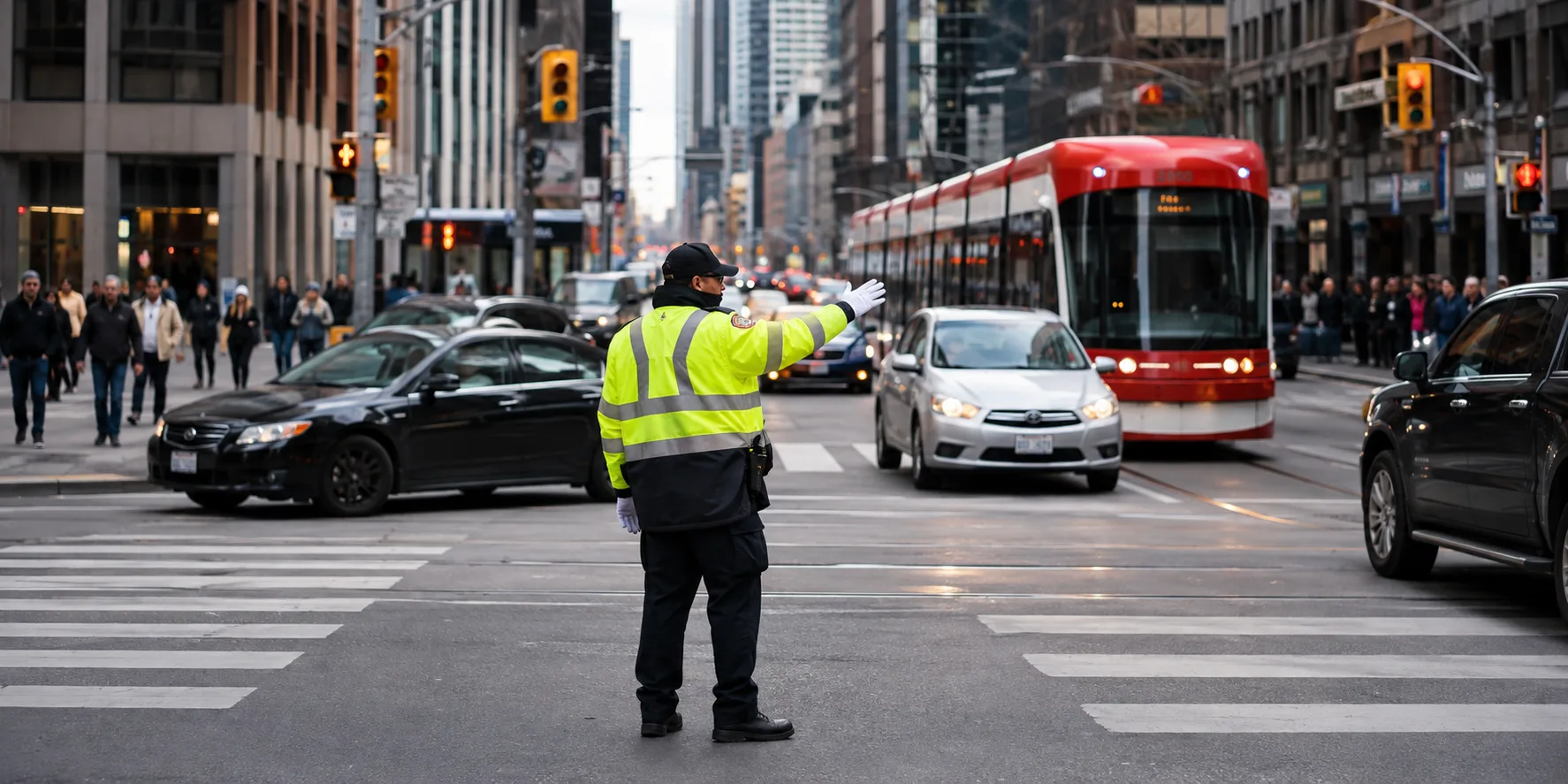
If you spend any time driving, cycling, walking or riding a streetcar through downtown Toronto, you’ve probably seen them: people in high-visibility uniforms standing in the middle of some of the city’s busiest intersections, waving traffic through, holding cars back, trying to stop drivers from entering intersections they can’t clear.
Toronto calls them Traffic Agents.
The concept is wonderfully uncomplicated. When an intersection starts to break down, put a human being there who can see what’s happening and intervene.
Toronto now has more than 100 active Traffic Agents, up from a handful a few years ago, and the City plans to reach 127 by the first quarter of 2027. Agent deployment increased from 10,503 hours in 2023 to 38,131 hours in 2025.
The City also attributes some extraordinary results to them.
Traffic Agents, it says, eliminate vehicles blocking intersections 96 per cent of the time and reduce travel times by up to 33 per cent. On King Street, the City says streetcar trips between University Avenue and Jarvis Street became 28 to 44 minutes faster when agents were present.
Those numbers make Traffic Agents sound like one of the most successful congestion-management investments Toronto has made.
So I took a closer look at the program for Toraffic.ca.
The conclusion is more interesting than either “Traffic Agents work” or “Traffic Agents don’t work.”
They probably do work.
But Toronto has remarkably little public evidence showing how much they work, where they work best, or whether the benefits justify what the program costs.
The program started under John Tory
The history goes back to Mayor John Tory’s first term.
Toronto was already wrestling with congestion and with the cost of using paid-duty police officers for routine traffic management. In May 2016, City Council formally asked Ontario to change the Highway Traffic Act so that people other than police officers, including special constables and municipal officials, could direct traffic.
Council also instructed the City Manager to develop an implementation plan for special constables who could perform that role. The proposal passed Tory’s Executive Committee unanimously.
Later that year Toronto tested the idea.
The Traffic Assistance Personnel pilot put paid-duty Toronto Police officers at busy intersections to actively manage pedestrians and vehicles. According to the City, the pilot produced at least a 90 per cent reduction in vehicle-related intersection blockages and a 70 per cent reduction in pedestrian-related blockages.
That experiment became the foundation for what would eventually become the civilian Traffic Agent program.
There was a practical problem. Directing traffic isn’t something Toronto could simply authorize municipal employees to do. The agents needed legal authority.
The City spent the next several years working toward a permanent Traffic Warden model. A 2018 Congestion Management Plan update said Toronto was implementing a full-time Traffic Wardens Program following the successful 2016 pilot, but deployment depended on Toronto Police designating the wardens as Special Constables.
The modern program was finally formalized on February 6, 2020, through an agreement between the City and Toronto Police Services Board.
Under that arrangement Toronto could hire and train employees who would be appointed as Special Constables, giving them the authority required to actively direct traffic. Toronto later amended its Municipal Code to formally define the Traffic Agent role.
So the political lineage is fairly clear.
John Tory’s administration created the program. Olivia Chow’s administration massively scaled it.
From experiment to 100 agents
For its first few years, the permanent program stayed relatively small.
That started changing in 2023.
Toronto budgeted for 30 Traffic Agents that year. In April, 14 were available, including 11 newly hired agents, serving 16 priority locations primarily in the downtown core, waterfront and Yonge-Eglinton area.
Then expansion accelerated.
Toraffic’s reconstruction of City budget and operational documents shows:
| Year | Funded agents | Deployment hours |
|---|---|---|
| 2023 | 30 | 10,503 |
| 2024 | 75 | 27,119 |
| 2025 | 100 | 38,131 |
| 2026 | 100+ active | not yet final |
The 2026 Congestion Management Plan says Toronto now has more than 100 active agents and intends to reach 127 by Q1 2027.
This isn’t a pilot anymore.
Traffic Agents have become a significant permanent part of Toronto’s transportation system.
And that makes a fairly basic question important. What are we getting for the money?
Roughly $10.5 million a year
Toronto doesn’t appear to publish a simple line saying, “The Traffic Agent Program costs $X per year.”
But we can estimate it.
The City’s 2025 budget added 25 Traffic Agent positions at an annualized cost of approximately $2.616 million. That works out to roughly $104,640 per funded position.
Apply that unit cost to 100 funded positions and you get an estimated full-year program cost of approximately $10.5 million per year.
That’s a Toraffic calculation, not a City-published program total, and it should be treated accordingly. It includes the budgeted cost of a position rather than simply an agent’s salary, which is actually useful for estimating the cost of operating the program.
At 2025’s 38,131 deployment hours, dividing a full 100-agent annual cost by operating hours produces an apparent cost of about $274 per deployed agent-hour.
That number probably overstates the true steady-state cost per hour because Toronto was still hiring throughout 2025. The annual cost assumes 100 positions for the entire year while the deployment-hour figure reflects a workforce that grew during the year.
Still, it gives us an order of magnitude.
Toronto is now making roughly a $10-million-a-year bet that putting people into congested intersections produces enough travel-time, reliability and safety benefit to justify the cost.
The famous 96 per cent result
Here’s where things get strange.
Toronto’s website describes its results confidently:
Traffic Agent presence eliminated instances of vehicles blocking intersections 96 per cent of the time and reduced travel times by up to 33 per cent.
Those are extraordinary results.
But try to find the experiment behind them.
The City’s public material doesn’t identify the intersections used to produce the 96 per cent result. It doesn’t give a measurement period. It doesn’t provide a sample size. It doesn’t describe the methodology.
A City congestion report attributes the number to earlier studies, but doesn’t provide enough information to reproduce them.
The 33 per cent travel-time number has the same problem.
We know Toronto says agents reduced travel time at intersections. What we don’t have is enough underlying information to know whether 33 per cent was an average across multiple intersections, an observation at one intersection, a maximum result, or something else.
The City’s current website has some careful wording here: “up to 33 per cent.”
That’s very different from saying Toronto traffic moves 33 per cent faster whenever an agent shows up.
Then there’s King Street
The most dramatic Traffic Agent claim comes from King Street.
Late in 2023, Toronto stationed Traffic Agents at major intersections along the King Street Transit Priority Corridor, including University, York, Bay, Yonge, Church and Jarvis.
In February 2024, the City announced that streetcar travel between University and Jarvis had fallen from approximately 45 to 65 minutes to 17 to 21 minutes when Traffic Agents were present.
That’s an improvement of 28 to 44 minutes.
If Traffic Agents alone produced that result, hiring them may be one of the easiest transportation decisions Toronto could make.
But that isn’t what the evidence establishes.
King Street was already a Transit Priority Corridor designed to give streetcars priority over through automobile traffic. The period also included enforcement activity, changes intended to prevent drivers from blocking intersections, signal management and other traffic measures.
There’s another issue with the baseline. A 45-to-65-minute journey represents an extraordinarily bad trip through this relatively short section of King Street. Toraffic’s analysis found that the comparable journey had historically been much faster.
In other words, the City’s comparison captures Traffic Agents working during exactly the kind of severe congestion they’re intended to address.
That’s useful evidence.
It just isn’t the same thing as demonstrating that an average King streetcar rider saves 28 to 44 minutes because Traffic Agents exist.
The safer conclusion: Traffic Agents appear capable of dramatically improving traffic flow during severe intersection blockage, particularly on transit corridors, but the City’s King Street data doesn’t isolate their effect from the other measures running at the same time.
That’s still a pretty good result.
It just isn’t the same claim.
We tried estimating the return
At Toraffic, we also tried asking a harder question. What might the time saved by Traffic Agents actually be worth?
There isn’t enough public evidence to calculate that directly, so we built scenarios instead.
We looked at two potential sources of benefit. King Street transit passengers, where keeping intersections clear can prevent streetcars carrying dozens of people from getting trapped behind cars. And vehicles passing through staffed intersections, where avoiding even small delays can add up across thousands of vehicles.
Using a value of time of $18.50 per person-hour, measured traffic volumes and TTC ridership as anchors, and deliberately varying the assumed time savings, our scenarios produced annual benefits ranging from approximately $3.6 million to $20.1 million per year.
Against an estimated $10.5-million program cost, that’s a benefit-cost ratio ranging from 0.34x to 1.92x.
Our middle scenario comes in at around $8.2 million, or 0.78x the estimated program cost.
That doesn’t mean Traffic Agents fail a cost-benefit test. It means the available evidence isn’t good enough to know.
And roughly 83 per cent of the benefit in our model comes from King Street, the same measurement where attribution to the agents is weakest. Change the assumption about King Street and the entire result changes.
You can explore the assumptions and calculations in the full Toraffic Traffic Agents analysis.
This may actually undersell the agents
There’s another side to this.
Our analysis only attempts to value travel time.
Traffic Agents may create benefits we aren’t counting. Keeping intersections clear can make streetcar service more reliable. It can keep emergency vehicles moving. Agents can intervene immediately when unusual congestion occurs. They can manage construction and special events. Their presence may deter illegal stopping and blocking behaviour before it happens.
There could also be safety benefits.
And every Traffic Agent directing traffic is potentially a task that doesn’t have to be performed by a police officer.
Those are genuine benefits, even if they’re hard to turn into dollars.
Toronto should measure this better
Traffic Agents are unusually well suited to rigorous evaluation.
Toronto knows when and where agents are deployed. The City has extensive traffic cameras and signal data. The TTC has vehicle location and travel-time data. Toronto collects traffic counts.
That’s the ingredients for a much better experiment.
Compare the same intersection at the same time of day with and without an agent. Measure queue length, vehicles processed, intersection blockages, travel time and transit delay. Repeat it across dozens of locations. Control for construction, weather, incidents and seasonal differences. Publish the resulting dataset.
Toronto could then answer questions like:
- Which intersections benefit most from agents?
- At what traffic volume does an agent become worthwhile?
- Are two agents substantially better than one?
- Is the benefit larger for transit than for private vehicles?
- What is the cost per vehicle-hour or passenger-hour saved?
- Do drivers behave differently after agents leave?
- Where should the next 27 agents be deployed?
That would turn Traffic Agents from something Toronto says works into something Toronto can demonstrate works.
A good idea deserves good evidence
There’s something refreshingly practical about the Traffic Agent program.
Toronto has increasingly sophisticated technology available to manage congestion: AI traffic systems, adaptive signals, cameras, sensors and enormous quantities of data.
And yet sometimes the solution is a person standing in an intersection telling a driver: no, you can’t go yet, there’s nowhere for you to go.
The original idea emerged under John Tory, beginning with the 2016 experiment and eventually becoming a permanent Special Constable program in 2020. Under Olivia Chow, Toronto has taken that relatively modest initiative and turned it into a workforce of more than 100 people, with 127 planned by early 2027.
That expansion may be entirely justified. The City’s own evidence certainly points in that direction.
But once Toronto is spending roughly $10 million a year on the program, “96 per cent” and “up to 33 per cent” shouldn’t exist as unexplained statistics on a website.
Toronto has enough data to tell us whether Traffic Agents are effective, where they’re effective and what that effectiveness costs.
It should publish it.
Until then, the most defensible conclusion from the Toraffic analysis is also maybe the most interesting one. Traffic Agents look like they work. We just can’t yet tell how well.
Frequently Asked Questions
What is a Toronto Traffic Agent?
A City of Toronto employee appointed as a Special Constable by the Toronto Police Services Board, which gives them the legal authority to direct traffic at congested intersections and issue tickets for non-moving violations. That legal piece is why the program took years to stand up. Directing traffic isn’t something the City could simply assign to municipal staff, so the arrangement had to be formalized with the police board on February 6, 2020.
How many are there and what do they cost?
More than 100 active agents today, with 127 planned by the first quarter of 2027. Funded positions went from 30 in 2023 to 75 in 2024 to 100 in 2025, and deployment grew from 10,503 hours to 38,131 hours over the same stretch. The City doesn’t publish a program total. Working from the 2025 budget, which added 25 positions at roughly $2.616 million annualized, Toraffic estimates about $104,640 per funded position and therefore around $10.5 million a year, or roughly $274 per deployed agent-hour.
Where does the 96 per cent figure come from?
That’s the problem. The City states it plainly on its website, but doesn’t name the intersections, give a measurement period, provide a sample size or describe the methodology. A City congestion report attributes the figure to earlier studies without enough detail to reproduce them. The companion travel-time claim is carefully worded as “up to 33 per cent,” which is a very different statement from saying traffic moves a third faster whenever an agent appears.
Did Traffic Agents really cut King Street streetcar trips by 28 to 44 minutes?
Something did. Whether it was the agents alone is unproven. King Street was already a Transit Priority Corridor, and the same period included enforcement activity, anti-blocking measures and signal management. The baseline also matters: a 45-to-65-minute trip across that short stretch is extraordinarily bad compared with how the journey historically performed. The fair reading is that agents can dramatically improve flow during severe blockage, not that the average rider saves half an hour because agents exist.
So are Traffic Agents worth the money?
Unknown, and that’s the honest answer. Valuing time at $18.50 per person-hour, Toraffic’s scenarios put annual benefits between $3.6 million and $20.1 million, a benefit-cost ratio of 0.34x to 1.92x, with a middle case of $8.2 million or 0.78x. About 83 per cent of that modelled benefit comes from King Street, the very measurement with the weakest attribution. The model also only values travel time, so it likely undersells agents by ignoring transit reliability, emergency vehicle movement, event and construction management, deterrence, safety, and police time freed up.
