Earlier in my career, choosing a technology stack came down what you wanted to build and: what are universities teaching? If developers were learning it, you probably could hire them. Simple.
Even myself, I ‘grew up’ building on Perl, PHP and the classic LAMP stack. It was practical, scrappy and wildly productive for its time. But the decision criteria back then were mostly about community, my skills, job markets and ecosystem maturity.
Those questions still hold. But in 2026 there is a new question that matters just as much:
How well does AI work with this technology?
The answer has a real impact on how fast a small team can build, and how much they can realistically accomplish without scaling headcount.
What makes a technology AI-friendly?
Two things matter most. First, how much public code and documentation exists for AI to learn from, since more examples means more accurate suggestions. Second, how quickly AI mistakes get caught. Technologies with strict rules and clear error messages surface problems fast. That tight feedback loop is where the real productivity gain comes from.
The Rankings
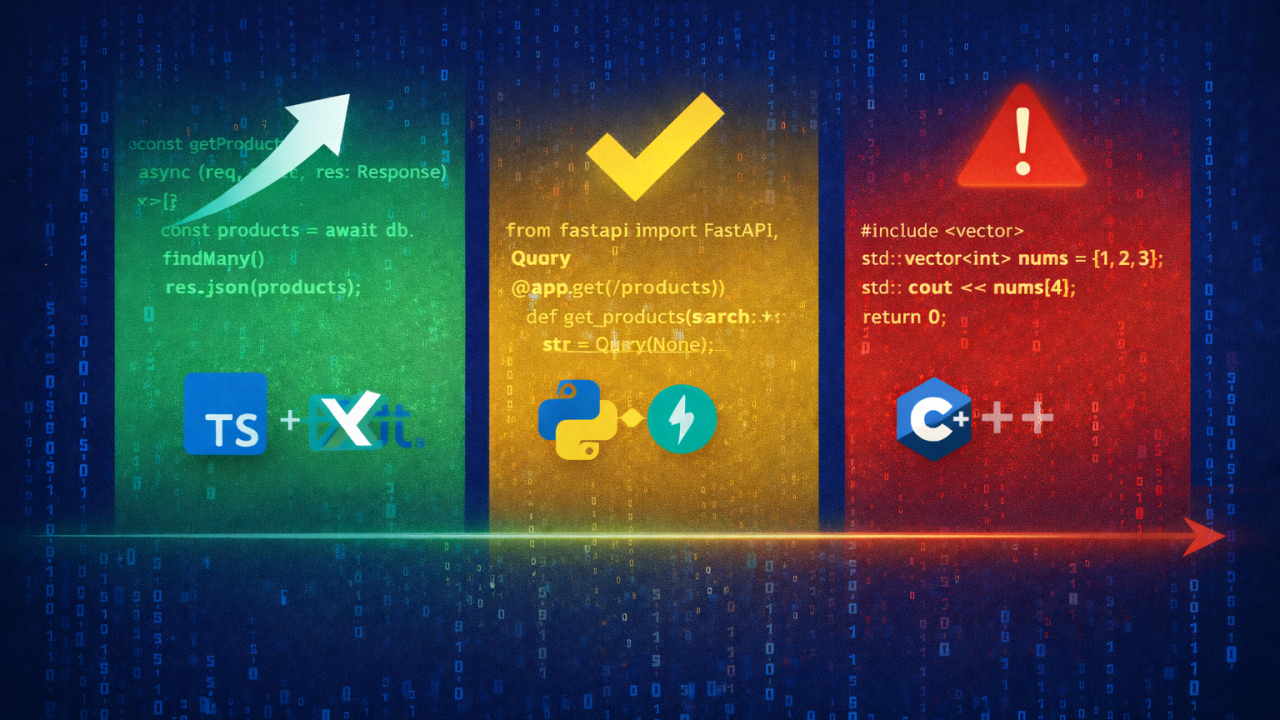
🟢 Tier A: Best AI leverage TypeScript and Python
The clear leaders. Both have enormous communities, years of documentation and mature tooling. TypeScript’s strict rules act like a spell-checker for code, catching AI mistakes quickly. Python dominates AI and data science, creating a natural fit for AI-powered products. If you are starting something new, these two offer the most AI-assisted productivity.
🟡 Tier B: Very strong C# / .NET, Laravel, Ruby on Rails, Go
All solid choices with strong AI support. Laravel and Rails have opinionated, predictable structures that AI handles particularly well. Go is underrated here, as its precision makes it excellent for AI-assisted debugging. C# benefits from deep Microsoft investment in AI tooling.
🟠 Tier C: Good, with caveats Java, Rust
Java is widely used and AI assistance works well for routine tasks, but its verbosity slows iteration. Rust has exceptional error messages that AI reasons about well, but AI still makes more mistakes here than in higher-level languages. It rewards expertise in a way that limits the gains for less experienced teams.
🔴 Tier D: More friction C++ and legacy enterprise systems
AI can help, but thinner documentation and fragmented tooling reduce the productivity gains considerably.
The bottom line
Stack decisions used to be about hiring pipelines. Now there is a third dimension: how much leverage does AI give you here?
A small team using the right stack with AI can move at a pace that would have required a much larger team just a few years ago. If you are making a technology decision today as a founder, CTO or business leader, that question is worth adding to your list.