
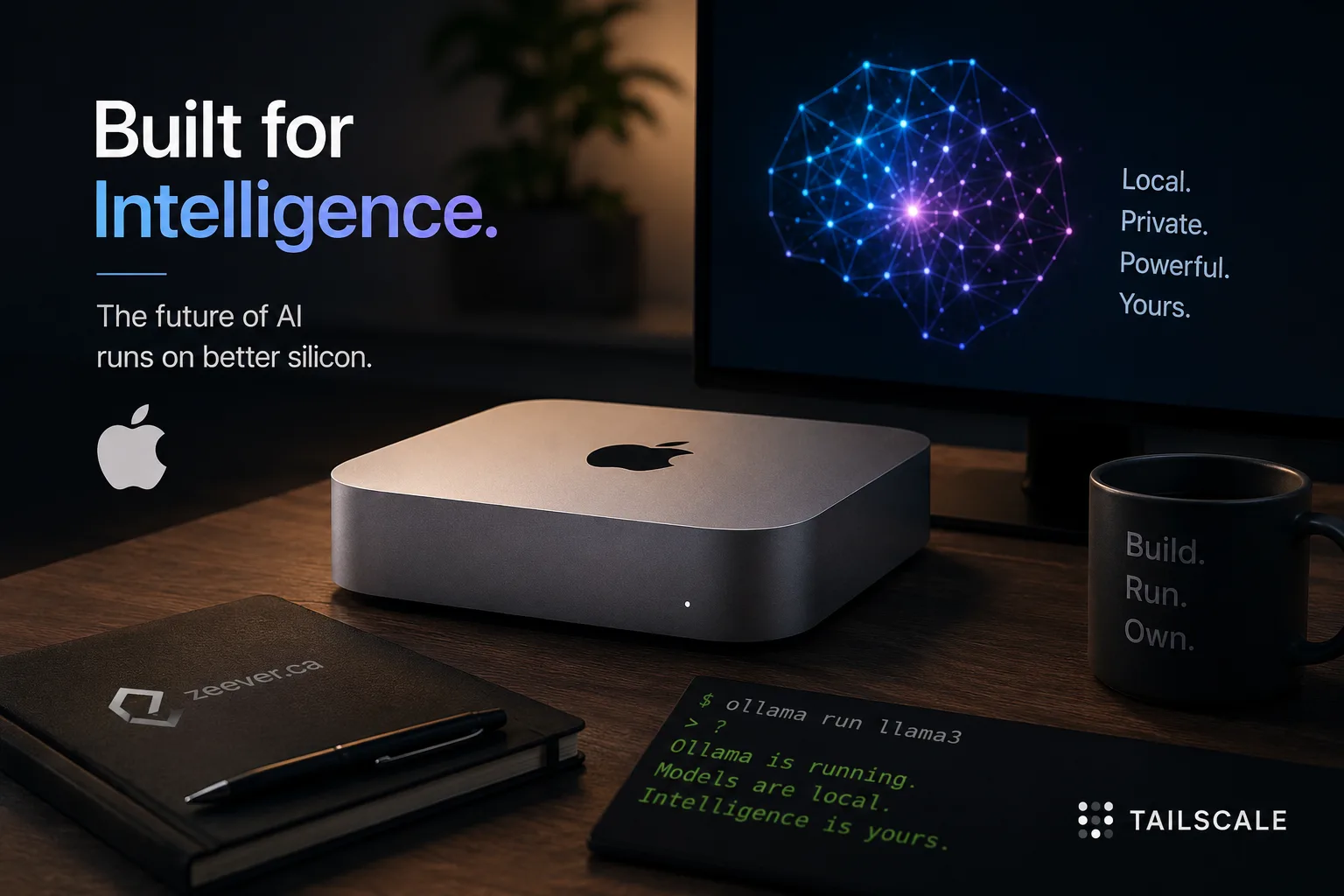
Apple does not have a frontier model, and most coverage stops there. The more interesting story is that Apple Silicon was quietly engineered for the kind of computing modern AI inference actually needs. Unified memory, high bandwidth, low power, and tight hardware/software integration make Mac Minis surprisingly capable AI appliances, especially for local agents, RAG pipelines, and coding workflows over Tailscale. The weakness is at the model layer, which is exactly where Apple has historically struggled (Maps, Siri, Ping, Office, TV+). Hybrid AI, with local inference for privacy and latency plus cloud escalation for frontier tasks, looks inevitable. Apple is better positioned for that future than most people realize, provided it does not partner its way through the software layer the way it did with Siri.
For the past year, most AI discussions about Apple have focused on what the company doesn’t have:
- no frontier model leadership
- no ChatGPT-scale public breakthrough
- no dominant AI assistant
- no visible equivalent to OpenAI, Anthropic, or Google DeepMind
I think that misses the point.
After spending the last year experimenting with local AI infrastructure through projects like Zeever.ca, I’ve become convinced that Apple may already have one of the strongest AI hardware positions in the industry.
Not because of the model.
Because of the silicon.
Simon Berg recently wrote an interesting piece arguing that Apple’s long-term bet is not on owning the best AI model, but on owning the best AI hardware substrate. His argument reframes Apple from “late to AI” into something more interesting: a company building the infrastructure layer for distributed AI inference.
That idea resonated with me because I’ve been seeing it firsthand in practical use.
Over the last several months, I’ve been running local models through Ollama across multiple environments, including older NVIDIA hardware, VPS infrastructure, and Apple Silicon devices. One of the more interesting setups involved serving models locally and accessing them remotely over Tailscale. The experience was surprisingly reliable, low-latency, and usable for real workflows.
The devices that consistently impressed me most were Apple Silicon systems.
The M-series chips are well-positioned for local AI workloads because of a few architectural decisions Apple made years before the current AI boom:
- unified memory
- high memory bandwidth
- efficient neural processing
- tight hardware/software integration
- low power consumption
- mature developer tooling
None of these were designed exclusively for generative AI, but they map almost perfectly onto modern inference requirements.
This is now becoming visible across the broader open-source AI ecosystem.
Early versions of OpenClaw, for example, were specifically optimized around running on Mac Mini systems using Apple’s M4 chips. That wasn’t accidental. Mac Minis increasingly represent an unusually compelling AI appliance:
- quiet
- efficient
- inexpensive compared to GPU servers
- deployable almost anywhere
- powerful enough for meaningful local inference
For developers experimenting with agents, retrieval systems, coding assistants, or lightweight orchestration, they’re becoming serious infrastructure options.
That creates a strategic tension.
Apple may have some of the best AI-ready consumer hardware in the world, but it still lacks direct ownership or deep partnership with a frontier AI model.
That’s the missing piece.
And honestly, it fits a long-running pattern.
Apple has historically struggled whenever software, services, or network effects matter more than hardware. The examples are not subtle.
Apple Maps launched in 2012 and was a disaster. Wrong directions, missing towns, melting bridges in satellite view. It took years of quiet rebuilding before Maps became merely acceptable, and even now most people I know default to Google Maps without thinking about it.
Ping, Apple’s attempt at a music social network, was shut down within two years. Apple has tried various social and messaging plays over the years, and outside of iMessage (which works mostly because of the lock-in), nothing has stuck.
Office and productivity is another long story. Pages, Numbers, and Keynote are fine tools, but Microsoft Office and Google Workspace own the actual workflows people use to run businesses. Apple never seriously contested that ground.
Siri is the most painful example. Apple bought Siri in 2010 and had a multi-year head start on every competitor in voice assistants. Then Alexa happened. Then Google Assistant happened. Then ChatGPT happened. Siri is still, in 2026, the assistant people apologize for using.
Apple TV+ has good shows but a small subscriber base relative to Netflix, Disney, or Amazon. The App Store is genuinely strong, but most of its value comes from being a toll booth on hardware Apple already controls.
The pattern is clear. When Apple controls the full stack and the product is mostly hardware with software wrapped around it, the company is unmatched. When the product is mostly software, services, or platform plays where someone else can iterate faster on the cloud side, Apple tends to lag.
That history is exactly why the model layer matters.
Today, Apple appears dependent on partnerships and external ecosystems for cutting-edge reasoning capability. Meanwhile:
- OpenAI controls one of the strongest commercial model ecosystems
- Anthropic continues to dominate many coding and reasoning workflows
- Google DeepMind owns both infrastructure and model depth
- Meta AI is aggressively distributing open-weight models
Apple’s weakness isn’t hardware capability.
It’s AI leverage at the model layer. And if the Maps, Siri, and social history is any guide, that gap will not close on its own.
That’s why the next few years get interesting.
Does Apple:
- deepen external partnerships?
- acquire model capability?
- heavily optimize for on-device open models?
- build orchestration layers between local and cloud inference?
- position itself as the “private AI operating system” rather than the best model company?
Local AI is improving extremely quickly.
For many workflows, you no longer need frontier-scale models running in massive cloud clusters every second. Smaller models running locally can already handle:
- coding assistance
- summarization
- search
- RAG pipelines
- lightweight agents
- workflow automation
- document analysis
- voice interfaces
Apple hardware is exceptionally good at this style of computing.
I don’t think the future is fully local AI. Cloud models still have enormous advantages in reasoning depth, context scaling, and orchestration.
But hybrid AI feels inevitable:
- local inference for privacy, latency, and persistence
- cloud escalation for deeper reasoning and frontier tasks
Apple is better positioned for that hybrid future than most people realize.
The company spent years building efficient silicon, memory architecture, and vertically integrated hardware while the rest of the industry focused on apps and cloud services.
Now AI is making those infrastructure decisions matter again.
The open question is whether Apple has learned anything from Maps and Siri, or whether it will once again build beautiful hardware and then partner its way through the software layer that actually defines the user experience.
Either way, the Mac Mini looks a lot less like a desktop computer and a lot more like an edge AI node.
Frequently Asked Questions
If Apple doesn’t have a frontier model, how can it have an AI strategy at all?
The strategy is the hardware. Apple Silicon was designed around unified memory, high bandwidth, efficient neural processing, and tight integration between chip and OS. Those decisions predate the current AI boom but map almost perfectly onto modern inference. The model is one layer of the stack, not the whole stack.
Is a Mac Mini really enough to run useful AI workloads?
For a lot of real workflows, yes. Coding assistants, summarization, RAG pipelines, lightweight agents, document analysis, and orchestration all run well on Apple Silicon. Throw Ollama on a Mac Mini and reach it over Tailscale and you have a quiet, efficient AI node that costs a fraction of a GPU server. It is not going to replace frontier cloud models, but it does not need to.
What does Apple’s history with Maps and Siri have to do with AI?
It tells you exactly where Apple struggles. When the product is mostly hardware with software wrapped around it, Apple is unmatched. When the win depends on software, services, network effects, or fast cloud iteration, Apple has consistently fallen behind. Siri had a multi-year head start and is still the assistant people apologize for using. That same dynamic applies to the model layer, and the gap will not close on its own.
So what does Apple actually need to do?
Pick a position and own it. Either build serious model capability internally, acquire a credible AI lab, optimize aggressively for on-device open models, or commit to being the private AI operating system that orchestrates between local and cloud. The worst path is the Siri path, where Apple ships beautiful hardware and partners its way through the software layer that actually defines the user experience.
