
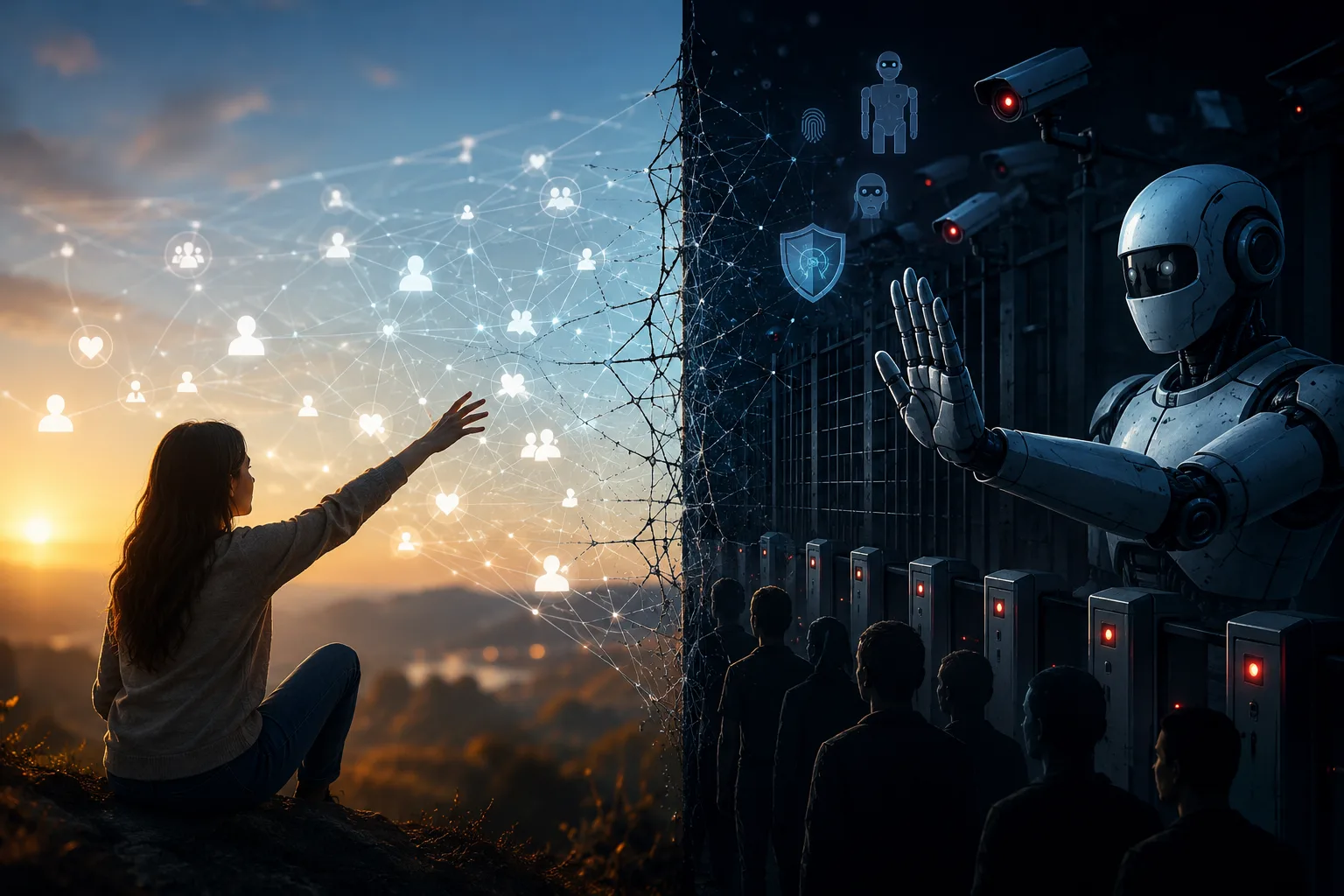
The web was built on a quiet handshake: robots.txt, a voluntary 1990s text file asking crawlers to behave, and for decades the biggest search engines listened. That low-friction trust let the open web scale. Agentic AI breaks the assumption because AI agents are built to finish tasks, not just index pages, and many will ignore the handshake. The likely response is more verification, more CAPTCHAs, and an internet that treats every visitor like a possible bot, quietly making the open web hostile to actual humans.
The early internet ran on trust. That sounds naive now, but it’s true.
No legal enforcement. No identity verification. No cryptographic signatures. Just a quiet agreement between websites and the machines that visited them.
The clearest example is robots.txt.
It showed up in the 1990s and was never a security system. It was more like a handshake. A website could politely ask a crawler:
- please don’t crawl this section
- don’t index this content
- slow down your requests
- don’t hammer the server
And here’s the wild part. Most of the big search engines actually listened.
The early web worked because the biggest players behaved themselves. Google got enormously powerful, but it played by the unwritten rules:
- identify your crawler
- respect robots.txt
- send traffic back to the source
- don’t scrape like a vandal
That low-friction trust model is a big part of why the internet scaled the way it did.
Agentic AI is about to break that system.
AI Agents Have Different Goals Than Crawlers
Old-school crawlers had a simple job:
- index pages
- rank them
- return links
AI agents are a different animal. They are being built to:
- finish tasks
- gather information on their own
- navigate websites
- compare prices
- summarize what they find
- fill out forms
- book travel
- buy tickets
- watch inventory
- keep working without supervision
That changes the math.
An AI agent is not just reading the web. It is doing things on the web.
And a lot of these systems do not care about the old handshake. Some ignore robots.txt completely. Others run through browser automation tools that look human. Some use residential IPs, rotate identities, or actively hide the fact that they are bots.
The internet was built assuming bots would be polite. AI agents assume the goal matters more than the manners.
Some Industries Are Already Feeling It
Travel sites are a good preview.
Picture millions of AI agents:
- watching airfares around the clock
- comparing hotel prices in real time
- booking and cancelling rooms automatically
- exploiting tiny pricing gaps
- coordinating purchases at scale
Now apply that to concert tickets. Sneaker drops. GPU launches. Real estate listings. Job applications. Government appointment systems.
At some point, a regular human cannot compete without their own agent. And the internet becomes machine-versus-machine by default.
The CAPTCHA Future Nobody Wants
The predictable response from platforms is more verification.
More CAPTCHAs. More anti-bot defences. More behavioural analysis. More identity checks.
This creates a nasty feedback loop. The smarter AI agents get, the more websites start treating everyone like a possible bot. And regular people pay the price.
We are already seeing the early signs:
- endless CAPTCHA prompts
- “verify you are human” popups
- blocked requests
- worse mobile experiences
- login walls everywhere
- increasingly aggressive bot defences
The irony is that CAPTCHAs may get less effective right as they get more common. Modern AI can already solve image puzzles, navigate browser flows, and imitate human behaviour patterns. So the friction goes up for humans while the sophisticated agents keep improving.
That is not a good trajectory.
Robots.txt Was the Web’s Trust Layer
Looking back, robots.txt feels almost idealistic.
A tiny text file. Voluntary compliance. No enforcement. Just a quiet “please respect these boundaries.”
It may have been one of the first machine-readable ethical systems on the internet. And for decades it mostly worked.
AI agents expose the weakness of any system built on voluntary cooperation. When autonomous systems are optimized for outcomes, trust falls apart fast.
From Trust to Verification
This is the bigger shift hiding under the AI boom.
The open web was optimized for openness, interoperability, anonymity, and low friction.
Agentic AI pushes it the other way. Toward authentication. Reputation systems. Cryptographic identity. Permissioned access. Behavioural scoring. Machine verification.
The web is slowly going to stop assuming good faith.
That matters for everyone, not just AI companies or publishers. Because the more autonomous AI agents become, the more the internet starts treating every visitor like a bot.
The Real Risk
The biggest risk is not that AI agents scrape websites.
The real risk is that the open web quietly becomes hostile to actual humans in the process.
A future stuffed with CAPTCHAs, identity checks, restricted access, gated APIs, anti-bot suspicion, and degraded anonymous browsing would be a profound break from the internet most of us grew up with.
The early web worked because trust was cheap.
The agentic web may make verification unavoidable. And once verification becomes the default, it is very hard to go back.
Frequently Asked Questions
What is robots.txt and why does it matter?
It is a small text file that websites use to tell crawlers what to index, what to skip, and how aggressively to crawl. It is voluntary, not enforceable. The early web worked because the major search engines chose to respect it, which built decades of low-friction trust between sites and machines.
How are AI agents different from traditional web crawlers?
Crawlers indexed pages. Agents finish tasks. They navigate sites, fill forms, compare prices, book travel, and act on their own without supervision. Many ignore robots.txt entirely, run through browser automation that mimics human behaviour, or actively hide that they are bots, because the goal matters more than the handshake.
Why are CAPTCHAs and verification walls becoming more common?
As autonomous agents get better at imitating humans, platforms respond by treating every visitor like a possible bot. The smarter the agents get, the more friction regular humans face. The irony is that CAPTCHAs already lose effectiveness right as they multiply, because modern AI can solve image puzzles, navigate browser flows, and pass behavioural checks.
What is the agentic web?
A web where a meaningful share of traffic, transactions, and decisions is driven by autonomous AI systems rather than humans. Agents watch prices, claim inventory, file applications, and coordinate at machine speed. Humans without their own agents end up at a structural disadvantage in everything from concert tickets to government appointments.
What happens to the open web from here?
It drifts from openness toward verification. Cryptographic identity, reputation systems, permissioned access, behavioural scoring, machine-readable signatures. The trust-by-default model that scaled the internet quietly gives way to verify-by-default, and once that becomes the norm it is very hard to roll back.
