
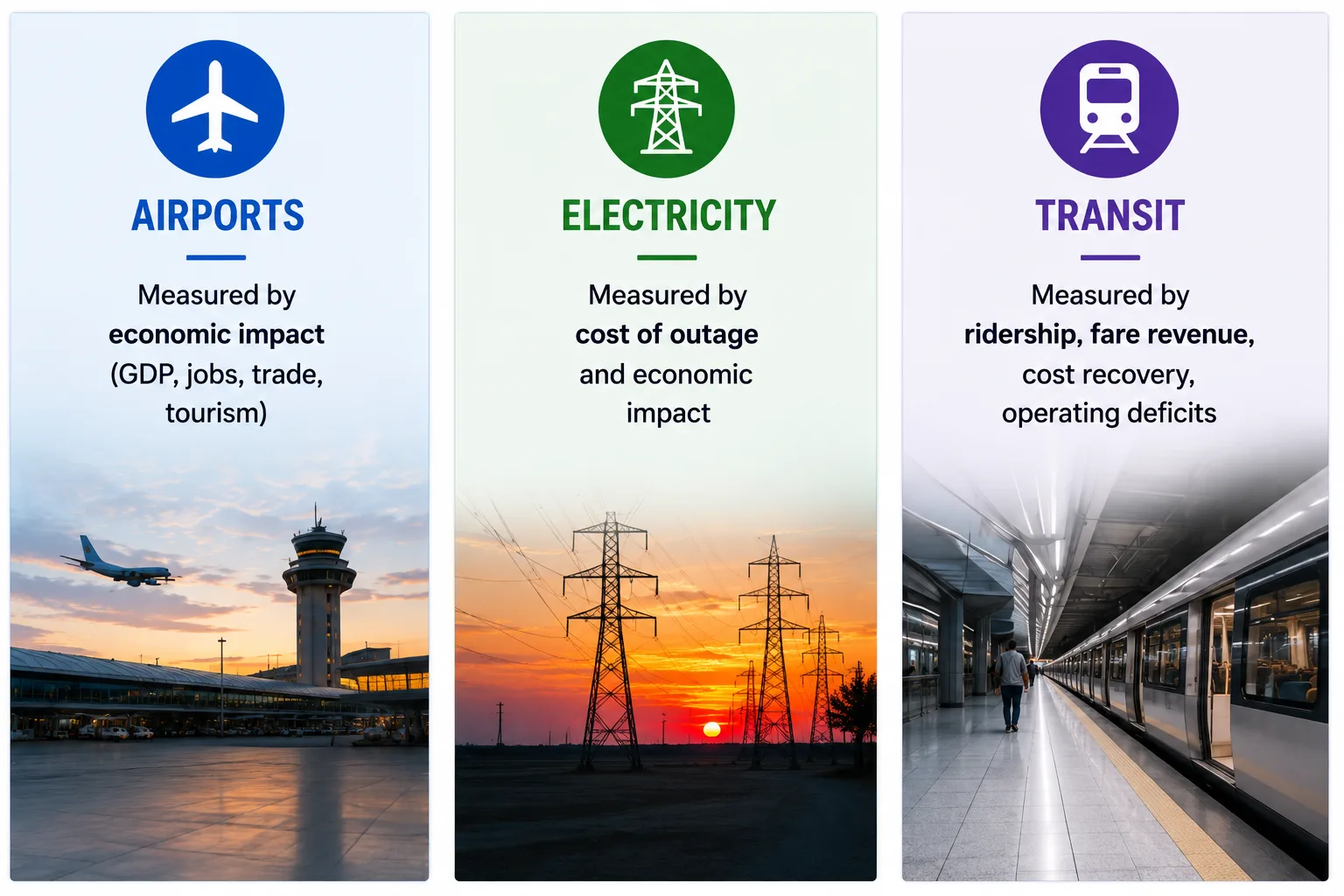
Ontario judges airports by economic impact and transit by fare revenue, and the framing distorts every transportation decision the province makes. Apply the same logic to electricity and the absurdity becomes obvious. Nobody measures the grid by the utility’s monthly bill. We measure it by what stops working when the power goes out. Transit deserves the same treatment because it is labour market infrastructure, not a service that needs to break even. Ontario already spends more on transit than airports, congestion costs the province roughly 12.8 billion dollars a year, and visitors arriving for the 2026 World Cup are noticing how disconnected the network feels. The fix starts with how we count.
I spent most of the weekend at our cottage. At one point the power went out. Again.
Anyone who spends time in rural Ontario knows the routine. You check the outage map, dig out the flashlights, and start doing the math on how long the fridge stays cold and whether the backup setup is going to earn its keep.
It got me thinking about how we measure the value of infrastructure.
Nobody measures the value of electricity by the revenue the utility earns. We measure it by what happens when the power goes out. The grid’s worth isn’t the monthly bill. It’s everything that stops working the moment the grid disappears.
Somewhere between checking battery levels and waiting for the lights to come back, I ended up reading FIFA tourist reviews and travel threads ahead of the 2026 World Cup. What surprised me wasn’t the talk about stadiums or hotels. It was the talk about transit.
Visitors were confused by the fragmented connections between the TTC, GO Transit, and UP Express. Some called Toronto’s network disconnected. Others wondered why getting between major destinations felt harder here than in other cities that host events on this scale.
That sent me down a rabbit hole. If Ontario spends far more on transit than it does on airports, why do airports get so much more political attention, strategic planning, and economic recognition?
The answer turned out to be more interesting than I expected.
The Airport Advantage
Airports are very good at telling their own economic story.
When airport authorities talk about investment, they don’t talk about parking revenue, landing fees, or concession sales. They talk about economic impact.
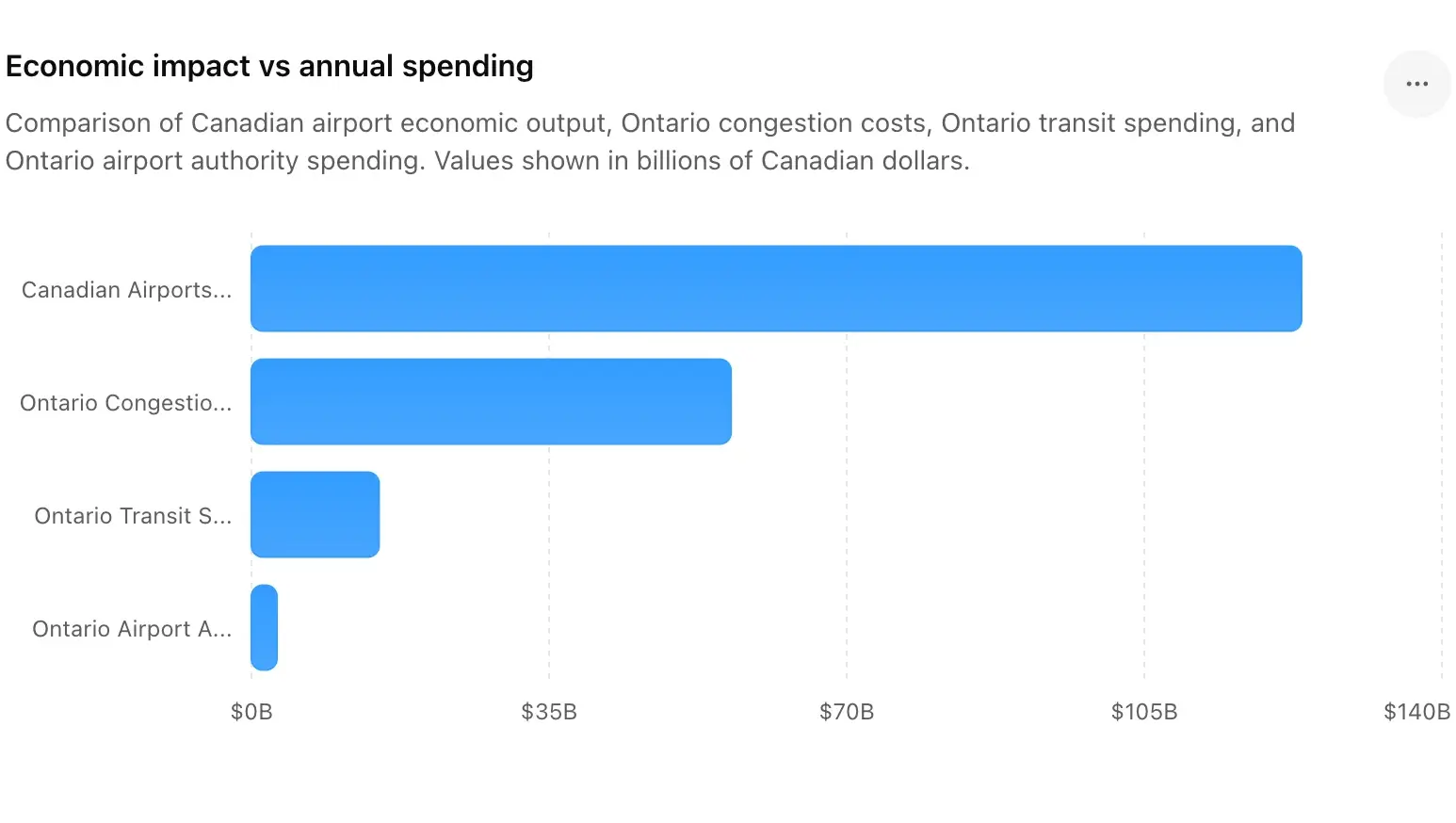
Canadian airports collectively support 435,800 jobs, $32.9 billion in wages, $49.6 billion in GDP, and $123.5 billion in economic output.
Those numbers are real and impressive, and they should be. Airports connect regions, support tourism, enable trade, and create opportunity. Nobody asks whether Pearson’s parking revenues justify its existence. Nobody evaluates Billy Bishop on fare recovery. We understand, intuitively, that airports are economic enablers.
Transit almost never gets the same courtesy.

The Transit Measurement Problem
Transit usually gets judged on ridership, fare revenue, cost recovery, and operating deficits.
Those are fine operational numbers. They are terrible economic ones.
Apply the same logic to electricity and the problem becomes obvious. Would anyone judge the value of Ontario’s grid by the utility’s monthly revenue? Of course not. We judge the grid by what happens when it fails. Factories stop. Businesses close. Supply chains break. Productivity collapses.
Transit works the same way. Its value isn’t in the fare box. It’s in the millions of economic interactions it makes possible every day.
The Cost of Congestion
Ontario’s congestion problem is already enormous. Recent estimates put the annual cost at roughly $12.8 billion in direct economic losses, and more than $56 billion once you fold in the broader social and economic effects.
Every delayed shipment. Every missed meeting. Every worker stuck in traffic. Every employer struggling to reach talent across the region. Those are economic costs, not inconveniences.
Transit isn’t just a transportation service. It’s labour market infrastructure. It’s how the regional economy moves.
The Strange Economics of Ontario Transportation
Here’s the part that surprised me most.
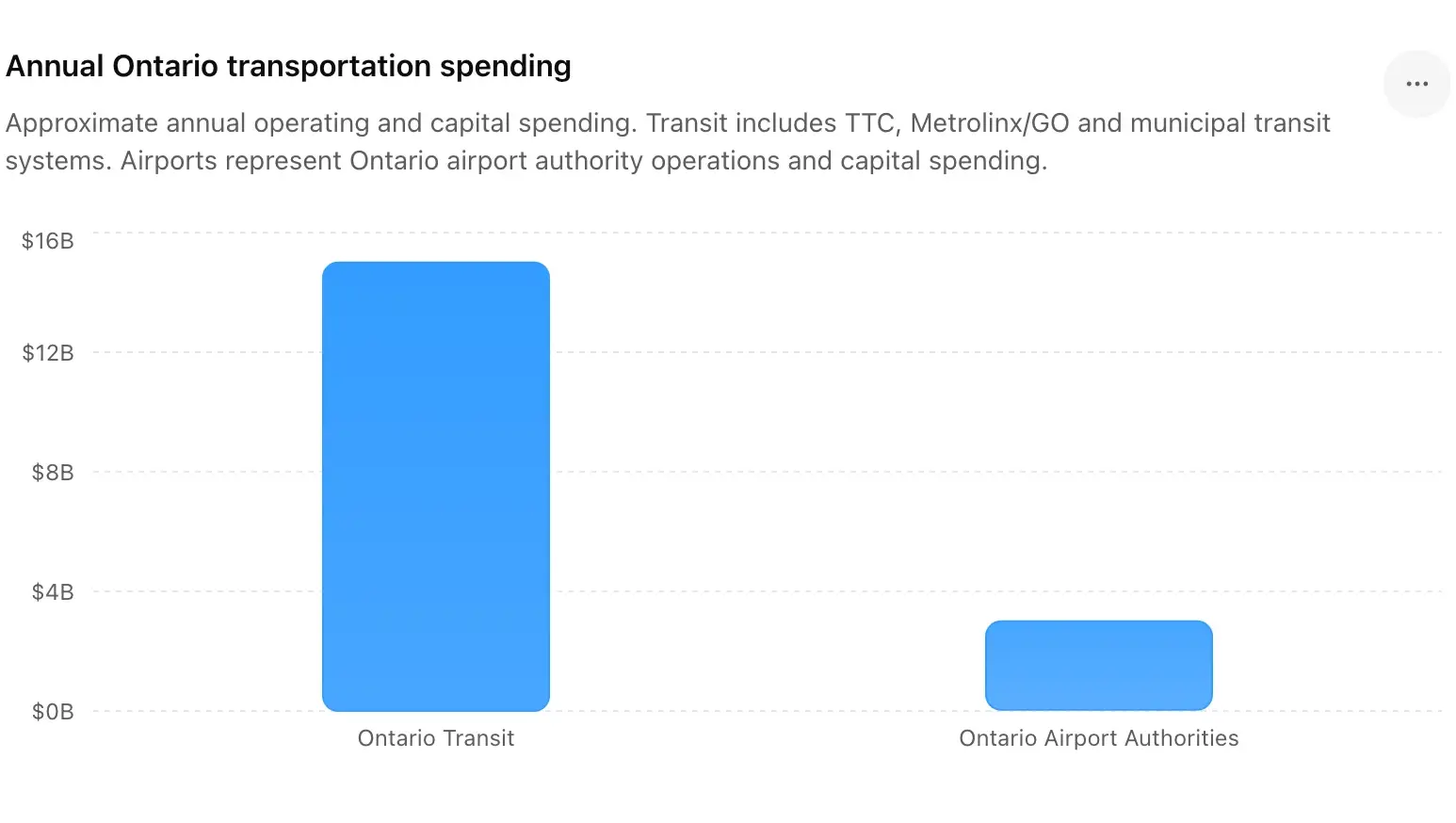
Ontario’s transit sector dwarfs its airport authority sector. The province is putting tens of billions into the Ontario Line, GO Expansion, the Eglinton Crosstown network, the Yonge North Subway Extension, the Scarborough Subway Extension, and Hamilton LRT.
Meanwhile the airport authority side is largely Pearson and Billy Bishop.
So transit represents one of the largest infrastructure investments in the province, and airports still command a level of strategic focus that transit rarely gets.
Part of the reason is governance. Aviation has a mature framework behind it: Transport Canada, NAV CANADA, international standards, national certification pathways, clear workforce pipelines.
Passenger rail and transit have nothing equivalent.
The Missing National Strategy
This is where it stops being an Ontario story.
Canada has no coherent national passenger rail strategy. No national transit framework. No consistent standards. No shared view of how passenger transportation should develop across the country.
And yet governments at every level are spending hundreds of billions on transit and rail.
We’re building, but not really coordinating. We’re investing, but not always learning. And we keep measuring outputs instead of outcomes.
The Billy Bishop Obsession
The clearest example is Billy Bishop.
For years, Toronto and Ontario have poured political energy into the future of the Island Airport. Expansion. Waterfront. Jets. Capacity. Elections. Round and round.
While politicians argue about airport capacity, commuters lose hundreds of hours a year to congestion. Regional rail corridors sit underused. Connections between the TTC, GO Transit, and UP Express stay more complicated than they need to be. And visitors arriving for one of the biggest sporting events on the planet are already noticing.
Expanding airport capacity while leaving regional transit half-optimized is like widening the driveway while the foundation cracks. One matters. The other matters more.
What If We Measured Transit Like We Measure Airports?
What if transit agencies reported economic impact instead of ridership? What if every transit debate started with labour market access? What if we measured the cost of transit failure the way we measure the cost of a power outage?
The numbers would tell a different story. The conversation would move from operating deficits to productivity, from ridership to economic output, from transportation policy to economic policy.
Because that’s what transit actually is.
The Question We Should Be Asking
For decades the question has been “Can transit pay for itself?”
It’s the wrong question. Nobody asks airports to pay for themselves through parking fees. Nobody asks the grid to justify itself through monthly bills.
The better question is what Ontario’s economy would look like without transit. The answer isn’t hard. Toronto would stop functioning. The GTA labour market would seize up. Congestion costs would climb. Productivity would fall. Billions in economic activity would simply vanish.
Our biggest mistake with transit isn’t underfunding it. It’s underestimating it.
Frequently Asked Questions
Why does Ontario measure airports and transit so differently?
Airports report economic impact like GDP, jobs, trade, and tourism, so the conversation starts with what they enable. Transit usually gets reported through ridership, fare revenue, cost recovery, and operating deficits, which makes it sound like a service that has to pay for itself. Same kind of infrastructure, very different scorecards.
Does Ontario spend more on transit or on airports?
Transit, by a wide margin. The province is investing tens of billions in the Ontario Line, GO Expansion, the Eglinton Crosstown network, the Yonge North Subway Extension, the Scarborough Subway Extension, and Hamilton LRT. The airport authority side is essentially Pearson and Billy Bishop, yet it still attracts a level of strategic attention that transit rarely gets.
How much does congestion actually cost Ontario?
Recent estimates put the direct economic loss at roughly 12.8 billion dollars a year, and more than 56 billion once you fold in the broader social and economic effects. That includes delayed shipments, missed meetings, workers stuck in traffic, and employers unable to reach talent across the region. These are economic costs, not inconveniences.
Why does aviation have stronger governance than passenger rail in Canada?
Aviation sits on top of a mature framework that includes Transport Canada, NAV CANADA, international standards, national certification pathways, and clear workforce pipelines. Passenger rail and transit have nothing equivalent. There is no national passenger rail strategy, no national transit framework, and no consistent set of standards across provinces.
What would change if we measured transit like we measure airports?
The conversation would shift from operating deficits to economic impact, labour market access, and productivity. Transit would be treated as the infrastructure it actually is, which is how a regional economy moves people, goods, and opportunity. It would also stop being judged against a question we never ask of airports, which is whether it can pay for itself.
Sources
Canadian Airport Economic Output ($123.5B, 435,800 jobs)
Canadian Airports Council. New Study Reveals Canadian Airports Generate $123.5 Billion in Annual Economic Output and Support Nearly 436,000 Jobs (2025). canadasairports.ca
Ontario Congestion Costs ($56.4B annual impact; $12.8B direct economic losses)
Canadian Centre for Economic Analysis (CANCEA). Impact of Congestion in the GTHA and Ontario: Economic and Social Risks (2024). cancea.ca
Ontario Transit Spending (~$15B annually)
Based on combined operating and capital expenditures from Toronto Transit Commission budgets, Metrolinx annual reports, Ontario municipal transit agency operating budgets, and Statistics Canada public transit capital investment data. Statistics Canada: Public Transit Capital Spending (2024). statcan.gc.ca
Ontario Airport Authority Spending (~$3B annually)
Estimate derived from annual reports of Toronto Pearson International Airport, Billy Bishop Toronto City Airport, Ottawa International Airport, and other major Ontario airport authorities. Toronto Pearson 2024 Annual Results. torontopearson.com
