
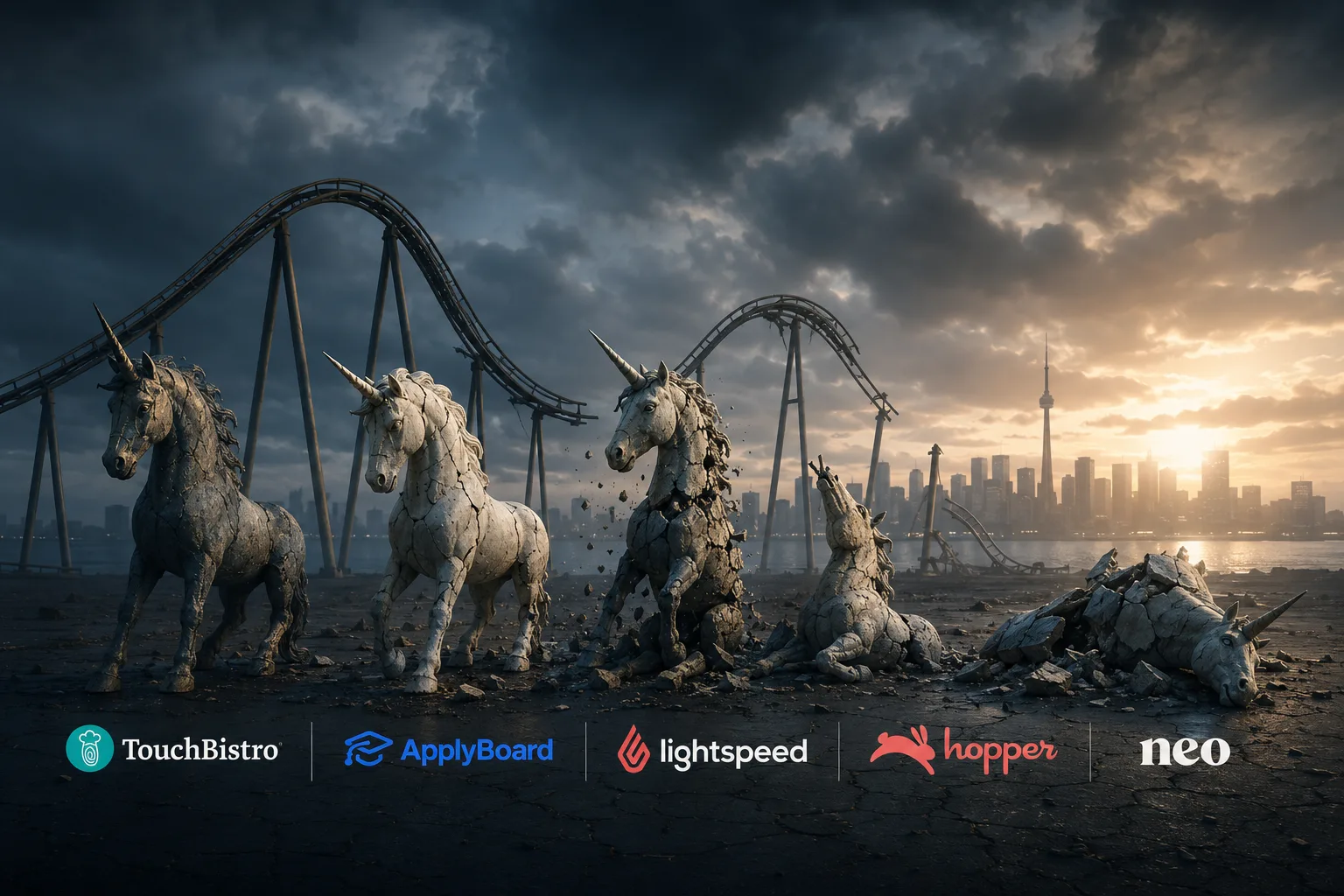
TouchBistro’s sale to Constellation Software, reportedly worth about $100 million and leaving OMERS with a nine-figure loss, is the sharpest example of a broader Canadian reckoning. TouchBistro, ApplyBoard, Lightspeed, Hopper, and Neo Financial were all crowned unicorns during the cheap-capital boom of 2020 to 2022, and none of them ended up in the same place: a lender-led recapitalization, policy-driven layoffs, a public valuation collapse without a business collapse, a private restructuring, and a down round. What connects them isn’t failure. It’s that their billion-dollar valuations were snapshots taken under financial conditions that didn’t last, and the real lesson is that raising money and creating value are not the same thing.
When I read this week that TouchBistro had been acquired by Harris Computer, part of Constellation Software, I thought back to 2017.
I interviewed for a senior technology leadership role at TouchBistro that year. I was impressed by the product, the market opportunity, the growth. TouchBistro had built an intuitive, mobile-first restaurant management platform at exactly the moment restaurants were ditching expensive legacy point-of-sale systems for cloud alternatives.
Before I went further, I talked to someone who had worked there. They told me to think carefully about the opportunity, based on their own experience with the company’s management and culture. That was one person’s perspective, not an independently verifiable fact about the company, but it lined up with some of what I picked up during the interview process. I passed on the role.
That conversation stuck with me as TouchBistro kept raising capital, expanding internationally, and attracting some of Canada’s most prominent institutional and venture investors.
Nine years later, the technology and the customer base are still valuable. Harris says TouchBistro now powers more than 16,000 restaurants in over 100 countries. But the financial result for its earlier investors looks a lot less successful. Harris announced the acquisition on July 7, 2026, without disclosing a price. The Globe and Mail later reported the deal was worth roughly $100 million, leaving OMERS with a loss exceeding $100 million.
I hope Constellation can turn the company around. Its model, buying specialized software businesses and holding them for the long haul, might give TouchBistro a more stable home than the venture cycle ever did.
TouchBistro is also part of a bigger Canadian story.
Between 2020 and 2022, Canada celebrated a new class of technology unicorns, private companies valued above US$1 billion. Their founders became symbols of an emerging innovation economy. Pension funds, global venture firms, and strategic investors rushed in.
Then the financial environment changed.
Interest rates rose. Public tech multiples fell. Private investors got choosier. Companies that had been rewarded for growing fast were suddenly asked to show margins, cash generation, a credible path to profit.
TouchBistro, ApplyBoard, Lightspeed, Hopper, and Neo Financial did not all end up in the same place. Some are still large, growing businesses. But each one shows a different piece of Canada’s great technology valuation reset.
TouchBistro: when growth financing becomes control financing
TouchBistro was founded in Toronto in 2010 by Alex Barrotti. The original pitch was simple and good: replace clunky restaurant point-of-sale systems with an iPad-based platform built around how servers and operators actually work.
The company gained real traction, and it attracted an extraordinary list of investors along the way.
In September 2019, OMERS Growth Equity led a C$158-million Series E. OMERS itself put in C$85 million, which it called its largest investment in a Canadian early-stage technology company at the time. Barclays, RBC Ventures, and BMO Capital Partners also joined.
In November 2022, TouchBistro announced another C$150 million in “growth financing” from Francisco Partners. The announcement said the money would fund growth, product development, acquisitions, and expansion into new restaurant categories.
The phrase “growth financing” doesn’t necessarily mean conventional equity, though.
According to The Globe and Mail’s later reporting, the Francisco Partners financing included debt that became a problem once TouchBistro missed its financial targets. The paper reported that a previously undisclosed recapitalization in December 2025 converted that debt into equity, handed Francisco Partners control of the board, and pushed existing shareholders down to a minority position.
The Harris sale followed in July 2026.
Harris disclosed the acquisition and TouchBistro’s customer reach, but not the transaction value or the earlier recapitalization. The $100-million price and the OMERS loss both come from The Globe and Mail’s reporting, not from the companies themselves.
This is a classic risk of debt-like growth capital.
Equity absorbs risk alongside the company. Debt sits ahead of equity and can carry covenants, conversion rights, governance rights. When a company grows as expected, debt lets existing owners avoid dilution. When targets get missed, it can shift control toward the lender and leave earlier shareholders with almost no leverage.
TouchBistro also ran into a serious competitor in Toast.
Toast wasn’t just selling point-of-sale software. It combined software, payments, payroll, lending, marketing, and online ordering into a broader restaurant operating platform. That gave it multiple revenue streams and let it spend heavily on customer acquisition.
TouchBistro still built a real company with thousands of customers. But a good product and a big customer base didn’t guarantee a good outcome for the people who financed it.
The operating company survived. The original investment thesis didn’t.
ApplyBoard: a unicorn built on a market shaped by government
ApplyBoard’s rise was even faster.
Founded in Waterloo Region in 2015, ApplyBoard built a platform connecting international students and recruitment partners with colleges and universities. It simplified applications across institutions and countries, in a large and growing global market.
In June 2021, ApplyBoard raised C$375 million at a post-money valuation of C$4 billion, or US$3.2 billion. Ontario Teachers’ Pension Plan led the round, with Fidelity, BDC, Index Ventures, and others joining.
That valuation assumed international student mobility would keep expanding.
But international education isn’t a normal software market. Its size depends heavily on government decisions: visas, immigration targets, post-graduation work rights, institutional eligibility, rules on student dependants.
Canada, the UK, Australia, and the US all tightened or considered tightening rules for international students. ApplyBoard itself has said that stricter regulations, rising costs, and shifting government policy have changed student demand and destination choices.
In June 2025, ApplyBoard cut more than 150 positions, citing policy changes across major destination countries and the need to adapt to a shifting global education market.
There’s also evidence that some investors marked down their ApplyBoard holdings sharply. Public reporting based on Fidelity fund disclosures pointed to an implied valuation well below the 2021 peak. ApplyBoard’s response was that such estimates reflect a “moment in time.”
That distinction matters.
An investor markdown is not a new financing round or a sale. It’s how an investor currently estimates the value of its holdings, using market comparisons and internal models. It doesn’t tell you what a buyer would pay for ApplyBoard, or what a new round would price it at.
So it’s fair to say ApplyBoard went through layoffs, real policy disruption, and investor markdowns.
It’s not fair to say ApplyBoard has failed.
What ApplyBoard’s story actually shows is concentration risk. It built technology around a large market, but much of that market ran on public policy. When governments changed the rules, the assumptions behind the growth and the valuation changed with them.
Lightspeed: a valuation collapse without a corporate collapse
Lightspeed is the most visible public-market case.
The Montreal company went public on the TSX in 2019 and became one of Canada’s most valuable listed technology businesses. Shares approached C$160 during 2021 as investors rewarded its expansion into commerce software and payments.
Along the way it made a string of large acquisitions, including ShopKeep, Upserve, Vend, and NuORDER, trying to build an integrated global commerce platform.
When tech valuations fell, Lightspeed’s market value fell hard with them.
In April 2024, the company announced roughly 280 job cuts. Reuters reported the restructuring was meant to cut headcount-related operating expenses by about 10 percent and get Lightspeed to profitable growth. It also authorized a share buyback program.
Founder Dax Dasilva came back as CEO and refocused the business around its strongest customer segments, deeper payments adoption, cost control, and profitability.
The results make Lightspeed hard to file under “lost.”
For the fiscal year ended March 31, 2026, Lightspeed reported annual revenue above US$1.2 billion. Fourth-quarter revenue was US$290.8 million, and the company posted US$55.5 million in operating cash flow for the full year. It’s forecasting fiscal 2027 revenue of US$1.225 to US$1.265 billion.
Shareholders who bought near the 2021 peak took enormous losses. The valuation had priced in expectations that didn’t hold up.
But the company is still operating at global scale, still generating more than US$1 billion a year in revenue, still moving toward stronger cash generation.
Lightspeed is the difference between a valuation collapse and a business collapse, in one company.
The valuation collapsed.
The company didn’t.
Hopper: a private company forced to adjust
Hopper is another one where the public evidence calls for caution.
The Montreal-founded travel technology company first made its name predicting when consumers should buy flights. It later expanded into hotels, home rentals, financial-protection products, and a B2B platform selling travel services to other brands.
Hopper raised US$175 million in August 2021 at roughly US$3.5 billion. In November 2022, Capital One put in another US$96 million in a deal reported to value Hopper above US$5 billion.
The company had already survived one crisis. It cut its workforce when global travel collapsed early in the pandemic, then rode the travel recovery back up and raised substantial additional capital.
But Hopper had to adjust again later.
In 2023, it reportedly cut around 250 positions as it restructured and leaned harder into its B2B travel platform.
Unlike Lightspeed, Hopper is private. It doesn’t publish the same detailed financials, quarterly results, or audited disclosures.
Which means we shouldn’t say Hopper’s current valuation has collapsed unless a new financing, sale, or reliable company disclosure actually shows it. A previous US$5-billion valuation tells you what investors were willing to pay in one specific transaction. It doesn’t tell you what Hopper is worth today.
Hopper belongs in this story because it raised money at boom-era prices and later made real workforce and strategic changes.
It doesn’t belong in the same category as TouchBistro, because there’s been no publicly disclosed distressed recapitalization or sale that locks in a loss for investors.
Its last chapter hasn’t been written yet.
Neo Financial: a down round, but not a dead company
Neo Financial became a unicorn in May 2022, raising C$185 million in equity at a valuation above C$1 billion.
The Calgary company set out to compete with Canada’s big banks by combining deposits, payments, credit cards, rewards, and consumer lending in one digital platform.
By November 2024, the financing climate had shifted.
Neo announced a C$360-million package: roughly C$110 million in equity and C$250 million in debt. Reuters confirmed the total figure, though Neo’s own announcement didn’t dwell on the new valuation.
Later reporting based on financing documents indicated the equity was priced well below Neo’s previous round. That makes it a down round: new shares sold at a lower company valuation than the prior raise.
A down round dilutes existing shareholders and formally resets the company’s value. It’s more concrete than an internal markdown, because it reflects a price actually negotiated with new investors.
Neo kept raising, though.
In February 2026, it brought in another C$68.5 million in equity from investors including AIMCo and Northleaf Capital Partners. Reuters reported the money would support a securitization program, letting Neo grow its lending book without funding every new loan out of equity.
That’s not automatically a bad sign.
Banks and consumer lenders routinely fund their loan books through deposits, credit facilities, loan sales, and securitization. Funding every new loan with equity would be expensive and would cap growth. Neo’s shift toward securitization could just as easily be its financial model maturing rather than the company retreating.
Its earlier investors still went through a valuation reset. The billion-dollar mark from 2022 didn’t hold in the next financing.
The story isn’t that the business disappeared. It’s that the market started pricing Neo less like a high-growth software startup and more like a financial institution, one whose worth turns on credit performance, funding costs, regulation, and risk-adjusted returns.
The common thread: valuations built for a financial world that disappeared
It would be wrong to call TouchBistro, ApplyBoard, Lightspeed, Hopper, and Neo Financial five failed companies.
Their outcomes were genuinely different:
TouchBistro went through a reported lender-led recapitalization and sold at a price that reportedly produced a major loss for OMERS. ApplyBoard faced real policy disruption, layoffs, and investor markdowns, but hasn’t disclosed a distressed financing or sale. Lightspeed lost enormous public-market value but remains a large, growing operating business. Hopper cut its workforce and adjusted strategy, but its current private valuation isn’t publicly established. Neo Financial completed a down round, then attracted more institutional capital to build a more scalable lending structure.
What connects them isn’t corporate failure.
It’s that their earlier valuations were set under financial conditions that didn’t last.
During the boom, investors competed to finance growth. Low interest rates inflated the present value of future earnings, and fast-growing tech companies could raise huge sums without showing near-term profit.
After 2021, the math changed.
Capital got more expensive. Public tech multiples fell. Private investors had fewer comparable deals to justify aggressive prices. Companies had to show not just rising revenue, but that each new dollar of revenue could eventually turn into sustainable cash flow.
That exposed a few weaknesses worth naming.
A unicorn valuation is not a company’s sale price
Private-company valuations get misread constantly.
When an investor buys a minority stake in a funding round, the price of those shares gets used to calculate a headline value for the whole company. But that investor often gets protections common shareholders don’t have: liquidation preferences, anti-dilution provisions, board seats, guaranteed returns.
So the headline valuation doesn’t necessarily reflect what every share is actually worth.
And it definitely doesn’t mean a buyer would pay that number for the whole business.
TouchBistro makes this vivid. A company can raise hundreds of millions, keep thousands of customers, keep operating, and still get sold for an amount that doesn’t come close to producing acceptable returns for the people who financed it.
Growth debt can preserve ownership, or it can transfer control
The years of cheap, abundant capital also pushed startups toward debt or debt-like instruments to stretch their runway without diluting existing owners.
That works fine when revenue grows, more financing stays available, and the company hits its covenants.
When those assumptions break, debt holders sit ahead of shareholders. They can convert debt into equity, negotiate stronger governance rights, or push a sale designed mainly to get their capital back.
Debt isn’t automatically bad for a company. Neo’s asset-backed lending strategy serves a different purpose than financing ongoing operating losses.
The questions that actually matter:
What assets or cash flows support the debt? What happens if targets are missed? Can the lender convert its position into equity? What governance rights come with the financing? Is the debt funding profitable assets and acquisitions, or recurring losses?
“Growth financing” as a label answers almost none of that.
Strong products do not guarantee strong investment outcomes
TouchBistro’s product wasn’t imaginary. ApplyBoard addressed a real problem. Lightspeed built a genuine global commerce platform. Hopper built real travel technology. Neo won customers in a banking market that’s dominated by a handful of incumbents.
None of these were companies built just to raise capital.
But product quality is only one input into investment returns.
Market structure matters. Competition matters. Regulation matters. Customer-acquisition cost matters. Financing terms matter. Exit timing matters.
Founders, employees, lenders, and different classes of investors can all walk away from the same company with completely different outcomes.
Was the generation really lost?
Calling this “Canada’s Lost Generation of Tech Unicorns” might be too pessimistic.
The companies haven’t all disappeared. Several are still growing, still employing Canadians, still serving customers globally, still building real technology.
What got lost was the certainty around their valuations.
The billion-dollar marks of 2020, 2021, and early 2022 got treated as proof that Canada had finally built a durable pipeline of globally dominant technology companies.
In reality, those valuations were snapshots taken during an unusual stretch of cheap capital and aggressive investor competition.
TouchBistro is the most sobering case because its reported sale crystallized the gap between the promise and the actual return. But the broader lesson isn’t that Canada should stop building ambitious technology companies.
It’s that raising money and creating value are not the same thing.
A high valuation can bring in capital, attract employees, generate press. It can also raise expectations, encourage overspending, and make a perfectly reasonable acquisition offer look inadequate.
The companies that come out of this reset in the best shape will probably be the ones that spend less time defending their old valuations and more time building real economics underneath them.
I still think TouchBistro built valuable technology for a real market need. I hope Harris and Constellation give it the disciplined, long-term operating environment it needs to rebuild.
Constellation’s model is a real departure from the venture model that financed TouchBistro’s expansion. Harris describes its approach simply: buy software businesses with growth potential, run them well, build for the long term.
Maybe that’s the final irony of this generation of Canadian technology companies.
After years of being pushed to grow fast enough to justify the next financing round, some of them may end up finding their best home with owners who are willing to stop chasing valuations and just run the business.
Frequently Asked Questions
Who bought TouchBistro and for how much?
Harris Computer, part of Constellation Software, announced the acquisition of TouchBistro on July 7, 2026, without disclosing a price. The Globe and Mail later reported the deal was worth roughly $100 million, which would leave OMERS with a loss exceeding $100 million on its earlier investment. Harris says TouchBistro now powers more than 16,000 restaurants in over 100 countries, so the operating business remains valuable even though the financial return for early investors was poor.
What does “Canada’s lost generation of tech unicorns” mean?
It refers to the class of Canadian companies valued above US$1 billion during the cheap-capital boom of 2020 to 2022, including TouchBistro, ApplyBoard, Lightspeed, Hopper, and Neo Financial. Most of these companies did not disappear. What got lost was the certainty around their valuations, which were set during an unusual stretch of low interest rates and aggressive investor competition that didn’t last.
Did these five companies fail?
No, and their outcomes were genuinely different. TouchBistro went through a reported lender-led recapitalization and sold at a loss for OMERS. ApplyBoard faced policy disruption, layoffs, and investor markdowns, but hasn’t disclosed a distressed sale. Lightspeed lost enormous public-market value but still generates more than US$1 billion in annual revenue. Hopper cut staff and shifted strategy, but its current private valuation isn’t publicly established. Neo Financial completed a down round, then raised more institutional capital. What connects them is a valuation reset, not corporate failure.
Why is a unicorn valuation not the same as a sale price?
When an investor buys a minority stake in a funding round, the price of those shares is used to calculate a headline value for the whole company. But those investors often get protections common shareholders don’t have, such as liquidation preferences, anti-dilution provisions, and guaranteed returns. So the headline number doesn’t reflect what every share is worth, and it certainly doesn’t mean a buyer would pay that amount for the entire business. TouchBistro shows a company can raise hundreds of millions, keep thousands of customers, and still sell for far less than its investors needed.
How did growth debt cost TouchBistro’s investors control?
According to The Globe and Mail, TouchBistro’s 2022 “growth financing” from Francisco Partners included debt that became a problem once the company missed its targets. A previously undisclosed recapitalization in December 2025 reportedly converted that debt into equity, handed Francisco Partners control of the board, and pushed existing shareholders into a minority position. Debt sits ahead of equity, so when targets are missed it can shift control toward the lender and leave earlier shareholders with almost no leverage. That’s the risk hidden inside the label “growth financing.”
