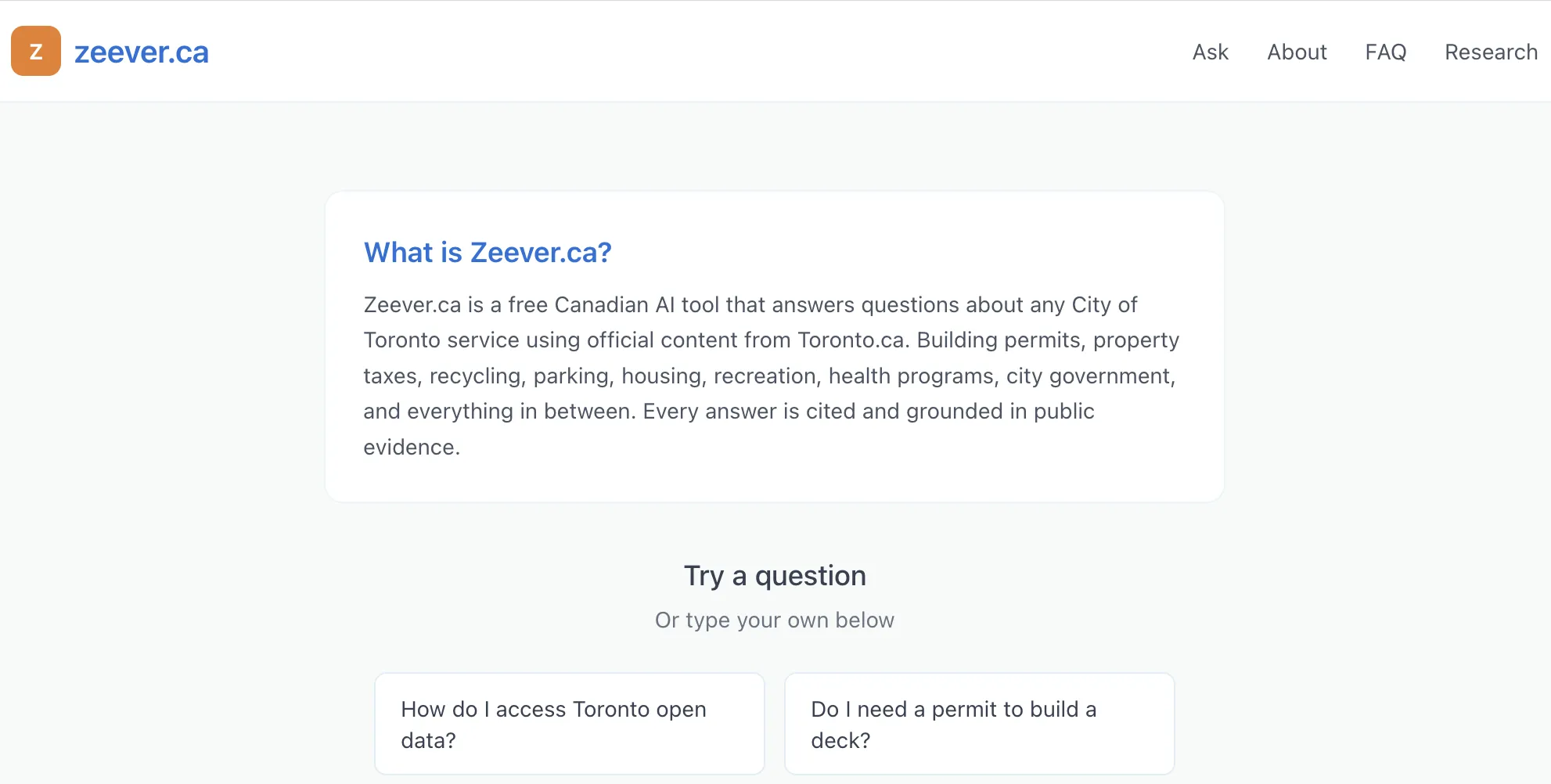
Canada has committed billions to sovereign AI, but what happens when you actually try to build something? Zeever.ca is a low-budget experiment that repurposes a desktop GPU, an existing VPS, and open models to answer real municipal questions using Canadian data. Sovereign AI doesn’t start with billion-dollar investments. It starts with using what you already have.
Canada has committed billions to sovereign AI.
But if you actually try to build something today, the experience looks very different.
Meanwhile, a different reality is taking shape globally, particularly in China. AI systems are being built on lower-cost hardware, with optimized models designed for efficiency over scale. Not every solution runs on massive clusters. Many run on constrained infrastructure, and they’re built for it.
Zeever.ca was inspired by that approach.
The Setup: Built on What Already Exists
This wasn’t a greenfield build.
The system is intentionally constrained:
- Older desktop with an RTX 3070 (8GB VRAM): for local inference
- Existing VPS with no GPU: set up years ago to host my websites
- Tailscale connection: linking the two environments
No new infrastructure. No specialized AI hosting. Just repurposing what was already available.
That constraint shaped every decision.
The Goal
Zeever is an experiment. Not in theory, but in practice.
What does “sovereign Canadian AI” look like if you try to build it yourself with limited resources?
No grants. No hyperscaler contracts. No supercomputer access. Just public Canadian data, open models, and modest infrastructure.
Stage 1: Grounding in Real Canadian Data
The experiment starts with City of Toronto (Toronto.ca) data.
The goal: build a system that can answer real municipal questions using Canadian data.
Stage 2: Data Structures, Efficiency Over Scale
Taking cues from the efficiency-first approaches seen in parts of the Chinese AI ecosystem, multiple strategies were tested:
- Raw scraping: baseline ingestion
- Chunked RAG: standard retrieval patterns
- Structured extraction: cleaner, typed outputs
- Early GraphRAG-style representations: relationship-aware retrieval
Key insight: efficiency is not just about smaller models. It’s about better data design.
Stage 3: Model Experiments
Primary model:
- Qwen 2.5 (7B Instruct): chosen specifically because it runs on 8GB VRAM
Additional APIs tested:
- Together.ai
- Fireworks.ai
- OVH Cloud
Stage 4: Infrastructure Reality
The split architecture became clear.
Local machine (GPU):
- Runs the model via Ollama
- Handles inference where possible
VPS (no GPU):
- Hosts the application
- Manages requests and routing
- Acts as the public interface
Connected via Tailscale.
This creates a practical pattern: keep compute local, expose it through lightweight infrastructure.
Stage 5: Inference Strategy
Three approaches emerged:
- Local inference: most sovereign, limited scale
- API inference: fast, but often not Canadian-hosted
- Hybrid: what actually works
Stage 6: The Working Demo
Zeever now includes a working prototype that:
- Answers questions using Toronto municipal data
- Compares models and approaches
- Measures latency and quality
What This Reveals
1. Sovereign AI is possible on a budget.
You can build meaningful systems with a single GPU, existing infrastructure, and open models.
2. Efficiency is underrated.
The kind of constraint-driven engineering seen in parts of the Chinese ecosystem is a real competitive advantage.
3. Infrastructure is the bottleneck.
Canada still lacks accessible modern GPUs, at-scale infrastructure, and easy access to local compute.
4. Sovereignty is a spectrum.
Most systems end up hybrid. Local plus external. Controlled plus outsourced.
Frequently Asked Questions
What is Zeever.ca?
Zeever.ca is a working experiment in sovereign Canadian AI. It uses a desktop GPU, an existing VPS, and open models to answer real municipal questions using City of Toronto data. It was built entirely on repurposed infrastructure with no new hardware or cloud contracts.
What does “sovereign AI” mean?
Sovereign AI refers to AI systems that are built, hosted, and controlled within a country’s borders using local data and infrastructure. In practice, sovereignty is a spectrum. Most real systems end up as a hybrid of local compute and external APIs.
What hardware does Zeever run on?
The inference runs on an older desktop with an NVIDIA RTX 3070 (8GB VRAM) using Ollama. The web application is hosted on an existing VPS with no GPU. The two are connected via Tailscale.
What AI model does Zeever use?
The primary model is Qwen 2.5 (7B Instruct), chosen because it fits within the 8GB VRAM constraint. Additional inference APIs from Together.ai, Fireworks.ai, and OVH Cloud were also tested.
Can you build useful AI without expensive cloud infrastructure?
Yes. Zeever demonstrates that meaningful AI systems can run on modest hardware with open models and well-structured data. The key is designing for efficiency rather than scale, focusing on better data architecture instead of bigger compute.
Why use Toronto municipal data?
City of Toronto data from Toronto.ca provides a real, publicly available Canadian dataset. It grounds the system in practical municipal questions rather than synthetic benchmarks, making it a genuine test of whether sovereign AI can deliver useful answers.
Final Thought
Zeever.ca is not a production system. It’s a working proof.
Sovereign AI doesn’t start with billion-dollar investments. It starts with using what you already have and pushing it as far as it will go.
The question isn’t whether it’s possible. It’s whether we can make it practical, scalable, and accessible in Canada.