
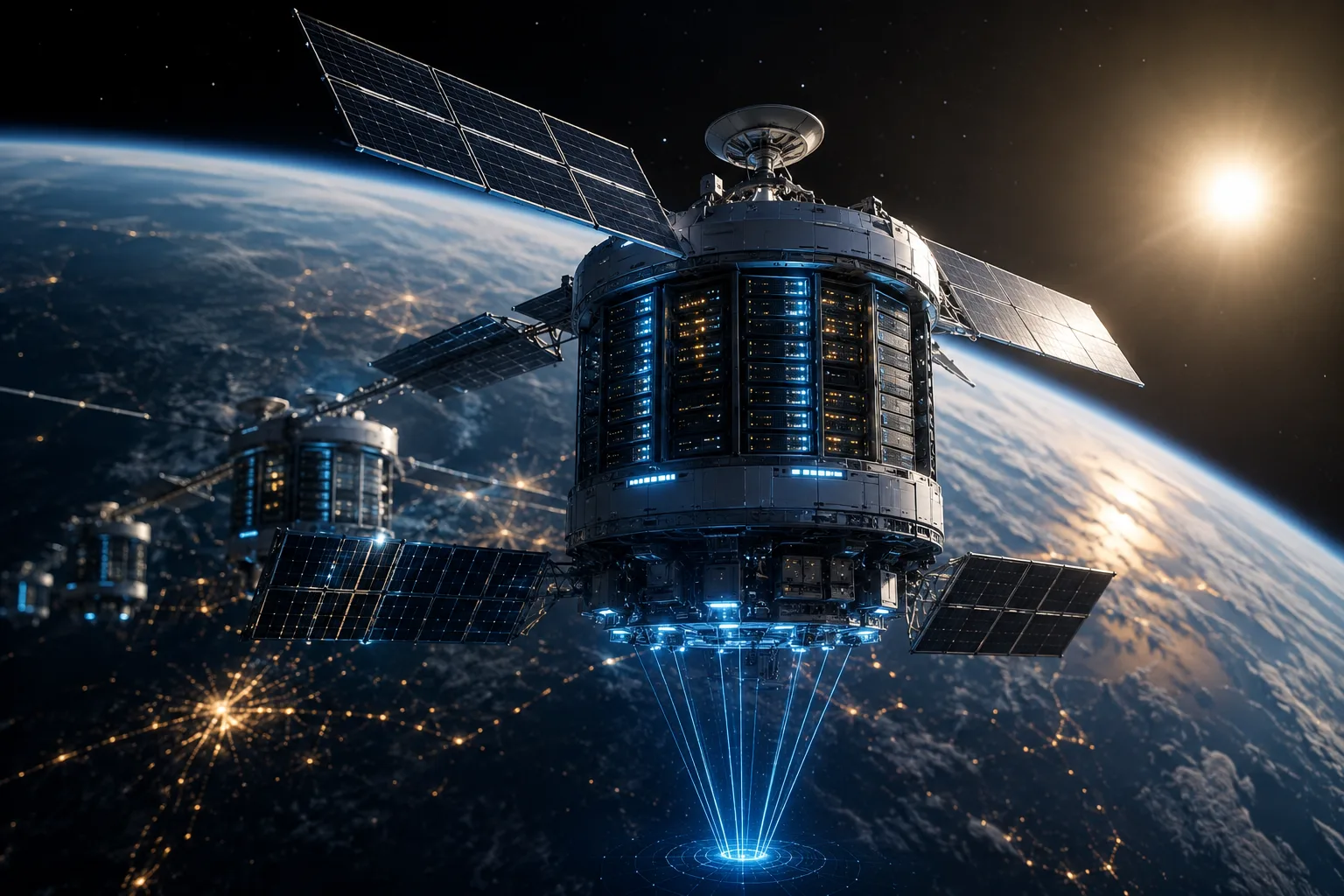
AI leadership is shifting from a software contest to an infrastructure contest. SpaceX’s IPO filings describe a vertically integrated AI platform of launches, satellites, Starlink connectivity, compute, and even orbital data centres, a signal that energy, GPUs, connectivity, manufacturing, and distribution are becoming the real competitive moats. For countries like Canada, that means sovereign compute, domestic GPU capacity, and AI infrastructure resiliency now matter as much as the models themselves. The next era of AI competition is ecosystem versus ecosystem, not model versus model.
For the past few years, most AI discussions have focused on models.
Who has the smartest chatbot? Who has the best benchmarks? Who has the best reasoning?
The recent SpaceX IPO disclosures point at something bigger:
The future of AI leadership may depend less on software and more on physical infrastructure control.
That has real implications for countries like Canada.
The SpaceX filings suggest the company increasingly sees itself not as a rocket company, and not even as an AI company, but as a vertically integrated AI infrastructure platform.
That includes launch systems, satellites, global connectivity through Starlink, AI compute infrastructure, orbital data centres, and the distribution network to move AI services globally.
The Orbital AI Data Centre Idea Sounds Crazy Until It Doesn’t
One of the most interesting details from the IPO disclosures was SpaceX’s long-term ambition to build orbital AI compute infrastructure.
The concept sounds almost science fiction:
- Massive AI compute satellites assembled in orbit
- Solar-powered data centres running continuously above the atmosphere
- Passive cooling from the vacuum of space
- Starlink-style networking stitching the constellation together
There’s a strategic signal hiding underneath the ambition.
AI infrastructure is running into real-world physical constraints. Power availability. Cooling capacity. Land access. Permitting delays. Grid limitations. Fibre connectivity. And growing geopolitical concerns about where compute physically lives.
Scaling AI is no longer a software problem. It’s an infrastructure problem.
That’s why hyperscalers are suddenly talking about nuclear power, modular reactors, custom silicon, dedicated fibre routes, and now potentially orbital compute.
Even SpaceX’s own filing acknowledged the commercial and technical risks involved with space-based AI infrastructure. Still, the direction is revealing.
Canada Is Facing the Same Problem
Canada has increasingly been discussing sovereign AI, Canadian GPU capacity, domestic compute infrastructure, and our dependence on foreign hyperscalers.
Those conversations are no longer theoretical.
If AI becomes foundational national infrastructure, countries without domestic compute capacity will eventually face pricing pressure, limited access to frontier GPUs, data sovereignty concerns, and dependence on external cloud providers.
That’s why we’re starting to see more activity across Canada around:
- Regional GPU clusters stood up by universities, telcos, and provincial efforts
- Canadian-hosted inference for workloads with residency requirements
- Sovereign AI infrastructure as a federal policy conversation
- Domestic data residency strategies inside large enterprises and government
The challenge is that AI infrastructure is incredibly capital intensive.
The SpaceX disclosures reportedly showed AI infrastructure spending exceeding rocket spending. That is a startling sentence to write. It captures how fast AI compute is becoming industrial-scale infrastructure rather than traditional software.
Starlink May Be the Most Important Part of the Story
One of the easiest mistakes when reading the SpaceX IPO coverage is focusing only on Grok or xAI.
The more important asset may actually be Starlink, because AI infrastructure isn’t useful without distribution.
SpaceX now controls launch capability, satellite deployment, global network infrastructure, edge connectivity, and potentially future orbital compute platforms.
That combination matters.
If AI agents increasingly operate continuously across vehicles, robots, remote regions, IoT systems, industrial environments, and autonomous infrastructure, then connectivity becomes part of the AI stack itself.
Starlink is no longer “just internet.” It may become the transport layer for globally distributed AI systems.
AI Is Starting to Look Like Utilities and Telecom
For years, the tech industry treated AI as software. The economics are starting to resemble something else. Telecom. Electricity. Transportation. Cloud infrastructure.
The winners will increasingly be organizations that control:
- Energy at industrial scale, often through dedicated generation
- Compute through owned GPU fleets and custom silicon
- Connectivity across regions and last-mile environments
- Manufacturing of the hardware itself
- Deployment into physical environments
- Distribution to end users and enterprise customers
Not just the best models.
That may be the biggest insight from the SpaceX IPO disclosures. It also helps explain why countries, provinces, and enterprises are suddenly thinking much more seriously about sovereign compute, local GPU capacity, energy availability, and AI infrastructure resiliency.
The next era of AI competition is not model versus model. It’s infrastructure ecosystem versus infrastructure ecosystem.
That’s a very different kind of race, and Canada is not yet positioned to win it.
Sources and Related Reading
- Reuters coverage of the SpaceX IPO and AI infrastructure ambitions
- Reuters on SpaceX orbital AI data centre risks
- MarketWatch on orbital AI compute satellites
- Orbital Data Centers: Spacecraft Constraints and Economic Viability
- Toward Communication-Efficient Space Data Centers
Frequently Asked Questions
Why does AI leadership now depend on physical infrastructure?
Because scaling AI has hit the limits of software. Frontier models need industrial-scale power, cooling, GPU supply, fibre, land, and permits. Whoever controls those physical inputs increasingly controls who gets to run frontier AI at all, which is why hyperscalers are now talking about nuclear power, modular reactors, custom silicon, dedicated fibre, and even orbital compute.
What is an orbital AI data centre?
A satellite or constellation of satellites that runs AI compute in space rather than on the ground. The pitch is continuous solar power, passive cooling in the vacuum of space, and Starlink-style networking between nodes. The economics and engineering are unproven, and SpaceX’s own IPO filing acknowledges that orbital data centres may not be commercially viable.
Why is Starlink relevant to AI?
Because AI agents, autonomous systems, robots, vehicles, and remote deployments all need reliable connectivity. As AI moves into the physical world, the network it runs on becomes part of the stack. Starlink gives SpaceX a global last-mile transport layer that ties launch, satellites, compute, and distribution into a single vertically integrated AI platform.
What is sovereign AI and why does Canada care?
Sovereign AI is the idea that a country should have meaningful domestic capacity to train and run AI on national soil, on hardware it controls, under its own data residency rules. Canada is concerned because it currently depends heavily on foreign hyperscalers for GPUs, compute, and infrastructure, which means foreign pricing, foreign priorities, and limited leverage if access tightens or trade conditions change.
What should Canadian leaders be doing about this?
Treating compute, energy, and connectivity as national infrastructure decisions, not procurement line items. That includes regional GPU clusters, Canadian-hosted inference for residency-sensitive workloads, federal investment in domestic AI infrastructure, and data residency policies that reflect where AI is heading rather than where it has been.
