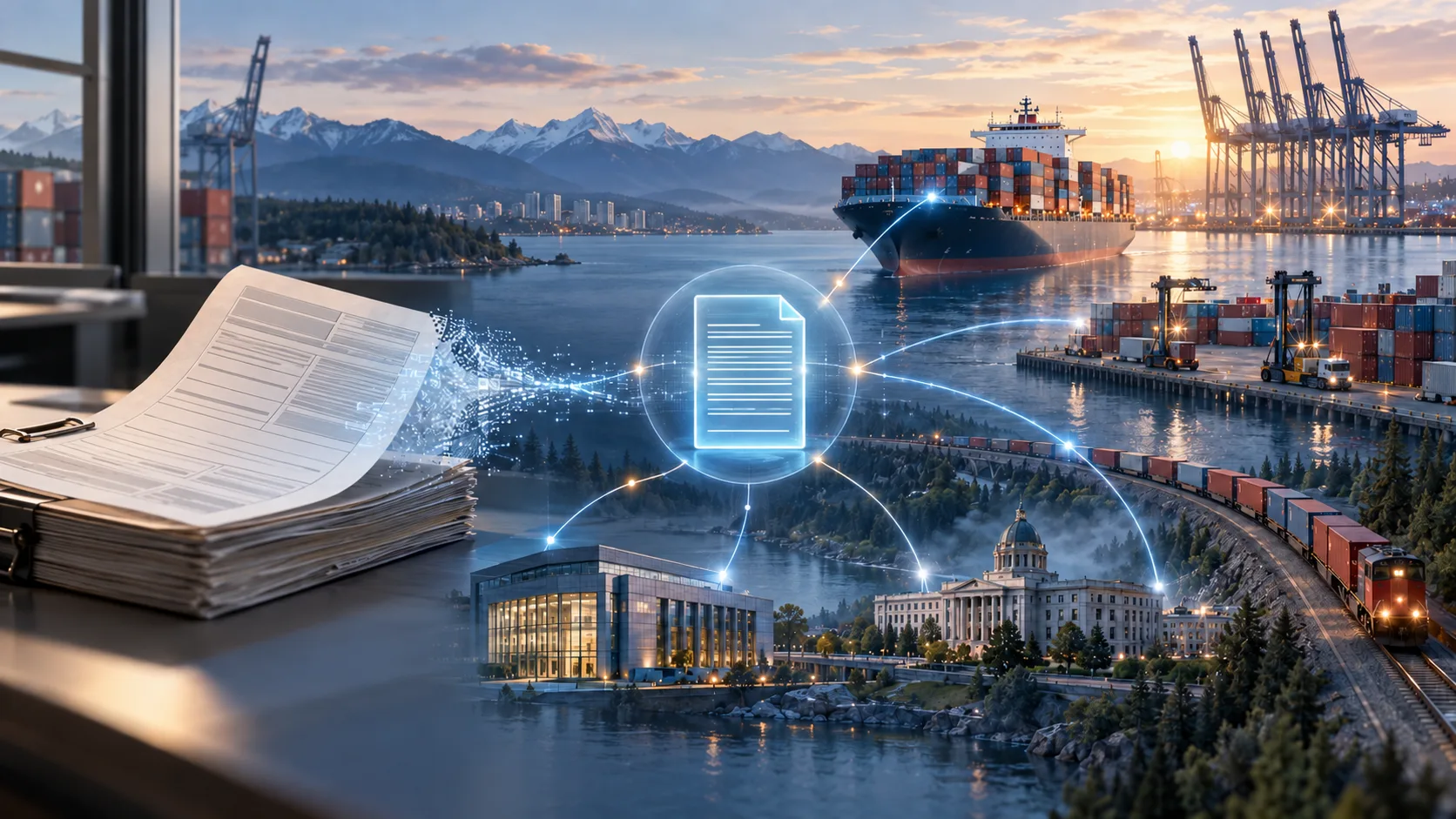
Bill C-39 contains a proposed Enabling Digital Trade Act, and it does something a PDF never could: it creates a digital original that is unique, controllable and transferable. That matters because a negotiable bill of lading controls the cargo, and a file that copies perfectly can’t answer who holds that control. The Act also lets one federal department reuse trade information given to another, overriding confidentiality provisions in the Customs Act, Income Tax Act and several others. Two things are missing. The bill leans on the phrase “reliable method” without saying what makes a method reliable, and it builds exactly the consolidated data environment where someone will propose AI without any of the safeguards that should come with it. Parliament is approving a foundation. The regulations, standards and procurement decisions that follow will decide whether Canada gets an interoperable public-interest trade layer or a pile of closed vendor platforms.
In 2008, in my first business law class at the University of Toronto, we spent time debating whether contracts sent by email, and signatures exchanged electronically, were legally valid.
The technology already felt ordinary. The law and business practice did not.
Almost twenty years later, surprisingly little has changed in a lot of organizations. Electronic signatures are widely accepted, yet important transactions still routinely produce PDFs that get printed, signed, scanned and emailed back. Sometimes paper is still legally required. More often it survives because a bank, insurer, regulator, lawyer or internal process keeps insisting on it.
Canada is now proposing to tackle a harder version of that problem through Bill C-39, the Building Canada Strong Act. Buried inside this large economic and transportation bill is a proposed Enabling Digital Trade Act.
It goes well beyond letting people swap paper for PDFs.
It creates the legal concept of a digital original that is unique, controllable and transferable. It would also give the federal government broader authority to accept trade information electronically and reuse it across departments.
That foundation is sound, and overdue. But the legislation pushes its most important technology choices down the road. The regulations, standards and procurement architecture will decide whether Canada builds an interoperable, public-interest digital trade layer or ends up with a collection of closed vendor platforms and opaque government data systems.
I think that second outcome is the default if nobody pushes back.
Why a PDF is not enough
Most electronic documents don’t need to be unique. If five people have identical PDF copies of a contract, nobody thinks there are five contracts.
Transferable trade documents work differently.
A negotiable bill of lading, for example, can give its holder the right to claim goods being carried on a ship. Possessing and handing over the document can transfer control of the cargo. A warehouse receipt does something similar for goods in storage.
With paper, the physical original answers a basic question: who controls the rights this document represents right now?
A scanned PDF can’t answer that. It can be copied perfectly and endlessly. If three parties each hold the same PDF bill of lading, which one controls the cargo?
The proposed Act handles this through the idea of an authoritative electronic record. To replace a paper trade document, an electronic record would have to:
- contain the required information;
- be distinguishable from copies using a reliable method;
- remain under reliable control from creation until it ceases to be valid;
- be protected against unauthorized alteration; and
- record when it has been converted from paper.
From there, the Act maps familiar paper concepts onto electronic ones. Possession becomes exclusive control. Delivery becomes a transfer of control. A signature has to reliably identify a person and show their intention. Amendments have to stay identifiable as amendments.
Once a paper original is properly replaced, the paper becomes legally inoperative. It also works in reverse. An electronic trade document can be converted back into a paper original, and then the electronic version becomes inoperative.
Call it what it is: digital title infrastructure. Scanning has nothing to do with it.
Technology-neutral, but architecture-dependent
The bill deliberately avoids prescribing a technology.
An electronic bill of lading could run on a centralized registry, a federated platform, cryptographically signed records, distributed-ledger technology, or anything else that can prove identity, integrity and exclusive control.
Blockchain is allowed. It isn’t required, and it shouldn’t be.
Technology neutrality is usually good legislation. Parliament should define the legal outcome, not pick a vendor or lock a particular architecture into law.
But “technology-neutral” can’t be allowed to mean “standards-optional.”
The bill leans on the phrase “reliable method” over and over, then leaves it to Cabinet to decide later what makes a method reliable. It doesn’t yet say whether a compliant system will need accredited digital identities, multi-factor authentication, cryptographic signatures, tamper-evident audit logs, independent certification, minimum availability or a tested recovery process.
Those aren’t side details. They’re what determines whether anyone can actually trust the digital document.
If control of an electronic record means control of a shipment worth millions of dollars, a compromised account or stolen signing key isn’t just a privacy breach. It’s the digital version of someone walking off with the original title document and the goods it controls.
“Tell us once” could be the bigger change
The second part of the proposed Act might end up mattering more than electronic bills of lading.
It would let businesses submit import and export information electronically even where an existing federal law contemplates a physical document. Federal departments could send permits, certificates and other information back electronically too.
The bigger shift is that information given to one federal organization could be disclosed to another organization legally entitled to collect it. To make that happen, the legislation can override specified confidentiality restrictions in the Customs Act, Income Tax Act, Excise Tax Act, Safe Food for Canadians Act, Canadian Environmental Protection Act and several other statutes.
The government calls this “Tell Us Once, Tell Us Digitally.” Rather than an importer submitting essentially the same information to several departments, authorized organizations could reuse what’s already been supplied.
That could remove a huge amount of friction. It could also lay the groundwork for a much smarter trade system.
Consistent, reusable digital information would make it possible to:
- identify contradictory declarations across agencies;
- match cargo records with permits and certificates;
- detect customs, origin and tax fraud;
- identify suspicious shipping patterns;
- predict port, railway and border congestion;
- prioritize higher-risk inspections; and
- automate genuinely low-risk transactions.
Bill C-39 would also allow a National Trade Corridors Council to monitor goods movement, measure performance against targets and investigate significant disruptions. A mandate like that practically asks for shared operational data, predictive analytics and, eventually, digital models of Canada’s trade corridors.
The bill never mentions artificial intelligence. It does, however, create exactly the kind of consolidated, structured, high-value data environment where someone will propose AI. Probably sooner than later.
The legislation creates AI capability without AI safeguards
Using AI to spot anomalies, forecast congestion or help officials work through complex records isn’t a problem in itself. Done well, it could make Canadian trade faster and more secure.
The trouble starts when analytical tools turn into decision systems.
An algorithm could influence whether a shipment gets inspected, delayed or denied. It could feed into a finding that a business is an elevated customs risk. Elsewhere in Bill C-39, expanded transportation security clearance powers could create pressure to use automated risk scoring that draws on information from Transport Canada, Public Safety, Immigration, the RCMP, CSIS, CBSA and possibly foreign governments.
Yet C-39 does not establish:
- a right to know when automation materially influenced a decision;
- a right to receive a meaningful explanation;
- human-review requirements;
- procedures for correcting inaccurate source data;
- model-testing or audit requirements;
- limits on secondary uses of shared trade information; or
- rules governing AI-generated evidence.
The federal Directive on Automated Decision-Making may apply when a department uses AI to make or support an administrative decision. It can require an Algorithmic Impact Assessment, transparency measures, testing and procedural safeguards. But a Treasury Board policy instrument isn’t the same thing as safeguards written into legislation, and it may not cover every question a cross-government trade data environment raises.
The danger of digitizing silos
Canada could implement this law badly and still be technically compliant.
Picture separate proprietary platforms for carriers, banks, ports, customs brokers and government agencies. Each one recognizes a digital original, but each uses its own identity system, data model, API and transfer mechanism. Participants pay several vendors to push the same transaction through disconnected networks. Government collects more data but says very little about how it’s linked, analyzed or used.
We’d have digitized the paperwork and still not have a digital trade system.
A better approach is a common trust and interoperability layer. Private companies could still build products and compete on service. They’d just do it on top of open standards for document schemas, identity, signatures, transfer of control, revocation, audit evidence and APIs.
Think of the difference between the internet and a single private online service. The public value comes from shared protocols that let many systems take part. Nobody has to use the same app.
Canada also has to decide which pieces count as public infrastructure. Government doesn’t need to run every electronic document registry. It should set the trust framework, the certification regime and the interoperability requirements. It may also need to provide common identity, directory, validation and audit services, so smaller exporters aren’t priced out by having to join several private networks.
What Parliament should ask
The Enabling Digital Trade Act deserves support. Committee review, though, should spend less time on whether electronic trade documents are a good idea and more on the infrastructure that makes them trustworthy.
Parliamentarians should ask:
Will Canada mandate open technical standards?
Legal recognition doesn’t help much if compliant platforms can’t exchange documents or transfer control between each other.
Who will certify a “reliable method”?
Will platform operators self-attest, or will independent technical and security certification be required?
What happens when a platform fails?
The framework needs rules for outages, insolvency, corrupted records, compromised credentials, lost keys, and moving authoritative documents to another provider in an orderly way.
Who owns and can reuse the data?
Cross-departmental sharing needs clear purpose limits, retention rules, access logs and real oversight.
How will businesses challenge automated decisions?
A shipment held up by an opaque risk score can do serious financial damage, even if a human eventually fixes the decision.
Will the government publish data standards and APIs?
Public specifications would encourage competition, let Canadian firms build compatible tools and reduce dependence on a handful of global vendors.
Which components will be common public infrastructure?
Parliament should know whether government plans to provide a shared trust layer or leave the architecture entirely to private platforms.
How will foreign systems be recognized?
The bill allows recognition of electronic trade documents used abroad, but making that work in practice will take compatible standards, identity assurance and legal coordination.
A foundation, not the finished system
Canada has legally accommodated electronic records for more than 25 years. Even so, too many important processes still treat digital documents as pictures of paper instead of authoritative digital objects.
The Enabling Digital Trade Act starts to change that. It recognizes that an electronic record can be original, unique, controllable and transferable, rather than a copy sitting on a screen.
That’s an important step. But Parliament is approving the foundation. The building comes later.
The regulations, technical standards and procurement decisions that follow will determine whether Canada ends up with an interoperable public-interest digital trade layer or a pile of closed platforms and opaque government databases.
The law should make room for innovation. The infrastructure has to protect competition, security, accountability and public trust.
Nearly twenty years after that business law class, nobody is really asking whether an electronic document can be legally valid anymore. The real question is whether Canada can build the shared digital institutions that make it worth trusting.
Sources
- Parliament of Canada, Bill C-39: Building Canada Strong Act, first-reading text.
- Parliament of Canada, Bill C-39 status and legislative history.
- Government of Canada, Bill C-39 Introduction and backgrounder.
- United Nations Commission on International Trade Law, Model Law on Electronic Transferable Records.
- Department of Justice Canada, Personal Information Protection and Electronic Documents Act, Part 2: Electronic Documents.
- Treasury Board of Canada Secretariat, Directive on Automated Decision-Making.
Frequently Asked Questions
What is the Enabling Digital Trade Act?
It’s a proposed Act sitting inside Bill C-39, the Building Canada Strong Act. It does two things. It creates the legal concept of a digital original that is unique, controllable and transferable, so electronic records can function as trade documents rather than copies of them. And it gives the federal government broader authority to accept trade information electronically and reuse it across departments.
Why can’t a PDF replace a bill of lading?
Because a negotiable bill of lading can give its holder the right to claim the goods on a ship, and possession of the document transfers that control. A PDF copies perfectly and endlessly. If three parties each hold the same PDF bill of lading, nothing in the file answers which one controls the cargo. Paper solved that with a physical original. Digital needs a different mechanism.
What makes an electronic record authoritative under the Act?
It has to contain the required information, be distinguishable from copies using a reliable method, remain under reliable control from creation until it ceases to be valid, be protected against unauthorized alteration, and record when it was converted from paper. The Act then maps paper concepts onto electronic ones: possession becomes exclusive control, delivery becomes transfer of control, and once a paper original is properly replaced the paper becomes legally inoperative.
Does this require blockchain?
No. The bill is deliberately technology-neutral. An electronic bill of lading could run on a centralized registry, a federated platform, cryptographically signed records, distributed ledger technology, or anything else that proves identity, integrity and exclusive control. Blockchain is allowed but not required, and it shouldn’t be.
What is “Tell Us Once, Tell Us Digitally”?
It’s the government’s name for letting information given to one federal organization be disclosed to another organization legally entitled to collect it, so importers stop filing substantially the same data with several departments. Making it work requires overriding specified confidentiality restrictions in the Customs Act, Income Tax Act, Excise Tax Act, Safe Food for Canadians Act, Canadian Environmental Protection Act and other statutes.
Does Bill C-39 regulate AI?
It never mentions artificial intelligence. What it does create is the consolidated, structured, high-value data environment where someone will propose AI. The bill establishes no right to know when automation materially influenced a decision, no right to an explanation, no human-review requirement, no model testing or audit obligations and no limits on secondary uses. The Treasury Board Directive on Automated Decision-Making may apply when a department uses AI for administrative decisions, but a policy instrument is not the same as safeguards written into legislation.
What does a bad implementation look like?
Separate proprietary platforms for carriers, banks, ports, customs brokers and government agencies, each recognizing a digital original but each using its own identity system, data model, API and transfer mechanism. Participants would pay several vendors to push the same transaction through disconnected networks, and government would collect more data while saying little about how it’s linked or used. That digitizes the paperwork without producing a digital trade system.
What should committee review focus on?
Not whether electronic trade documents are a good idea, but the infrastructure that makes them trustworthy. Whether open technical standards will be mandatory, who certifies a reliable method, what happens when a platform fails or a provider goes insolvent, who can reuse the data and under what limits, how businesses challenge automated decisions, whether data standards and APIs will be published, which components count as public infrastructure, and how foreign systems get recognized.