
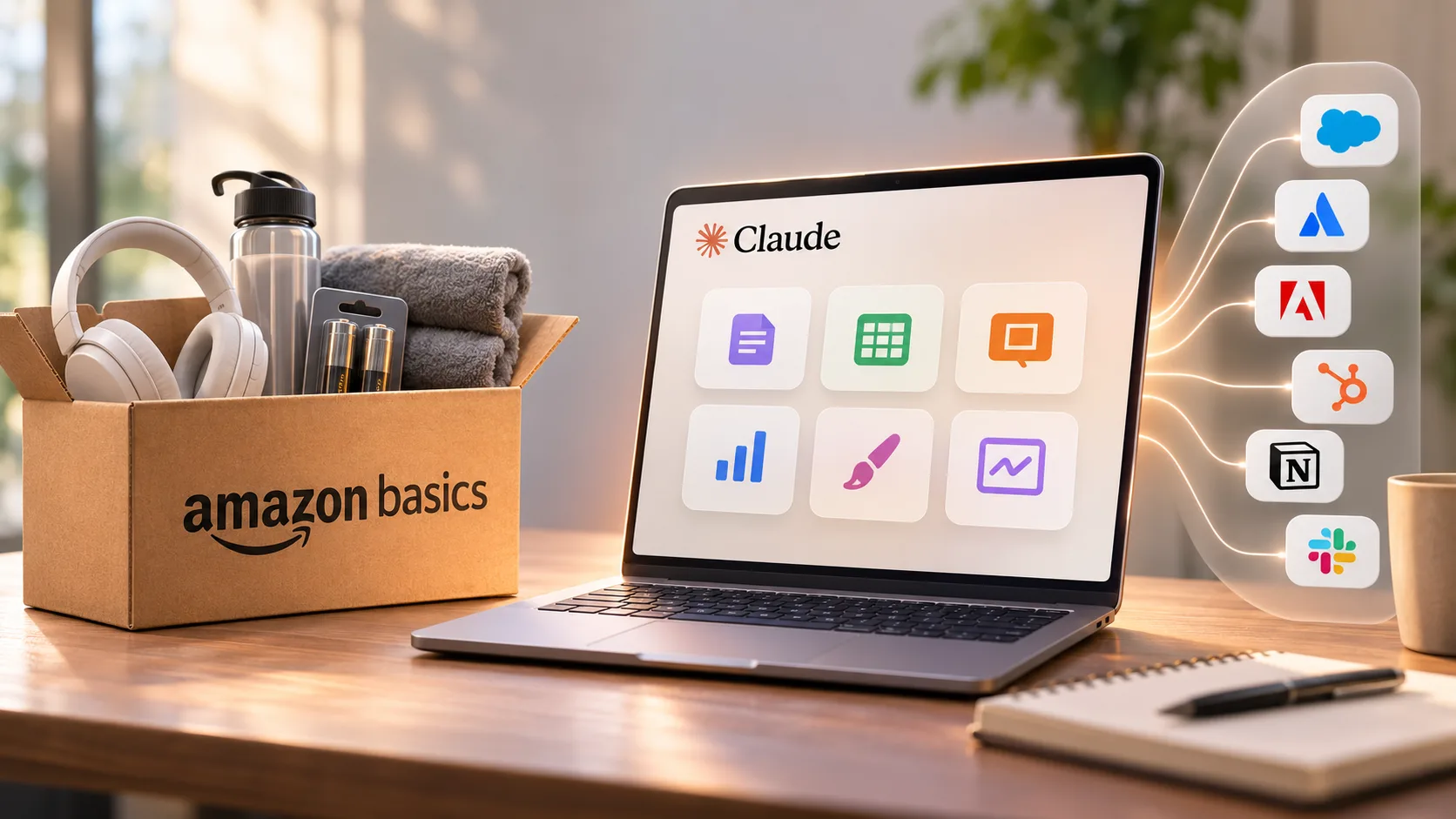
AI platforms are starting to compete with software by selling outcomes instead of tools. Claude’s Docs, Slides, Sheets and Data apps don’t need to match Excel or PowerPoint feature for feature, because people want the finished analysis or briefing, not the app. Connectors to Salesforce, Workday and others shift the customer relationship to Claude, and SaaS gets restructured behind an AI interface rather than disappearing.
Anthropic keeps shipping software, and the easy read is that it’s building cheaper SaaS. I think that misses what’s actually happening.
Amazon Basics worked by watching what sold, finding popular categories and undercutting the people who’d already proven the demand. Let someone else do the expensive work of building a market, then show up with a good-enough version at a lower price.
Anthropic looks like it’s doing the same thing with Claude, but there’s a twist that matters more than the analogy.
Amazon still had to make a battery to compete with the battery makers. Claude doesn’t have to build a better spreadsheet to compete with Microsoft. It just has to get the work done that people used to need a spreadsheet for.
That’s the difference between commoditizing a product and commoditizing the work itself.
The catalogue is getting real
Anthropic announced a pile of stuff in November: Sheets, Whiteboards, Data, and meetings on the way. These sit on top of what was already there. Docs. Slides. Design.
The obvious comparison is one-for-one with the incumbent in each category.
| Claude capability | Traditional software |
|---|---|
| Docs | Word, Google Docs |
| Slides | PowerPoint, Google Slides |
| Sheets | Excel, Google Sheets |
| Whiteboards | Miro, FigJam |
| Design | Canva, Figma |
| Data | Tableau, Looker, Power BI |
| Meetings | Otter, Fireflies, Granola |
And the counterargument writes itself: Claude Sheets can’t do everything Excel can. It handles simple spreadsheets and punts the hard stuff back to Excel.
That’s exactly why the Amazon Basics parallel holds. A product doesn’t need to match every feature to erode the value of the incumbent for most people. Good enough at a fraction of the effort wins a lot of the market.
Tools were never what people wanted
For decades, software sold capabilities. Excel analyzes numbers. PowerPoint communicates ideas. Tableau visualizes performance. Miro helps teams collaborate.
But nobody actually wanted any of those things. They wanted to understand their finances, win over an audience, make a decision, coordinate work.
The old path to those outcomes ran through buying software, learning its interface and doing the labour yourself.
That path is collapsing. You describe the result you want, and the platform picks the tools, does the work and hands back the deliverable.
A manager doesn’t build a dashboard. She asks why sales dropped. An executive doesn’t make slides. He asks Claude for a board briefing. The spreadsheet, the deck, the doc become implementation details.
That’s a far bigger threat than cheaper software. It changes what the customer is even paying for.
And it’s not trying to replace everything
The most telling part of the announcement was what Anthropic chose not to build.
Alongside the new apps, it expanded connectors that let existing software run inside Claude. Adobe, Atlassian, Box, HubSpot, Notion. Figma and Shopify are coming.
That’s a different strategy for the complex stuff. Anthropic isn’t building a Salesforce replacement, an ERP, a payroll system or a data warehouse. It’s building the interface through which people reach those systems.
The Salesforce integration lets Claude prep account briefings and review pipelines while Salesforce stays the system of record. Same idea with NetSuite and Workday for finance and HR.
So the market seems to be splitting three ways.
Everyday productivity work, Claude builds directly. Complex enterprise systems, Claude plugs into and helps you work inside. Specialized professional tools, Claude does the basics and leans on partners for the advanced stuff.
That’s a pattern, not a wall. Anthropic can push further into any of these whenever it wants.
The real prize is the relationship
And here’s where Amazon Basics stops being a useful comparison.
Amazon competed with its sellers while still running the marketplace. Claude could become the workplace itself, with all the SaaS you used to open running quietly behind it.
Picture an employee asking Claude to flag at-risk customers, draft a retention plan and update the pipeline. Claude pulls from Salesforce, crunches it in a warehouse, builds the deck, writes the changes back to the CRM.
Salesforce still does the essential work. But the employee’s relationship is with Claude now.
Which leaves an awkward question for every software vendor: if your customers stop opening your app but keep using your services through an AI platform, who owns the customer? And who keeps the pricing power?
So what happens to SaaS?
The first casualties are the tools whose main value is producing simple artifacts. Meeting notes, decks, reports, charts, basic design. That’s where Claude’s good-enough lands hardest.
The entrenched systems have real defences. Years of data, business rules, integrations, permissions, compliance. None of that reproduces with a chat interface.
But even those vendors will feel pressure as AI absorbs the routine work that used to justify their UIs and their per-seat pricing.
SaaS doesn’t disappear. It gets restructured. Software that just helps people do routine tasks becomes easy to substitute. Software that holds authoritative records, runs complex transactions or carries specialized expertise stays valuable, but increasingly works behind an AI interface.
Amazon Basics attacked the margins on individual products. Claude is attacking something more basic: the assumption that you have to buy, learn and run separate software products to get your work done.
That might be the biggest change in this business since SaaS showed up.
Frequently Asked Questions
How is Claude like Amazon Basics?
Amazon Basics watched what sold and undercut the sellers who had already proven the demand with a good-enough version at a lower price. Claude is doing something similar with Docs, Slides, Sheets, Whiteboards, Data and Design, which line up against Word, PowerPoint, Excel, Miro, Canva and Tableau.
Does Claude Sheets replace Excel?
No. It handles simple spreadsheets and hands the hard stuff back to Excel. That’s why the Amazon Basics comparison holds: a product doesn’t have to match every feature to erode the incumbent’s value for most people.
What does selling outcomes instead of software mean?
People never wanted a spreadsheet or a deck. They wanted to understand their finances, make a decision or brief a board. When you can describe the result and the platform picks the tools and does the work, the spreadsheet and the deck become implementation details, and that changes what the customer is paying for.
Which SaaS tools are most at risk from Claude?
Tools whose main value is producing simple artifacts like meeting notes, decks, reports, charts and basic design. Systems of record like Salesforce, NetSuite and Workday have real defences in their data, business rules, integrations and compliance, but they’ll increasingly sit behind an AI interface, and the customer relationship moves to Claude.
