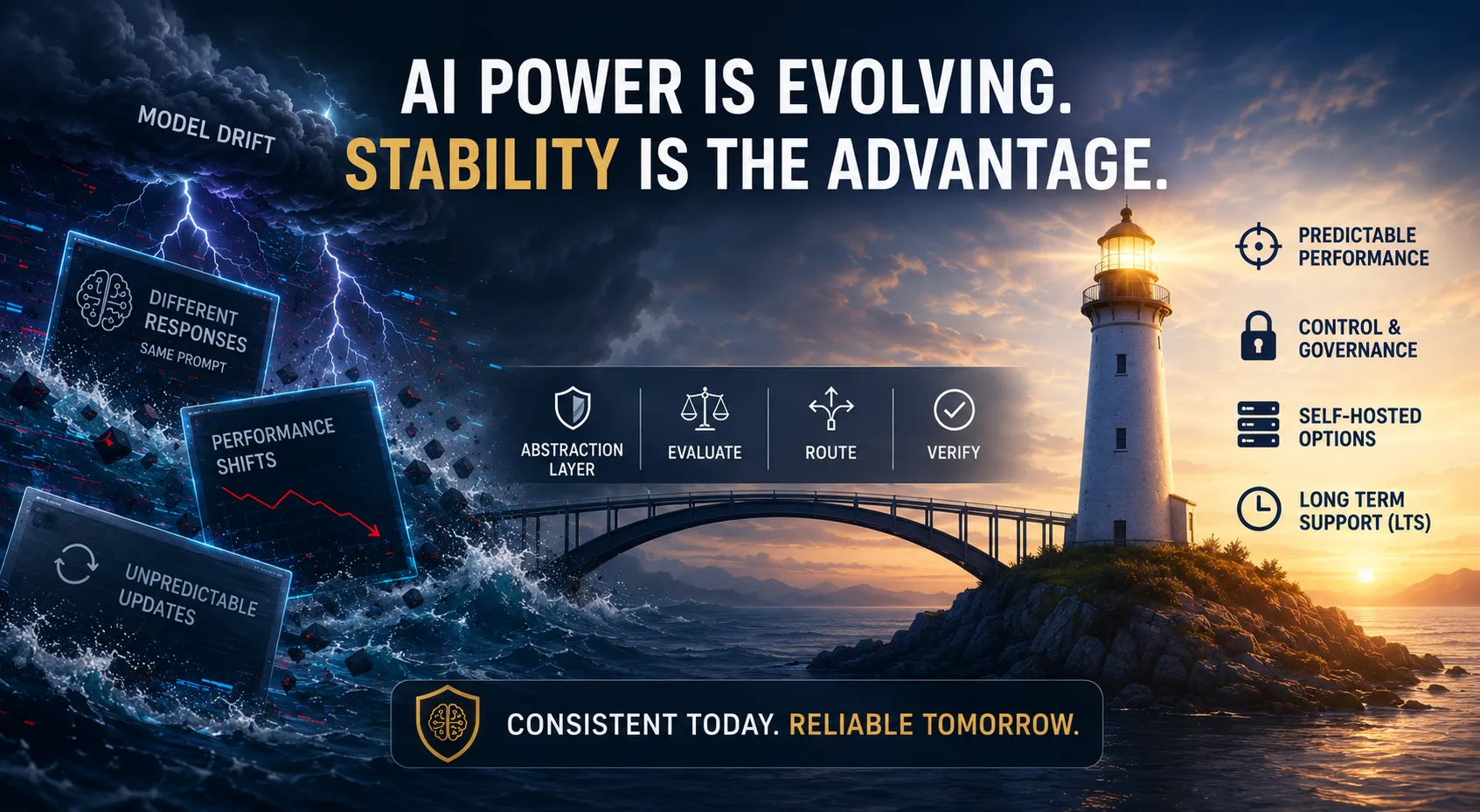
Frontier AI models drift. Even with the same prompts, same architecture, and same model name, behavior shifts week to week as labs tune reasoning, tool use, and inference routing underneath production systems. For enterprises building real workflows, predictable performance now matters more than peak intelligence. The industry needs Long-Term Support (LTS) AI models with fixed behavioral contracts, controlled upgrade paths, and guaranteed support windows. The first frontier lab that ships one will win a lot of enterprise business that currently has nowhere comfortable to land.
Earlier this year, AMD’s AI leadership team published a widely discussed analysis of thousands of coding agent sessions. Their conclusion matched something many developers had already started feeling in their gut: the AI seemed to be changing underneath them.
The analysis claimed models were reading less code, exploring repositories less thoroughly, making assumptions earlier, and showing reduced reasoning depth over time.
Whether every conclusion held up almost stopped mattering. The bigger story was that a growing number of developers and businesses were independently reporting the same experience.
The AI didn’t get dumber. It got different.
For companies building products and workflows on top of AI systems, this exposed a hard operational truth: AI model performance is no longer stable enough to assume consistency over time.
A model that performs brilliantly this week may behave noticeably differently next week, even when the prompts are unchanged, the architecture is unchanged, the workflows are unchanged, and even the API model name is unchanged.
The problem shows up most clearly in coding agents, reasoning-heavy systems, and long-context workflows. Tools like Claude Code, ChatGPT, Gemini, and others are evolving continuously underneath the surface through model tuning, system prompt changes, reasoning budget adjustments, tool-use policies, inference routing, safety layers, context summarization, and infrastructure optimization.
The result is a new operational problem: AI drift.
And businesses are starting to figure out something important. They don’t actually want the best model. They want the most predictable model.
My Experience with Model Drift
This problem became impossible to ignore while working on ModelTrust.app.
One of the original goals of ModelTrust was deceptively simple: run the same prompts across multiple models and compare outputs.
What emerged was something more interesting. Even the same model could produce materially different answers over time.
Not just random variation in wording. Different reasoning paths. Different confidence levels. Different hallucination rates. Different code quality. Different levels of architectural understanding.
In some cases, prompts that worked reliably for weeks would suddenly start failing after an upstream model update.
The challenge got worse in structured workflows: JSON outputs, validation pipelines, extraction tasks, scoring systems, and coding operations. A small change in model behavior could cascade into broken automation, invalid structured outputs, inconsistent evaluations, and degraded user experiences.
This is fundamentally different from traditional software dependencies.
When we upgraded a database driver or framework version in the past, we expected change management. With AI APIs, the dependency itself changes underneath production systems while you sleep.
AI Models Are Becoming “Living Infrastructure”
Many businesses initially treated AI APIs the same way they treated cloud infrastructure: stable services with versioned improvements over time.
But frontier AI systems behave more like continuously deployed operating systems, probabilistic collaborators, or living infrastructure. The underlying behavior changes constantly.
Even dated model identifiers do not guarantee full consistency, because orchestration layers change, tool-calling policies evolve, inference optimizations shift, and context management systems adapt dynamically.
This is especially noticeable in agentic systems. A small reduction in reasoning depth, context retention, or file exploration can dramatically impact coding agents, research agents, planning systems, and enterprise automation workflows.
Why Reliability Matters More Than Peak Intelligence
There is a growing realization across enterprise AI teams:
The highest benchmark score is not always the best production model.
For many businesses, predictable performance matters more than occasional brilliance. I’d go further: chasing benchmark leaders into production is one of the most common mistakes I see enterprise teams make right now.
Variant-sensitive businesses increasingly prioritize determinism, reproducibility, operational stability, governance, observability, and regression control.
This is especially true for legal workflows, financial systems, healthcare, regulated industries, enterprise automation, and software engineering pipelines.
An AI model that produces a brilliant answer 90% of the time but behaves unpredictably the other 10% may be less valuable than a slightly weaker model that behaves consistently.
That is a big part of why abstraction layers are becoming strategically important.
Building an Abstraction Layer for AI Systems
In projects like Zeever.ca and ModelTrust, I increasingly found myself building abstraction systems instead of model-specific systems.
The architecture shifted toward interchangeable model providers, common orchestration pipelines, structured prompt frameworks, output validation layers, and evaluation tooling.
The question stopped being:
“Which model is best?”
And became:
“Which model is good enough and operationally reliable?”
This matters for LLM-heavy products where uptime matters, workflows matter, integration stability matters, and cost predictability matters.
The pattern showing up across serious AI systems is consistent. Use multiple providers. Continuously benchmark them. Fallback automatically. Isolate business logic from model-specific behavior.
In other words, AI models are increasingly being treated like interchangeable compute infrastructure. That framing feels right to me, and I think the teams that internalize it early are going to have a real advantage.
The Growing Interest in Self-Hosted Models
This instability is also driving renewed interest in self-hosted AI, open-weight models, sovereign AI infrastructure, and frozen inference stacks.
With self-hosted systems, organizations gain significantly more control over determinism and operational consistency. That includes the ability to host weights directly, pin quantization versions, freeze inference stack configurations, control orchestration, manage context windows, version prompts internally, and test using standardized control prompts.
It creates a much more stable operating environment. Instead of waking up to silent upstream behavioral changes, organizations can benchmark intentionally, upgrade deliberately, and maintain reproducibility over time.
The tradeoff is that open models often lag frontier proprietary systems in reasoning quality, coding performance, multimodal capability, and ecosystem maturity.
For many businesses, that tradeoff is starting to look worth it.
The Missing Layer: LTS AI Models
What the industry needs is the equivalent of Ubuntu LTS, Java LTS, Node.js LTS, or enterprise Linux distributions.
Long-term support AI models.
Models with fixed behavioral contracts, versioned reasoning behavior, stable orchestration layers, guaranteed support windows, and controlled upgrade paths.
Not every business wants the latest experimental reasoning optimization pushed into production overnight. Many want consistency, auditability, reproducibility, and operational trust.
AI infrastructure is evolving faster than enterprise governance frameworks can adapt. That gap is becoming one of the most important operational challenges in modern software development, and the first frontier lab to ship a credible LTS tier is going to win a lot of enterprise business that currently has nowhere comfortable to land.
The Future of AI Operations
We are entering a world where AI systems require regression testing, observability, telemetry, evaluation pipelines, model routing, and reliability engineering.
The organizations that succeed with AI long term will not be the ones with access to the most powerful models. They will be the ones that build the best systems around managing uncertainty.
The future of enterprise AI may not belong to the smartest model. It will belong to the most stable one.
Frequently Asked Questions
What is AI drift?
AI drift is the gradual, often silent change in a model’s behavior over time, even when the model name, prompt, and architecture stay constant. It can show up as different reasoning paths, varying hallucination rates, changes in code quality, or reduced context retention. Drift is driven by upstream tuning, system prompt changes, reasoning budget adjustments, tool-use policy updates, and inference routing changes.
What is an LTS AI model?
A Long-Term Support (LTS) AI model would be a frozen model release with fixed behavioral contracts, a guaranteed support window, and controlled upgrade paths, similar to Ubuntu LTS or Java LTS. Enterprises could rely on it for predictable performance across regulated workflows without worrying about silent upstream changes. No frontier lab ships a true LTS tier today.
How can businesses protect against model drift today?
Build an abstraction layer between business logic and model providers, run continuous regression tests with control prompts, use multiple providers with automatic fallback, and version your prompts and evaluation suites the same way you version application code. Treat models as interchangeable compute, not as fixed dependencies.
Are self-hosted open-weight models a solution?
For organizations that prioritize determinism and reproducibility, yes. Self-hosting allows pinning weights, freezing inference stacks, and controlling orchestration. The tradeoff is reasoning quality, multimodal capability, and ecosystem maturity, where open models still lag frontier proprietary systems. For regulated industries, the stability often outweighs the capability gap.
Why does a dated model identifier not guarantee consistency?
The model weights may be pinned, but the surrounding system is not. Orchestration layers, tool-calling policies, safety filters, context summarization, reasoning budget allocation, and inference routing all evolve continuously. The dated identifier locks one component while many others keep changing underneath production systems.
Which industries are most exposed to AI drift?
Legal workflows, financial systems, healthcare, regulated industries, enterprise automation, and software engineering pipelines are most exposed because they depend on deterministic outputs, auditability, and reproducible reasoning. Variability that is acceptable in a consumer chatbot is unacceptable in a contract review pipeline or a clinical decision support tool.