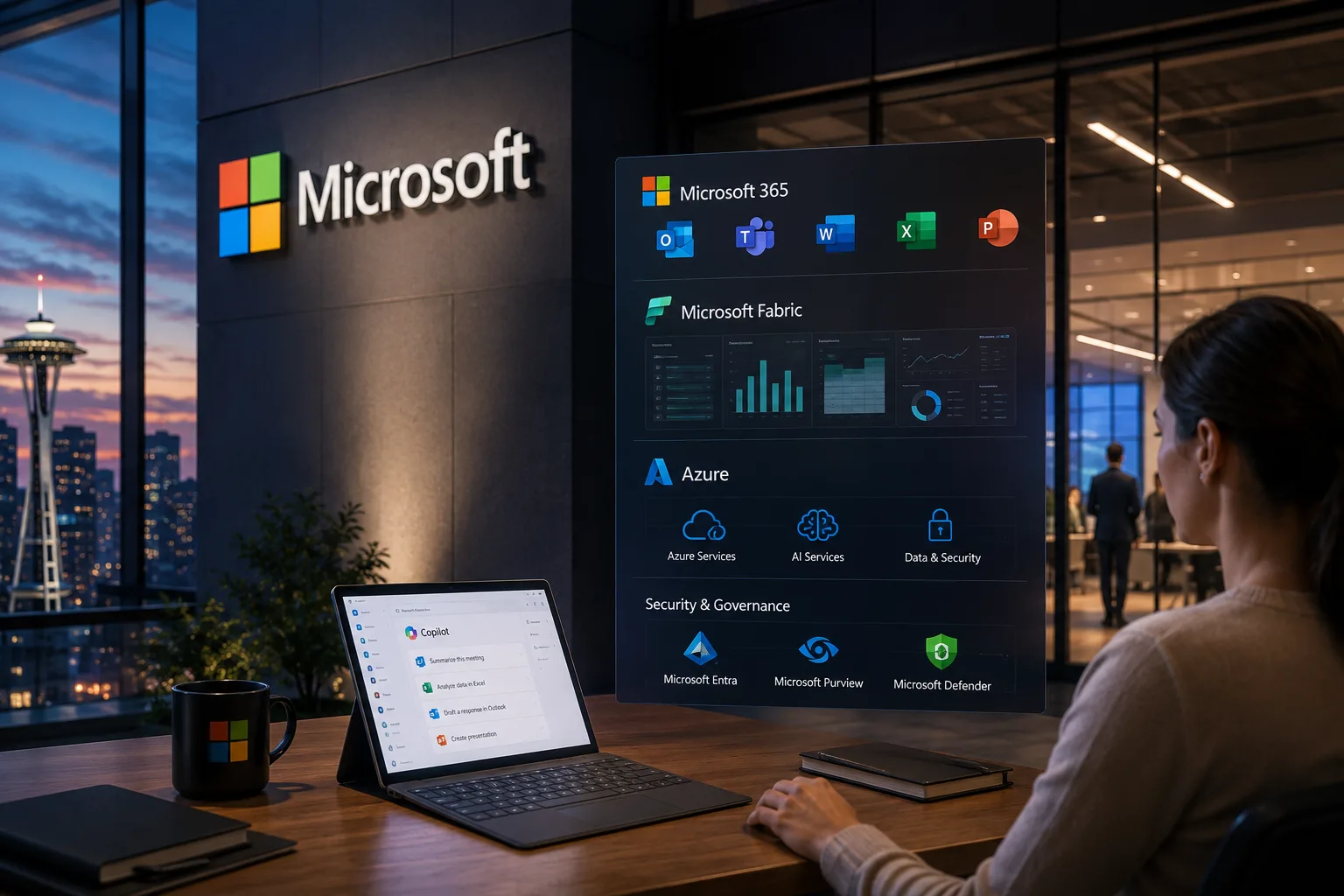
Microsoft’s Frontier announcements reveal a strategy much bigger than Copilot. Microsoft IQ stitches together Work IQ, Fabric IQ, and Foundry IQ into a permission-aware enterprise memory layer; Copilot Cowork turns Copilot from assistant into multi-step operator across Office; and Agent 365 wires governance into Entra, Purview, and Defender. The real bet is owning the full enterprise AI stack. Identity, data, workflows, agents. Because in enterprise AI, organizational context matters more than having the best model.
For the last year, many people’s experience with Microsoft Copilot has been something like:
“Wow, this isn’t very good, but it has terrifyingly good access to all our enterprise data.”
That awkward tension may actually explain Microsoft’s entire AI strategy.
Copilot itself has often felt inconsistent. Underneath it, Microsoft has been building something much larger: an enterprise AI operating system.
This week’s details around Microsoft’s Frontier program made that direction much clearer.
Microsoft Is Building Enterprise Memory
The most important announcement may not be Copilot at all.
It’s Microsoft IQ.
Microsoft IQ appears to be an attempt to solve one of the hardest problems in enterprise AI: organizational context.
Most companies today have:
- documents spread across SharePoint
- conversations trapped in Teams
- analytics buried in BI tools
- workflows fragmented across dozens of apps
- tribal knowledge living in employee heads
AI systems are only as good as the context they can access.
Microsoft’s answer is a three-layer enterprise context architecture.
Work IQ
Understands how work actually happens inside Microsoft 365.
Meetings, emails, chats, documents, workflows, collaboration patterns.
Fabric IQ
Adds business meaning from Microsoft Fabric and OneLake.
This is where raw information becomes business context:
- metrics
- reporting
- operational signals
- analytics
- structured enterprise data
Foundry IQ
Provides governed access to enterprise knowledge across Azure, SharePoint, and even the web.
This is Microsoft trying to create a secure, permission-aware enterprise knowledge layer for AI agents.
Individually, these are useful. Combined, they become extremely powerful.
AI agents are no longer just chatbots with search. They become systems that can potentially understand:
- how your organization operates
- what your data means
- what employees are allowed to access
- how workflows connect together
That’s a very different category of AI system.
Copilot Is Evolving Into Agents
The second major signal was Copilot Cowork.
Microsoft describes this as a native agentic experience running across Outlook, Teams, Excel, and Word with:
- multi-step reasoning
- visible thought processes
- cross-application workflows
- the ability to revise tasks mid-process
Copilot is evolving from an assistant into an operator. (For how the broader enterprise AI subscription landscape now stacks up, see The Best AI Subscription for Business in 2026.)
The reference to Anthropic’s Claude Cowork technology is also notable. It suggests Microsoft understands that the future of enterprise AI is not simply:
“Ask AI a question.”
It’s:
“Give AI a task and let it coordinate work across systems.”
That shift is enormous.
We are moving from AI-generated text to AI-managed workflows.
Agent 365 May Actually Be The Most Important Piece
The least flashy announcement may matter the most.
Agent 365 is effectively a control plane for AI agents.
This is where enterprise reality enters the conversation. The biggest blockers to AI adoption inside organizations are increasingly not model quality, prompts, or UI.
They are:
- governance
- compliance
- security
- identity management
- permissions
- auditability
- data leakage
- uncontrolled shadow AI
Microsoft integrating AI governance directly into Entra, Purview, and Defender is a massive strategic move.
It means Microsoft sees AI agents becoming permanent infrastructure inside enterprises. Not experiments. Infrastructure.
The Big Enterprise Problem Nobody Wants To Talk About
Most organizations are nowhere near ready for any of this.
Most enterprises still struggle with:
- fragmented data
- broken permissions
- outdated governance
- duplicate systems
- poor metadata
- inconsistent retention policies
- unclear ownership of information
- years of SharePoint chaos
Enterprise AI exposes organizational dysfunction incredibly quickly.
If your systems are messy, your AI becomes messy. If your permissions are broken, your AI becomes dangerous. If your data lacks meaning, your AI becomes unreliable.
AI readiness has far less to do with model selection and far more to do with operational maturity.
Microsoft’s Real Goal
The deeper pattern is that Microsoft is trying to own the full enterprise AI stack:
- identity
- governance
- data
- workflows
- orchestration
- productivity tools
- agent infrastructure
- enterprise memory
This is much bigger than adding AI features to Office. Microsoft appears to be building an AI-native enterprise operating environment.
Unlike many AI startups, Microsoft already has the one thing that matters most: access to enterprise workflows and enterprise data.
That may matter more than having the best model.
In enterprise AI, context is everything, and Microsoft may already own more organizational context than anyone else on earth.
Frequently Asked Questions
What is Microsoft IQ?
Microsoft IQ is Microsoft’s enterprise context layer for AI, built in three parts: Work IQ (how work happens across Microsoft 365), Fabric IQ (business meaning derived from Microsoft Fabric and OneLake data), and Foundry IQ (governed access to enterprise knowledge across Azure, SharePoint, and the web). Together they function as permission-aware organizational memory that AI agents can reason over.
What is Copilot Cowork?
Copilot Cowork is Microsoft’s agentic Copilot experience running natively across Outlook, Teams, Excel, and Word. It performs multi-step reasoning, exposes its thought process, coordinates work across applications, and can revise tasks mid-process. It is positioned as the shift from Copilot-as-assistant to Copilot-as-operator.
What is Agent 365?
Agent 365 is Microsoft’s control plane for AI agents inside the enterprise. It integrates AI governance directly with Entra (identity), Purview (data governance and compliance), and Defender (security), making agents a managed, audited part of enterprise infrastructure rather than ungoverned experiments.
How does Microsoft’s Frontier program differ from regular Copilot?
Frontier is the broader strategic program behind the next generation of Microsoft AI. Enterprise memory (Microsoft IQ), agentic workflows (Copilot Cowork), and agent governance (Agent 365). Copilot is one user-facing surface on top of that stack; Frontier is the infrastructure underneath.
Why is enterprise AI mostly about operational maturity, not model selection?
Frontier models have largely converged on raw capability, so the differentiator is whether an organization can feed AI clean data with correct permissions, coherent governance, and well-defined workflows. Messy systems produce messy AI output; broken permissions make AI dangerous; missing metadata makes AI unreliable. The work is organizational, not technical.
What advantage does Microsoft have over AI-native startups in the enterprise?
Microsoft already sits inside enterprise identity (Entra), productivity tools (Microsoft 365), data infrastructure (Fabric, OneLake), governance (Purview), security (Defender), and cloud (Azure). That gives Microsoft direct access to organizational context. Workflows, documents, permissions, communications. That AI-native startups have to integrate into one customer at a time. In enterprise AI, that context is the moat.