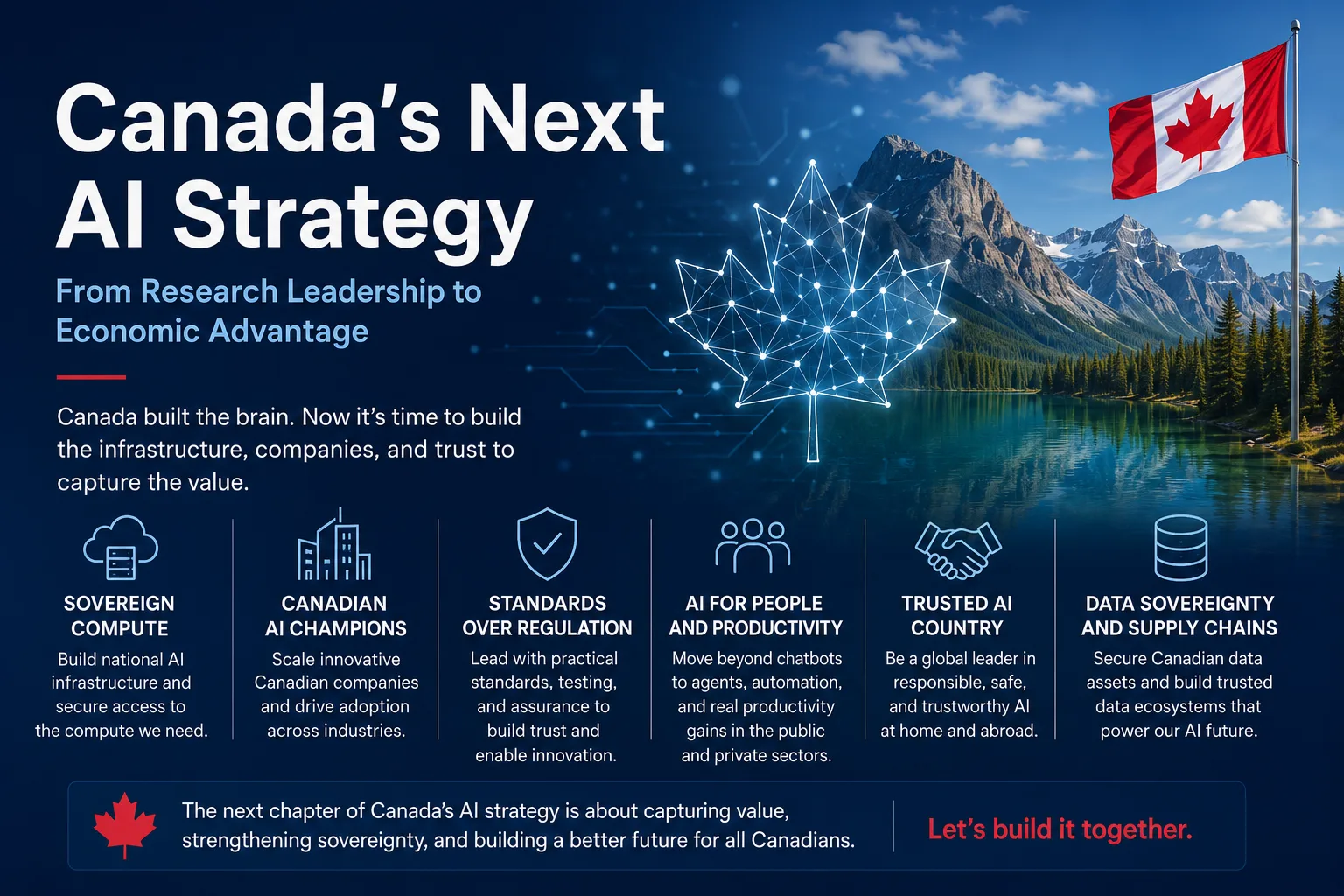
Scoring my five-prediction post on Canada’s next AI strategy a few days later: sovereign compute (9/10) and standards over regulation (9/10) look strongest, Canadian AI champions and Trusted AI positioning both hold up, and the agents-and-MCP call was right in direction but too specific in language. The sixth pillar I missed is data sovereignty and data supply chains, the argument that compute without trusted data assets won’t deliver Canadian economic value. The real shift between the 2017 strategy and what comes next: from “how do we build world-class AI research?” to “how do we capture the value while keeping Canadian control of compute, talent, data, and trust?”
Looking at the current Pan-Canadian AI Strategy and the signals coming out of 2026, here’s how I’d describe where things stand. (For the original predictions this post is scoring, see Prediction: Canada’s Next AI Strategy Will Be About Compute, Sovereignty, and Trust.)
The 2017 Strategy: Build the Brain
The first strategy was a research and talent play, full stop. The goals were to keep world-class AI researchers in Canada, build research clusters around Toronto, Montreal, and Edmonton, train graduate students, stand up the Canada CIFAR AI Chairs program, and back Mila, the Vector Institute, and Amii.
On its own terms, it worked. Canada became one of the densest sources of AI talent in the world, pulled in corporate AI labs, and built a research reputation people actually recognize.
The catch is that we got very good at inventing AI while most of the economic value got captured somewhere else. (I dug into this gap in Industrializing AI: Canada’s Next Challenge After Research Leadership.)
The Current Strategy (2022 to 2026): Expand the Reach
The second phase bolted on three pillars: commercialization, standards, and continued talent and research.
The money started flowing past researchers and into industry adoption, standards work, compute infrastructure, and the institutes. That’s already a move away from pure research.
But the center of gravity hasn’t really shifted. The current strategy still leans hard on academic talent, research excellence, and building out the field, the recent $24M for more Canada CIFAR AI Chairs is more of the same.
Scoring My Own Predictions
My article called five shifts. Here’s how they’re holding up.
Sovereign compute. This is the one I got most right. Government investment in compute is already climbing, and you can’t sit in a serious Canadian AI conversation now without GPUs, data centres, energy supply, and national infrastructure coming up within ten minutes. Compute is being treated like strategic infrastructure, not lab equipment. I’m confident this ends up as a core pillar. (Background reading: Canada’s AI Compute Landscape. What I Found When I Tried to Build on It.)
Canadian AI champions. Mostly right. The 2017 strategy optimized for researchers, and the obvious next question is “so where are the Canadian companies?” Policy talk has moved toward commercialization, adoption, productivity, and growth. The direction is correct, but I doubt government will openly pick winners. Expect procurement preferences, commercialization funding, scale-up programs, and cluster money instead of anyone naming a national champion out loud.
Standards over regulation. Right, and underrated. The current strategy already carries a standards pillar through the Standards Council of Canada. The governance conversation keeps circling risk management, assurance, transparency, and testing rather than some sweeping new regulatory regime. That tracks with how enterprises actually govern AI day to day.
Agents and MCP infrastructure. Half right, and this is where I’d walk myself back a bit. Canada will move past chatbot talk, yes, but governments don’t write strategies around specific technical architectures. Nobody in Ottawa is going to say “we need MCP.” The language will be productivity, autonomous systems, AI-enabled services, public sector transformation, digital infrastructure. All of that enables agents without ever naming the plumbing. Right direction, wrong level of specificity.
Trusted AI country. Right, and probably our best shot. Canada already has the pieces: early work on AI ethics, CIFAR, responsible AI research, the new Canadian AI Safety Institute, a reasonably high level of public trust, and an international reputation for governance. Recent safety investments suggest trust is becoming a real differentiator. We won’t beat the U.S. on capital or China on scale. Trust might be the one lane where we can actually lead.
The Prediction I Missed
There’s a sixth shift I left out: data sovereignty and data supply chains.
A chunk of Canadian policy thinking is now arguing that compute alone doesn’t get you there, the next round of competitiveness depends on access to trusted data, public datasets, data-sharing frameworks, privacy-preserving exchanges, and Canadian-owned data assets. More commentators are calling data supply chains the missing pillar.
If I were rewriting the article today, I’d add it as prediction six: the next strategy will fold in a national data strategy welded tightly to AI.
Scorecard
- Sovereign compute: 9/10
- Canadian AI champions: 8/10
- Standards over regulation: 9/10
- Agents / MCP infrastructure: 6/10
- Trusted AI positioning: 8/10
- Data sovereignty (the missing pillar): 8/10
The real gap between 2017 and whatever comes next is one question.
2017 asked: how do we build world-class AI research?
The next strategy is asking: how do we capture the economic value while keeping Canadian control over the infrastructure, talent, data, and trust that make it possible?
Frequently Asked Questions
What was the 2017 Pan-Canadian AI Strategy?
The 2017 Pan-Canadian AI Strategy was a research-and-talent play led by CIFAR. It funded the Canada CIFAR AI Chairs program, backed Mila, the Vector Institute, and Amii, and built research clusters in Toronto, Montreal, and Edmonton. On its stated goals it worked. Canada became one of the densest AI talent pools in the world and pulled in corporate AI labs.
What is the current Pan-Canadian AI Strategy focused on (2022 to 2026)?
The second phase added commercialization, standards, and continued talent and research as pillars, with money flowing into industry adoption, standards work, compute infrastructure, and the institutes. The center of gravity is still academic, though, the recent $24M top-up for more Canada CIFAR AI Chairs is consistent with that.
Which predictions about Canada’s next AI strategy held up best?
Sovereign compute (9/10) and standards over regulation (9/10) scored highest. Compute is being treated as strategic national infrastructure in policy conversations, and the Standards Council of Canada angle is doing more of the governance work than any new sweeping AI law. Canadian AI champions (8/10), Trusted AI positioning (8/10), and the agents/MCP call (6/10) all held up directionally, with agents needing reframed language for government audiences.
Why was the agents and MCP prediction only “half right”?
The direction is correct. Canada will move past chatbot framing toward systems that take action, but governments don’t write national strategies around specific technical architectures like MCP. The official language will be productivity, autonomous systems, AI-enabled public services, and digital infrastructure. The plumbing is right; the vocabulary in the prediction was too engineer-specific for the policy audience.
What is the sixth pillar. Data sovereignty and data supply chains?
Compute alone doesn’t produce Canadian economic value if the trusted data, public datasets, data-sharing frameworks, privacy-preserving exchanges, and Canadian-owned data assets aren’t there to feed it. A growing share of Canadian policy thinking is treating data supply chains as the missing pillar, and the next strategy will likely weld a national data strategy directly into the AI strategy.
What is the single biggest shift between the 2017 strategy and what comes next?
The question changed. 2017 asked how Canada could build world-class AI research, the next strategy is asking how Canada captures the economic value while keeping domestic control over the infrastructure, talent, data, and trust that produce it. That moves the strategy from research policy to industrial policy.