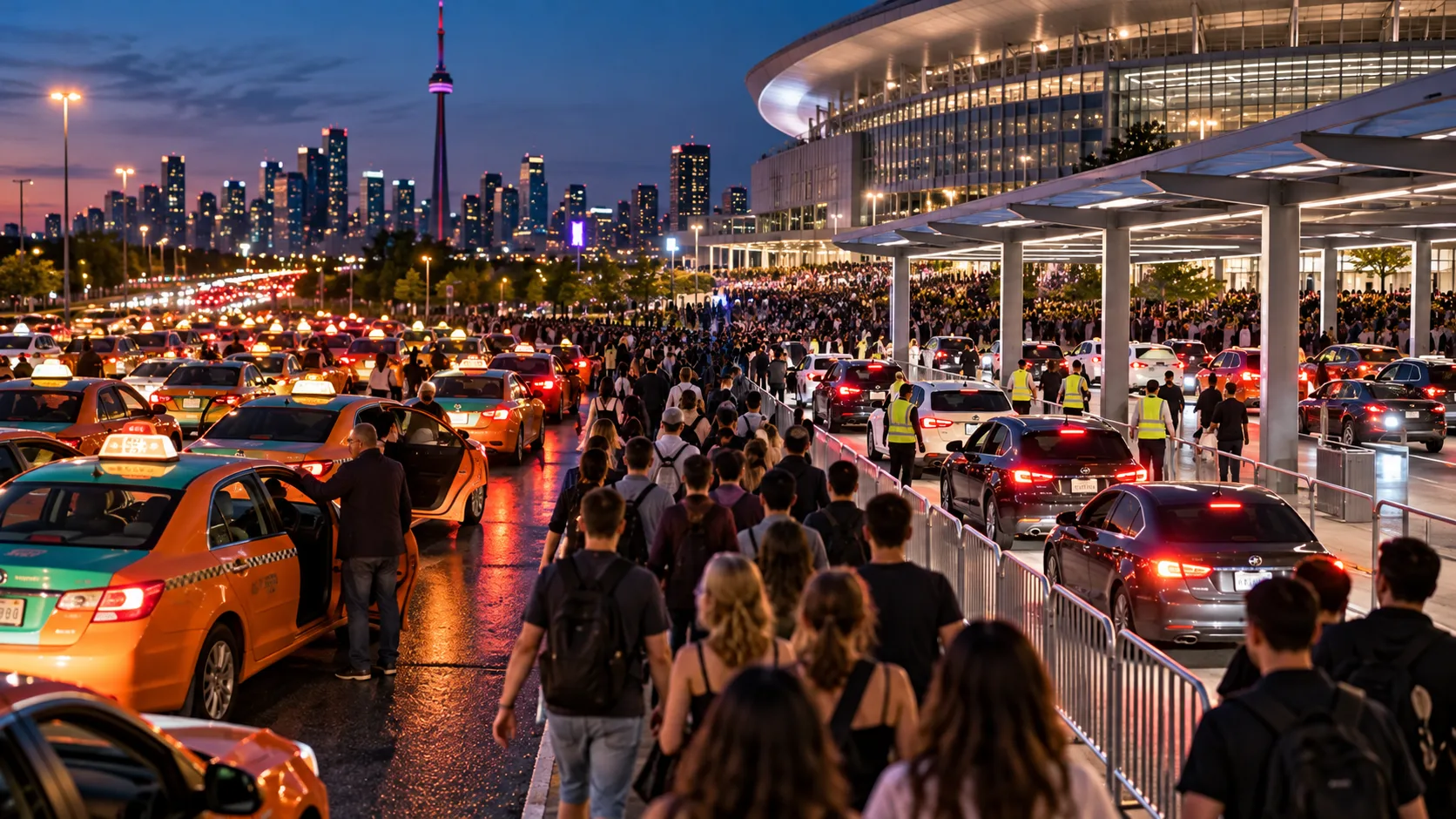
Getting home after a Toronto concert is a dispatch problem, not a parking problem. One rider matched to one specific car works on an ordinary street and falls apart when several thousand people are on the same block, so drivers circle, riders wander, and trips get cancelled while every stuck car takes up road space. Rogers Stadium answered it with more pavement and opened in 2025 to complaints about hours-long waits, cancelled rides and a pickup area people could not reach. Airports solved this decades ago with a queue: take the next available car and give the driver a code. Uber and Lyft both sell that capability to venues as a consulting product. Matching riders to cars is the one part of this that is entirely the platforms’ job, and Toronto already regulates vehicle-for-hire, so it could require coordinated pickup above an attendance threshold instead of leaving venues to negotiate for it.
Getting a ride home after a big concert in Toronto is a mess, and I think most of it is a dispatch problem that Uber and Lyft already know how to solve.
I’ve been in it. Walking past dozens of taxis parked in the road, a lot of them apparently off duty or not taking passengers, while traffic stacked up behind them.
Rideshare works fine on a normal street. One passenger, one driver, and the app tells each of them where the other is. Put several thousand people on the same block at once and that model falls apart. Drivers circle and riders wander, and plenty of trips get cancelled before anyone finds anyone. Every car stuck in that loop is taking up road space while it tries to finish a match the software already made.
Rogers Stadium at Downsview was supposed to deal with this by setting aside huge areas for vehicle pickup. More pavement doesn’t change the basic problem. You are still looking for one specific car among hundreds, and the driver is still looking for you among thousands. After the stadium opened in 2025, concertgoers complained about long trips home, cancelled rides and trouble just getting to the pickup area. A bigger lot without better dispatch is a bigger airport terminal with no gate assignments.
Take the next car
Airports figured this out decades ago, and so did every taxi stand. When demand is all in one place, a line works better than everyone hunting for their own assigned vehicle.
The rideshare version is simple. You request a ride and get a pickup code instead of a licence plate. You join the line, take whichever eligible car is at the front, and give the driver your code, which ties your trip to that car. No walking the rows of a parking lot, and the driver isn’t circling the block looking for a waving arm.
Uber built exactly this in 2016, and built it for event venues rather than airports. PIN matching has run at more than 60 events worldwide since then. Its successor, ExpressMatch, has cut rider wait times by 40 to 65 percent at the airports using it.
So the capability already exists, it was designed for stadiums rather than borrowed from somewhere else, and it is a decade old with measured results behind it.
I haven’t been able to confirm it’s been used at a Toronto stadium.
What the platforms already sell
Both companies have event programs. Uber Mobility Solutions offers venues geofenced pickup zones and specialized dispatch tools, along with traffic planning and people on site. Uber describes it as a commercial arrangement, with one-time payments or annual contracts. Lyft’s Venues and Events program covers pickup coordination and custom instructions for drivers, and Lyft says the consulting is free, though that doesn’t tell you whether the better dispatch tools come with it. Neither one publicly promises next-car matching for Toronto events.
So why is a working pickup at a stadium something a venue has to go and negotiate? Uber and Lyft make money on every one of those trips. They own the matching algorithm and they decide what drivers and riders get told. Meanwhile the venue supplies the space, and the city and police are left dealing with the blocked roads. Riders and drivers absorb the wait. I’m not saying the platforms should build roads or staff every venue. But matching riders to cars is the one part of this that is entirely their job.
Where the city comes in
Bad pickups do real damage. They block traffic and hold up transit. People end up walking where they shouldn’t, and the surrounding neighbourhoods turn into parking lots for the night.
Toronto and Ontario already regulate vehicle-for-hire. Above some attendance threshold, they could require the platforms and the big event organizers to run a coordinated pickup system. Government doesn’t need to pick Uber’s PIN system or any other particular technology. It can set targets for things like wait times and cancellations, and for keeping passengers safe, and leave the companies to work out how to meet them.
Right now a rideshare pickup after a concert can be less organized than a taxi stand was 50 years ago, and it’s run by companies whose whole business is matching people to cars. They have the tools. I think the city should stop treating those tools as an upgrade venues have to buy and make them part of the licence to operate here.
Frequently Asked Questions
How does the queue actually work in the app?
You request a ride as normal and get a six-digit code rather than a plate number and a driver photo. You walk to one dedicated zone and join the line. Drivers receive a pickup opportunity for the venue and queue on their side, with the option to snooze for a few minutes if they are busy. The car at the front takes the rider at the front, the rider reads out the code, and that is what binds the trip to that vehicle. Nobody is searching for anybody.
What do Uber and Lyft charge venues for this?
Uber treats it as consulting. Its own FAQ describes ongoing consulting agreements and annual fixed service contracts for clients with long-term or multi-project needs, alongside one-time engagements. Lyft currently says its venue and event consulting services are offered free of charge until further notice, which is a notably different posture, though it does not tell you which dispatch tools are included.
Isn’t this just a Rogers Stadium problem?
Downsview makes it worse because of where it is and how the road closures work, but the underlying failure is not about that site. Any venue emptying tens of thousands of people at once hits the same wall, because one-to-one matching assumes the rider and driver can find each other. Fix the dispatch and a difficult site becomes manageable. Leave it alone and a good site still fails.
Why should the city get involved at all?
Because the costs land on people who are not party to the deal. The venue negotiates, the platforms collect the fares, and the blocked roads, delayed buses and overrun side streets are absorbed by the neighbourhood and the police. That is the textbook case for regulation, and Toronto and Ontario already license vehicle-for-hire, so the authority exists.
What would a rule actually say?
It would set outcomes rather than naming a product. Above an attendance threshold, require a coordinated pickup plan and hold the platforms to measurable targets: median wait from request to pickup, cancellation rate inside the zone, and passenger safety at the pickup point. Let Uber and Lyft decide whether they meet that with PIN codes, ExpressMatch or something they have not built yet. Mandating a specific technology ages badly. Mandating a result does not.