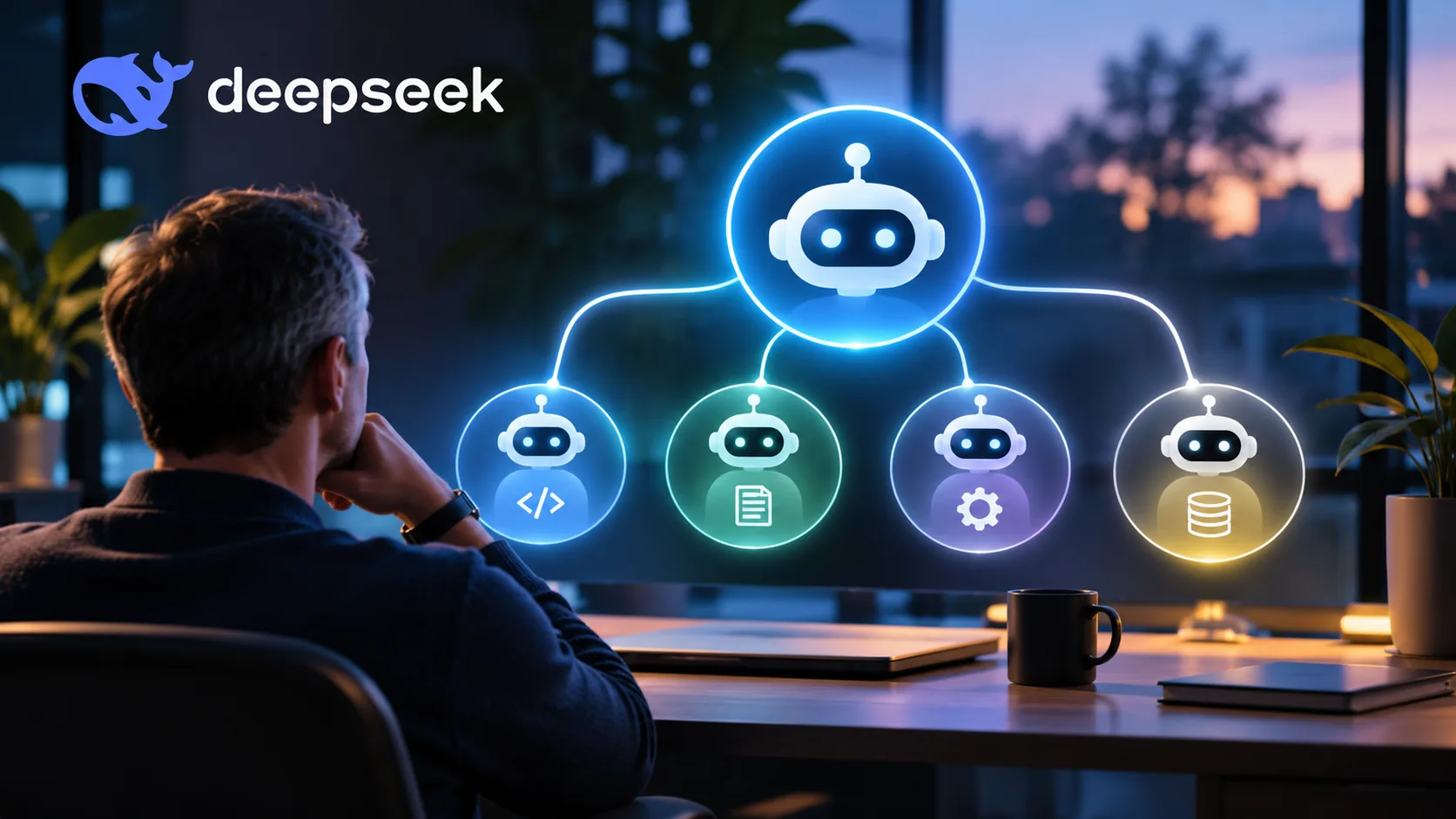
Human attention, not model intelligence or computing power, may be the real limit on AI agent productivity. One developer can comfortably supervise a couple of agents, but every extra agent adds questions, approvals and progress reports. DeepSeek’s Super-agent design uses a Router, Workers and a Watchdog to cut that coordination, and points to a better measure: useful work completed per hour of human attention.
I’ve been using DeepSeek for some personal projects for a while, so I read their recent paper on agent systems with real interest. It’s called Exploring Super-agent Design: Towards a More Autonomous Agent System, and it raises a question I haven’t heard asked as directly anywhere else.
What if the thing holding back AI productivity isn’t model intelligence or computing power? What if it’s human attention?
A developer can comfortably supervise one or two coding agents. Add five more, each one generating questions, requesting approvals and reporting progress, and the productivity gains start leaking away into coordination. We have made execution dramatically cheaper. Human attention hasn’t gotten any more abundant.
DeepSeek’s answer is a two-layer setup built around a Router and a set of Workers. The Router keeps the big picture, talks to the humans, hands out tasks and coordinates. It can run on a lightweight model because it isn’t doing the hard work itself. The Workers do the execution, on more capable models, with access to the tools.
That part is a familiar org chart. The interesting bit is how they cut out coordination once a task is owned. After a Worker takes a task, later messages can go straight to it instead of bouncing through the Router every time. When they disabled that direct path in their experiments, routing decisions went up around 30% and cache-read token use up roughly 37%.
Anyone who has managed a team already knows this. Copying the manager on every message doesn’t improve much. It just creates overhead. Delegate, leave ownership alone, escalate only when you have to.
Then there is the part I keep coming back to. Most assistants today are reactive. They wait for instructions, do the task, report back. DeepSeek is exploring something more autonomous: an agent that watches events, spots useful work, and acts without needing constant direction. Say it’s monitoring a repo. A bug report lands, the agent investigates, reproduces it, prepares a fix. The human shows up when there is something worth reviewing, not at every step.
This is the difference between autonomy and interruption. An agent that announces every move and asks questions constantly is technically autonomous, but it still eats your attention. A genuinely useful one has to know not just when to act, but when to shut up.
They also propose a separate Watchdog to check whether Workers are progressing or stuck. That’s them admitting autonomous agents need the same things we built for distributed systems: monitoring, recovery, accountability.
The economic implication is the part I found genuinely surprising. The most efficient architecture might not be the one burning the fewest tokens. Their early experiments finished tasks faster with the Super-agent approach even though it consumed substantially more cached input tokens. That was synthetic workloads, not proof of real-world gains, but it still raises the question. Take two systems: one spends $2 on inference but needs 20 minutes of supervision, the other spends $5 and needs two minutes. The second one might be far cheaper overall, even though its AI bill is higher.
We need a different way to measure AI productivity. Tokens and inference cost matter, but so do interventions, coordination time, autonomous completion rates, and whether the outcome is any good. The number that matters might turn out to be useful work completed per hour of human attention.
None of this removes accountability, and DeepSeek is clear about that. Agents need boundaries around what they can decide and what needs approval. An agent might investigate a bug and prepare the fix without permission to deploy it. A coordinating agent might delegate work without touching the execution tools its Workers hold. Execution authority and decision authority are not the same thing, and that distinction matters more as agents start taking on ongoing responsibilities instead of one-off prompts. Governance isn’t something you bolt on after.
The reach of this goes well past software. Most enterprise AI today looks like personal productivity tools, each employee using an assistant to speed up their own tasks. But organizations run on connected processes, dependencies, shared information, decisions. Persistent, coordinated agents could start holding some of that together, keeping an eye on ongoing work, reacting to events, pulling a human in only when judgement is actually needed. That’s a change from helping people work faster to raising how much work the whole organization can carry.
The Super-agent architecture is still experimental, and some of it is proposed rather than built. But the direction is what matters. For years the whole field chased smarter models. The next fight might come down to organizing that intelligence so humans don’t have to supervise every interaction. I think the edge won’t go to whoever has the smartest agents. It’ll go to whoever has agents that need the least attention while still delivering.
Frequently Asked Questions
What is DeepSeek’s Super-agent design?
It’s a two-layer agent system from the DeepSeek Harness Team. A Router on a lightweight model keeps the big picture, talks to people and hands out tasks. Workers on more capable models do the execution with access to the tools. Once a Worker owns a task, later messages can go straight to it, and a proposed Watchdog checks whether Workers are progressing or stuck.
Why is human attention the bottleneck for AI agents?
Agents have made execution much cheaper, but each one still generates questions, approval requests and progress reports. A developer can comfortably supervise one or two coding agents. Past that, the productivity gains start leaking away into coordination.
Can a more autonomous agent system cost less even if it uses more tokens?
It can. In DeepSeek’s early synthetic experiments, the Super-agent approach finished tasks faster while consuming substantially more cached input tokens. A system that spends $5 on inference and needs two minutes of supervision may be far cheaper overall than one that spends $2 and needs 20 minutes.
How should organizations measure AI agent productivity?
Tokens and inference cost still matter, but so do interventions, coordination time, autonomous completion rates and whether the outcome is any good. The number that matters might turn out to be useful work completed per hour of human attention.