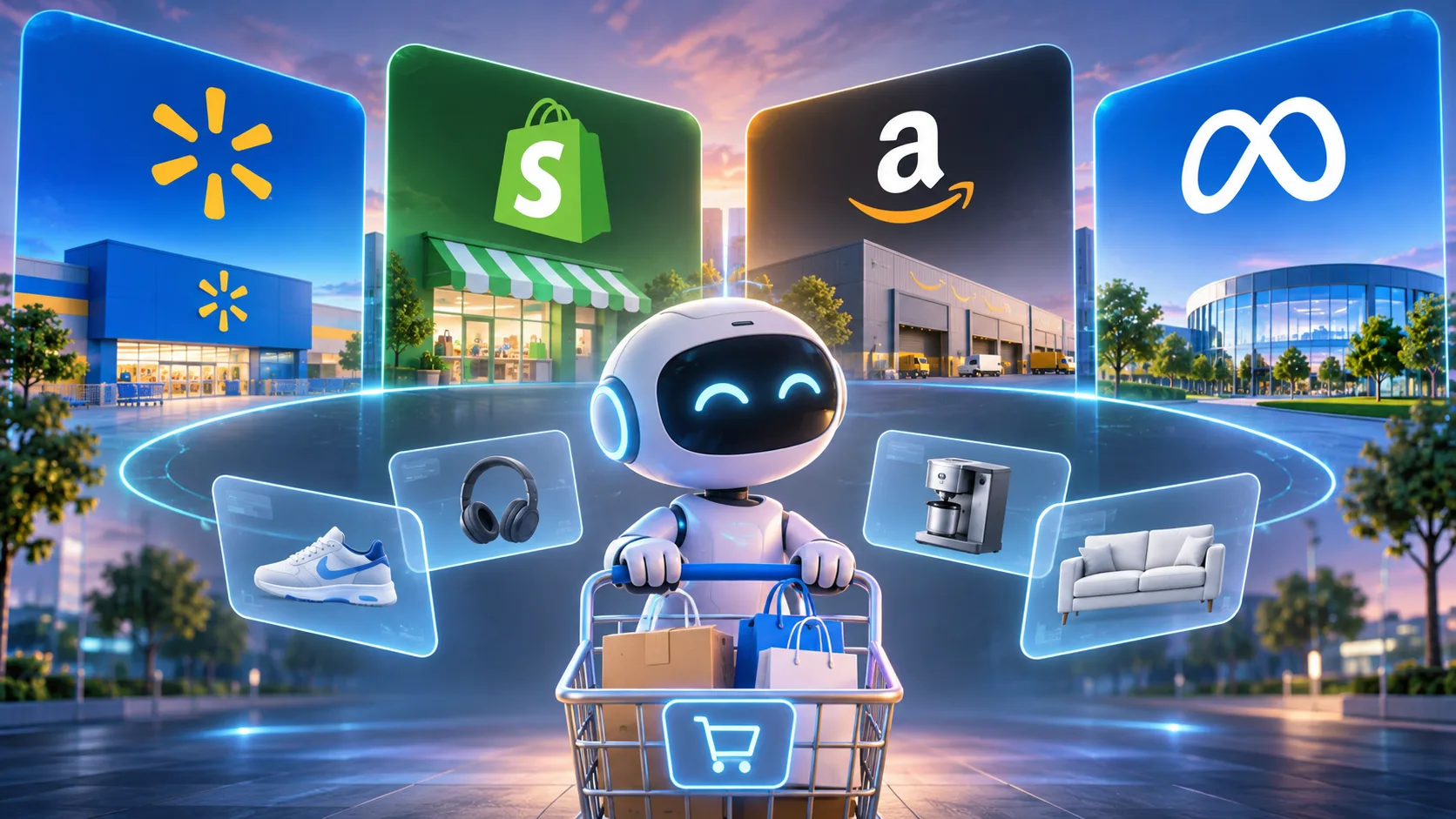
AI shopping agents shift e-commerce from people visiting retailer websites to software that searches, compares and buys on a shopper’s behalf. The hard problem is trust: whose interests the agent serves, how much authority it gets, and who is responsible when it goes wrong. Walmart, Shopify, Amazon and Meta are taking very different positions, and the outcome will decide whether the agentic web stays open.
For twenty years, e-commerce worked on a simple assumption. People go to a website, search for a product, compare a few options, and buy. Retailers spent billions making that journey better. Search rankings, product pages, ads, checkout. All of it tuned for a human at the other end.
AI agents break that assumption.
Picture this. You tell your assistant to find a replacement dishwasher, compare the options, check delivery, and buy something within budget. You never visit a retailer’s website. You never see a sponsored listing. You never touch a checkout. The agent does the work, you approve the decision, and the relationship that used to belong to the retailer now belongs to whoever runs the agent.
Over the past several weeks Walmart, Shopify, Amazon, and Meta have all made it clear the fight for that relationship has already started.
On October 21, Walmart announced an Agent Gateway, Agent Profiles, and new terms for agent activity. The gateway lets approved third-party agents connect to Walmart’s shopping infrastructure through the Model Context Protocol, so a program gets a structured way to search and transact instead of fumbling around a website built for humans. It’s starting as a developer beta.
Agent Profiles is the more interesting part. Every authorized agent gets its own identity inside a customer’s account, so a customer can see what each one bought, require approval on every purchase, set spending limits, and revoke access any time. Agents won’t get payment-card details or the ability to change payment methods, and customers get the same prices either way. There’s even a privacy angle: Walmart wants to help agents find products a customer regularly buys without exposing their full shopping history.
That last bit matters. This isn’t Walmart just making its website easier for a bot to read. It’s building an authorization and transaction framework for software acting on a person’s behalf. Walmart also runs Sparky and plugs into Muse, ChatGPT, and Gemini, and its bet is straightforward: wherever customers choose to delegate their shopping, it wants to remain a place those agents can buy from.
Shopify’s Fall ’26 Edition, from October 28, is a different bet. Instead of owning a destination, Shopify wants to be the plumbing connecting merchants, consumers, and agents. Shop.dev, Shop.md, expanded Catalog APIs, WebMCP tools, and checkout built for third-party AI experiences. Shopify says its catalog has over a billion products and 400 million Shop Pay accounts. Those are numbers about potential reach, not people already buying through agents.
There’s also a merchant knowledge base, which I suspect is the part most people will skip over. Merchants can review and publish information agents can pull about their business: return policies, shipping destinations, that sort of thing. Shopify drafts it from the storefront, but the merchant has to approve it first.
Think about why that matters. A customer asks an agent to find a Canadian retailer selling a specific product with free returns, delivery within five days, and a manufacturer’s warranty. The agent needs more than a product description. It needs current, machine-readable facts about the merchant’s policies, and Shopify wants to make those facts available next to the products and the checkout. The strategic bet is that the future of e-commerce is less about pulling people into storefronts and more about making commerce available wherever an agent happens to be running.
Amazon has been less welcoming.
In September it blocked Meta’s Muse from shopping on its platform, and it’s challenged Perplexity’s Comet browser agent over automated shopping. Amazon wants third-party agents to identify themselves, follow its participation rules, and meet privacy and security standards. Fair enough. An agent that handles customer credentials and makes purchases needs real safeguards.
But Amazon also has a commercial reason to keep the experience under control. Its business isn’t just completing transactions. Product discovery, sponsored listings, ads, customer relationships, purchasing data. All worth protecting. An independent agent that compares across retailers would walk right past a lot of that.
The irony is that Amazon is building its own agentic shopping at the same time. Alexa for Shopping already helps customers discover and buy, and its experimental Buy for Me feature has tried purchasing from other retailers. In November, Reuters reported Amazon considered a World Product Graph, a huge database of products across the internet, including ones Amazon doesn’t sell. Amazon said the planning document was outdated and may not reflect current plans, so it’s not a confirmed launch. Still, the direction is worth watching. Amazon may not want independent agents shopping freely inside its marketplace, but it clearly sees the value in being the agent that shops for the consumer. The line that matters is between controlling access to Amazon and controlling access to the customer.
Then there’s Muse, which showed up almost overnight. Launched in September, it climbed the app-store rankings fast, and within weeks Meta was announcing retail integrations with Walmart, Best Buy, Sephora, Wayfair, and Shopify, plus payment connections like Shop Pay and PayPal. Meta is also putting Muse into AI glasses, where you could point at a product and ask the agent to find it, compare it, or buy it.
That’s the thing to notice. Shopping agents may not stay standalone apps. They could end up inside the operating system, the browser, messaging, smart glasses, whatever people use all day. Meta has distribution through its social platforms and hardware. Google has Gemini, Search, Android, Chrome. OpenAI has ChatGPT. Apple has the devices. Amazon has Alexa, Prime, the marketplace, and an enormous pile of purchasing data.
So could Amazon launch a standalone agent to take on Muse directly? It has most of the pieces already, even though nothing is confirmed. The harder question is whether it could convince people to trust it as an independent advisor. An agent that recommends products from across the web has to persuade users it’s acting in their interests, not steering them toward whoever pays its operator the most. That’s a much harder problem than building a chatbot that can find products.
We talk about AI agents like a technical problem. Can they navigate a site, hit an API, compare products, run a transaction? Those capabilities matter, but trust is the real limit on adoption. A September report cited research that only 16% of shoppers were comfortable letting an assistant both find and buy on their behalf. People will happily ask an agent to research a television. Giving it permission to spend $2,000 is another thing entirely.
I see five problems.
First, whose interests does the agent represent? A trustworthy agent has to separate recommendations rooted in the customer’s preferences from sponsored placements and affiliate commissions. If a product gets recommended because the merchant pays more, the customer deserves to know. This gets more important as companies like Shopify build financial incentives for developers who generate transactions.
Second, how much authority should an agent have? Walmart’s separate identities, spending limits, and revocable permissions are a good start, but spending limits alone aren’t enough. People may want limits by merchant, product category, geography, or transaction type. An agent allowed to buy groceries shouldn’t also be able to buy expensive electronics.
Third, how do we check that an agent decided well? Agents misunderstand specs, recommend incompatible products, miss shipping charges, rely on stale inventory. Customers need to see why a recommendation was made, what alternatives were considered, and what supports the decision. In an ideal world the agent produces a decision record: the requirements, the products it evaluated, the sources it consulted, the trade-offs, and the authorization it got.
Fourth, who is responsible when it goes wrong? An agent orders the wrong appliance, misses a delivery window, buys something that can’t be returned. Is it the customer, the developer, the retailer, the payment provider? Existing consumer protections don’t vanish because software started the transaction, but the responsibility across these systems needs to be clearer.
Fifth, how much should the agent know? A good shopping agent benefits from your household, location, clothing sizes, preferences, budget, and purchase history. That’s a lot of personal information concentrated in one service. Consumers will need real control over what an agent remembers, what it shares, and whether they can move it to a competitor.
The agent that wins won’t just be the one that completes the most tasks. It’ll be the one people trust to decide when they’re not looking.
There’s a bigger issue that deserves more attention: what happens to the open web when agents become the main way people and businesses meet.
Today anyone can load a public retailer’s site, compare products, and choose where to shop. An agent may not have the same freedom. Retailers can block automated traffic, require approved integrations, restrict transactions, or strike exclusive deals with particular AI providers. Some of that is necessary. Businesses need to protect accounts, stop fraud, manage costs, and control sensitive information.
But if every major retailer demands a separate commercial agreement before an agent can read product information or complete a purchase, the web gets a lot less open. A handful of big AI companies could lock up preferred access while smaller developers and new competitors get left outside. We’d recreate the gatekeeper problem of app stores and marketplaces, this time sitting on top of the consumer’s own assistant.
There are promising technical pieces. MCP gives AI apps a common way to connect to tools and services. Shopify’s WebMCP lets agents use structured storefront functions instead of pretending to be a human clicking around. Meta has previewed a Personal Agent Protocol, built with Walmart, Shopify, and Stripe, to help personal agents talk to business agents.
But a published protocol doesn’t guarantee interoperability. An open agentic web needs a few principles. Public information, prices, availability, published policies, should stay discoverable without exclusive commercial deals. Authentication should be portable and permission-based, so people can authorize their own agents without handing over a password or full account access. Transaction permissions, spending limits, approvals, revocation, records, shouldn’t have to be rebuilt for every retailer and every AI provider. Agents should identify themselves so retailers know when they’re dealing with software. Customers should be able to switch agents without their preferences and history becoming a lock-in mechanism. And recommendations should be transparent about when money influences what an agent shows.
Above all, the standards for agentic commerce shouldn’t be controlled only by the companies with the biggest marketplaces or the biggest AI platforms. Open protocols and independent implementations will matter as much as model quality. Otherwise we replace an open web of competing retailers with a few proprietary shopping networks.
For businesses, this is an immediate problem. For years retailers optimized their sites for Google and for human visitors. Now they also have to ask whether an agent can understand their products, verify their claims, compare their offerings, and finish a transaction. That means accurate structured product data, current pricing, reliable inventory, clear policies, accessible interfaces. A retailer with beautiful pages but incomplete specs could lose a recommendation to a competitor with better structured data. A business with a great return policy might never get considered if an agent can’t find that policy. And a merchant may find its most important sale happens entirely off its own site.
This isn’t SEO with a new name. Search has been about getting discovered and pulling in traffic. Agentic commerce adds being evaluated, trusted, selected, and transacted with by software. That’s a different kind of competitiveness, and most merchants haven’t started on it.
The next battle in e-commerce isn’t just over where people shop. It’s over which platform an agent trusts enough to recommend, compare, and buy from.
Walmart is betting that opening its infrastructure to approved agents keeps it relevant wherever customers shop. Shopify is betting it becomes the infrastructure connecting merchants to agents across the web. Amazon is protecting its marketplace while building its own shopping AI. And Muse is showing how fast a new agent can come out of nowhere and challenge all of them.
The prize is real. Whoever runs a consumer’s trusted agent could shape purchases across thousands of retailers without owning a single product or warehouse.
But it’s also a choice about what kind of internet we want. We can build an agentic marketplace where consumers pick their agents, merchants compete openly, and shared standards make shopping safer and easier. Or we can let a few platforms decide which agents reach which stores, which products get considered, and which transactions are allowed.
The agent that wins should be the one that earns the customer’s trust, not the one that talks its way into the most walled gardens.
I’d rather have products, merchants, and agents all competing out in the open. What I don’t want is another set of locked doors.
Frequently Asked Questions
What is Walmart’s Agent Gateway?
It’s a way for approved third-party AI agents to search and buy from Walmart through the Model Context Protocol, instead of clicking through a website built for people. It’s starting as a developer beta. Alongside it, Agent Profiles give each agent its own identity inside a customer’s account, with spending limits, purchase approvals and access you can revoke any time.
Why did Amazon block Meta’s Muse?
Amazon wants third-party agents to identify themselves, follow its participation rules and meet its privacy and security standards. It also has a commercial reason. Product discovery, sponsored listings and purchasing data are a big part of its business, and an independent agent comparing across retailers walks right past them.
How many shoppers trust AI agents to buy for them?
Not many yet. A September report cited research that only 16% of shoppers were comfortable letting an assistant both find and buy on their behalf. People will hand an agent the research. Letting it spend $2,000 is a different decision.
How should retailers get ready for AI shopping agents?
Make sure an agent can read and verify what you sell. That means accurate structured product data, current pricing, reliable inventory and clear policies. A great return policy doesn’t help if an agent can’t find it, and a competitor with better data can win the recommendation.
Sources and further reading
- Walmart: Making It Possible for Agents to Shop on Behalf of Customers, October 21, 2026
- Shopify: Fall ’26 Edition for Developers, October 28, 2026
- Shopify: Fall ’26 Edition for Merchants, October 2026
- Meta: The Biggest News From Connect 2026, September 2026
- Axios: Amazon Boots Meta’s Muse in Fight Over AI Shopping, September 21, 2026
- Reuters: Amazon’s Plan to Own the World’s Product Data and Fight AI Shopping Agents, November 13, 2026
- Reuters: AI Shopping Agents Could Threaten Amazon and Walmart’s Ad Business, November 4, 2026