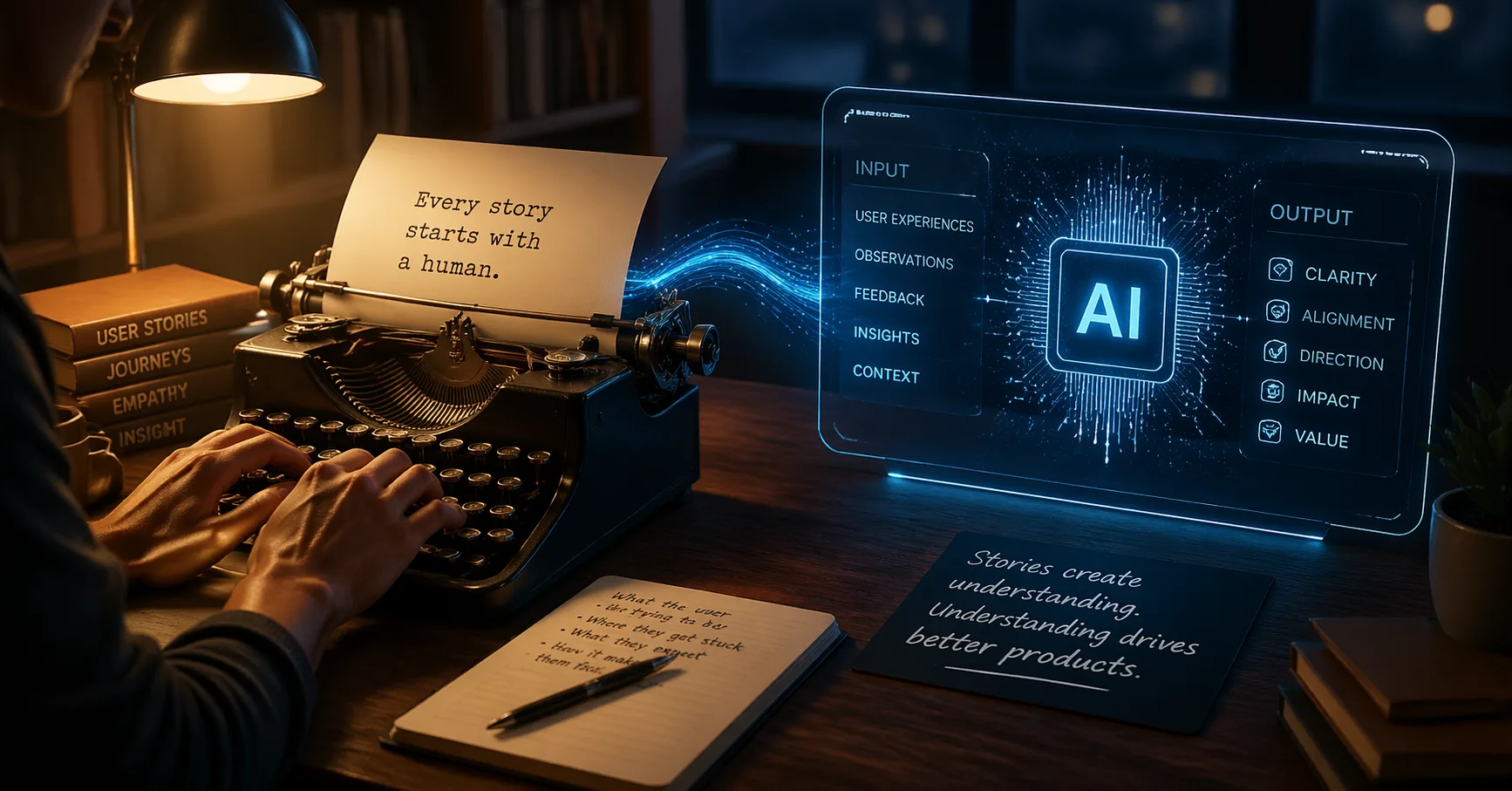
AI is compressing execution, but storytelling remains the skill it can’t replace. In product management and technology leadership, the ability to frame problems as narratives, translate user experience into stories engineers internalize, and create alignment through compelling framing is becoming the core differentiator. The tools have changed. The models have changed. But the need to make people feel the problem and the opportunity has not.
There’s a quiet shift happening in product management and technology.
It isn’t about frameworks.
It isn’t about roadmaps.
And increasingly, it isn’t even about the technology itself.
It’s about storytelling.
In a world where AI can generate code, summarize research, and design interfaces, the differentiator is no longer what you build. It’s how clearly and compellingly you can articulate why it matters.
I was reminded of this last summer after reading The Science of Storytelling by Will Storr. The book is ostensibly about fiction and craft, but what stuck with me was how directly it applies to business. The way our brains are wired for narrative. How we process change through character and cause. Why a well-framed story moves people in ways data rarely does. It pulled the thread forward for me. Storytelling isn’t a soft skill on the side of the real work. In business environments, it increasingly is the work.
The Prof G Perspective: Story Over Data
Scott Galloway has been making this argument for years, and it’s becoming more relevant in the AI era.
He argues that in the battle between narrative and numbers, humans choose narrative most of the time.
Even more interesting:
- Storytelling isn’t just communication. It’s a competitive advantage.
- The best stories surprise, dramatize, and stick.
- And storytelling itself is a service, a mechanism for generating hope.
That last point matters more than it seems.
In AI-driven product development, where possibilities are expanding faster than most teams can process, people don’t just need information. They need orientation.
Stories provide that.
My First Lesson in Product Storytelling
I learned this long before AI.
Early in my career at Secure Computing, I was working with customers in the Japanese market. We were building software that, on paper, worked well.
In reality, it didn’t fit.
The only way to understand that gap wasn’t through dashboards or metrics. It was through listening.
- Sitting with customers
- Observing how they actually used the product
- Understanding the friction, confusion, and workarounds
Because of the time difference, we rarely spoke live.
So I would write long, detailed emails back to the engineering team. Not just describing bugs or features, but telling stories:
- What the user was trying to do
- Where they got stuck
- What they expected versus what happened
- How it made them feel
Those emails weren’t status updates. They were narratives.
And they worked. They changed how engineers thought about the product.
Storytelling as a Product Skill
What I didn’t fully appreciate at the time was that I was doing something fundamental: translating user experience into a story that engineers could internalize.
That’s still the job today, but it’s becoming more important.
Why? Because AI is compressing everything else.
- Code is easier to generate
- UX patterns are easier to replicate
- Insights are easier to surface
But meaning is still hard. And meaning lives in stories.
AI Has Raised the Bar
Ironically, AI doesn’t reduce the importance of storytelling. It amplifies it.
We now have tools that can generate product specs, user personas, feature ideas, and entire product strategies.
Without a coherent narrative, those outputs feel generic, disconnected, and interchangeable.
The real leverage comes from using AI to support a story, not replace it.
Academic research is starting to reflect this too. Generative AI is most powerful when it creates personalized narratives that resonate with users emotionally, not just functionally.
The New Product Differentiator
In the past, great product managers were structured thinkers, data-driven decision makers, and strong executors.
Those still matter.
But today, the standout PMs and technology leaders are the ones who can:
- Tell a compelling story about the user journey
- Connect features to real human outcomes
- Create alignment across teams through narrative
- Make people feel the problem and the opportunity
In a world of infinite AI-generated options, the question becomes: why this product? Why now? Why does it matter?
Only a story can answer that.
Back to Today
I find myself using the same skills I developed years ago, just in a different context.
- Listening carefully, now often to data and AI outputs
- Interpreting signals
- Translating them into something human
- Framing them as a story others can act on
The medium has changed. The models have changed. But the core skill hasn’t.
If anything, it’s becoming the most important one.
Final Thought
AI will continue to commoditize execution.
But storytelling? That’s becoming the moat.
For product managers and technology leaders, it may be the one skill that AI can’t fully replace, because it’s not just about generating content.
It’s about understanding people.
Frequently Asked Questions
Why is storytelling becoming more important as AI advances?
AI is compressing execution. Code generation, UX patterns, research summaries, and even product strategies can be produced by AI tools. But meaning, context, and the ability to make people care about a problem remain human skills. Storytelling is the mechanism that turns raw AI output into something that moves teams and customers to act.
How does storytelling apply to product management specifically?
Product managers translate between users, engineers, and stakeholders. The most effective way to do that is through narrative: framing what a user was trying to do, where they got stuck, and what they expected. This approach changes how engineering teams think about problems, far more effectively than feature lists or bug reports alone.
Can AI replace storytelling in business?
AI can generate narratives, but it can’t replace the human judgment behind them. Knowing which story to tell, when to tell it, and why it matters requires understanding people, context, and organizational dynamics. AI is most powerful when it supports a story rather than tries to replace one.
What book influenced this perspective on storytelling?
The Science of Storytelling by Will Storr explores how brains are wired for narrative, how we process change through character and cause, and why stories move people more effectively than data. While written about fiction craft, the principles apply directly to business communication and product leadership.
What skills should product managers develop alongside AI tools?
The standout product managers and technology leaders today can tell compelling stories about user journeys, connect features to real human outcomes, create alignment through narrative, and make people feel both the problem and the opportunity. These skills become more valuable, not less, as AI handles more of the execution work.