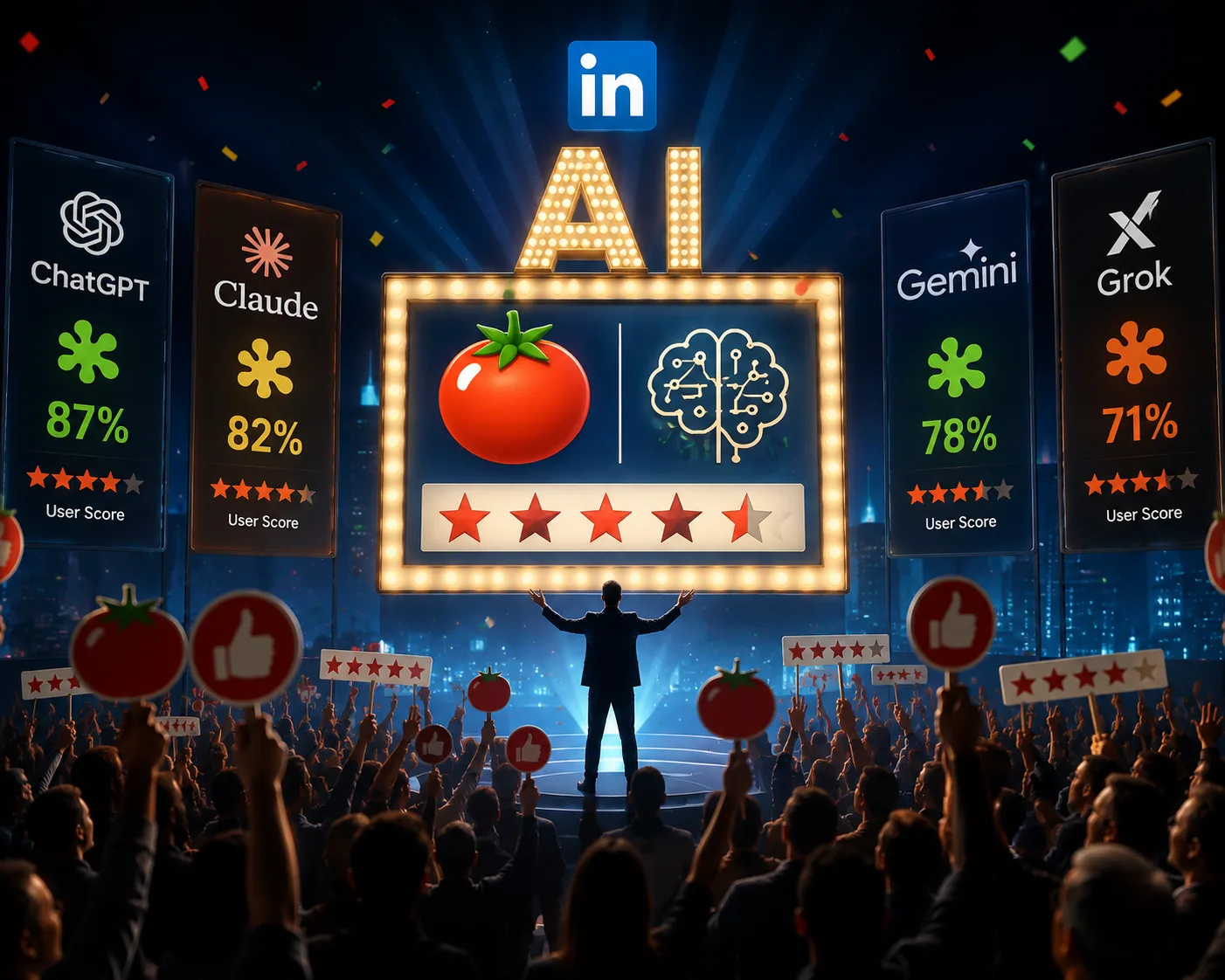
LinkedIn’s Crosscheck is a crowdsourced AI leaderboard where professionals rate model responses, scored by industry, function, and seniority. Rotten Tomatoes for language models, with real career context attached to every rating. The interesting move isn’t the feature; it’s who is doing the ranking. Whoever owns the leaderboards may end up shaping AI adoption more than the labs building the models. Crosscheck looks less like a product feature than emerging infrastructure for the AI market.
Every AI company says its model is the best.
OpenAI publishes benchmark scores. Anthropic talks about safety and reasoning. Google points to multimodal results. xAI sells real-time information. Everyone has a scorecard, and everyone wrote their own test.
If you are a professional trying to pick a tool, that is not much help. It is noise. (I’ve made the case before that model choice in 2026 turns on fit-to-workflow, not raw benchmark scores.)
Crosscheck is LinkedIn’s attempt to cut through it. You can see the live version at the Crosscheck leaderboard.
On the surface it is simple. You submit a prompt, you get responses from several models, you rate what comes back. Those ratings pile up into a score for each model. Rotten Tomatoes, except the critics are working professionals and the films are language models.
The interesting part is not the feature. It is who is running it.
LinkedIn knows who you are. Not in the vague way an ad network knows you, but specifically: your industry, your job function, your seniority, your career history. No other AI evaluation has that context attached to the person doing the rating.
So a marketing director, a software engineer, an HR lead, and a CFO can rate the same model and disagree completely, and all four ratings are useful, because LinkedIn knows which one is which.
That changes what “best” means. For the first time a model can be ranked by whether it actually helps with your job, not by how it scores on a test someone built to make their own model look good. (Related: why most organizations have no idea which AI to trust.)
Which raises the questions worth asking. Will companies start choosing vendors off Crosscheck rankings? Will the labs tune their models to win professional ratings instead of benchmarks? Could a leaderboard for a single industry end up mattering more than every academic benchmark combined?
There is a privacy side to this too. Crosscheck runs on prompts, responses, ratings, and professional context, all collected and aggregated. LinkedIn says the point is to help professionals see which models work best for their kind of work. Fair enough. But anyone using it should be clear about what they are handing over and how it gets used.
Here is the pattern I keep coming back to.
Search engines ranked websites. Social networks ranked content. Now the platforms are ranking the models themselves.
Whoever owns those rankings may end up with more power over AI adoption than the people building the models. That is the part almost nobody is talking about yet.
Crosscheck looks like a product feature today. I think it is closer to infrastructure.
Frequently Asked Questions
What is LinkedIn Crosscheck?
Crosscheck is a LinkedIn Labs project that lets professionals submit prompts, receive responses from multiple AI models, and rate the answers. Aggregated ratings turn into a leaderboard scored against the rater’s industry, job function, and seniority. Functionally, it’s a Rotten Tomatoes for language models. Every reviewer comes with verified professional context attached.
Why is Crosscheck different from MMLU, MT-Bench, or other AI benchmarks?
Traditional benchmarks measure how a model performs on tests written by researchers, often the same labs that build the models. Crosscheck measures whether the model is actually useful to working professionals on real prompts, segmented by who’s doing the rating. That moves the evaluation from “which model is technically best” to “which model is best for my kind of work.”
Why does LinkedIn have an unusual advantage here?
LinkedIn knows the rater’s verified industry, job function, seniority, and career history. No other AI evaluation surface has that context. That means a marketing director, software engineer, HR lead, and CFO can rate the same model differently and every rating is independently useful, because the platform knows which one is which and can segment accordingly.
Could Crosscheck change how enterprises choose AI vendors?
Quite possibly. If a credible leaderboard shows that one model meaningfully out-performs others for legal, healthcare, marketing, or engineering work, as rated by actual professionals in those roles, that becomes the kind of signal procurement teams use, and AI labs respond to. Industry-specific leaderboards may end up shaping vendor selection more than general academic benchmarks.
What are the privacy considerations with Crosscheck?
Crosscheck collects prompts, model responses, user ratings, and professional context, then aggregates them to build the leaderboard. LinkedIn’s stated purpose is helping professionals identify which models work best for their kind of work. Anyone using it should be clear-eyed about what they’re submitting, how it’s stored, and what it’s used for downstream. Treat any prompts you’d consider sensitive as if they’ll be retained.
Why is Crosscheck closer to infrastructure than a product feature?
Search engines ranked websites. Social networks ranked content. Crosscheck ranks the models themselves. Once a professional-context leaderboard becomes the default reference for “which AI is best for my role,” it stops being a feature and starts behaving like market infrastructure, shaping vendor selection, model tuning, and AI adoption at scale. Whoever owns that layer may end up with more influence on the AI market than the labs building the models.