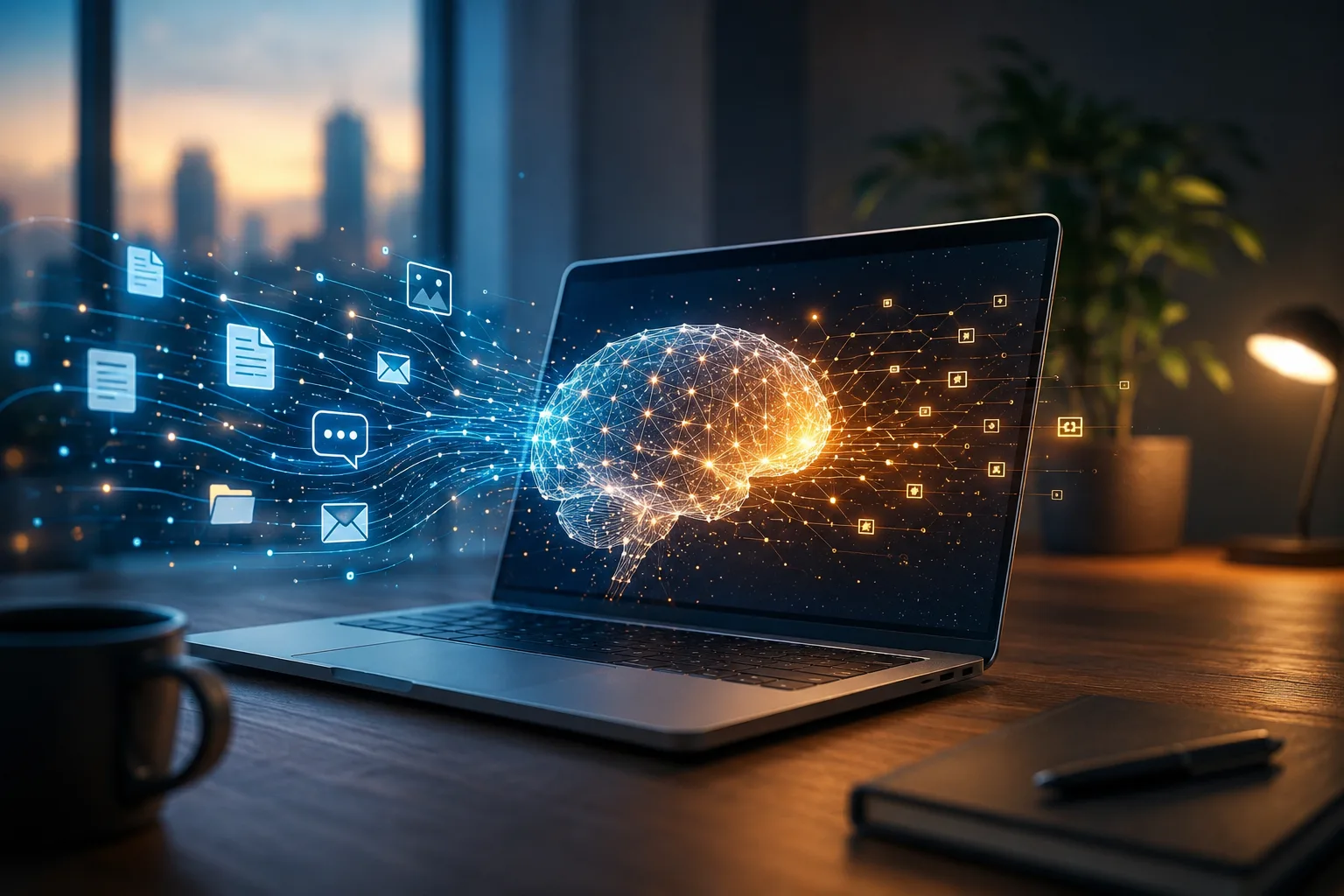
The next major AI shift is not a bigger model. It is where the model runs. Frontier capability is compressing fast enough that a MacBook Pro, Mac Studio, Copilot+ PC, or RTX workstation can already do real work offline, and the next wave is persistent on-device assistants that know you, internal company models that keep enterprise data inside the business, and a hybrid architecture where intelligence lives in hyperscale clouds, inside organizations, and on the devices we carry. The most interesting AI computer over the next five years may be the personal AI datacenter sitting in front of you.
For the past decade, computing followed one direction. Everything moved to the cloud. Files, email, applications, even our photos and memories.
When generative AI showed up, most people assumed the pattern would hold. Massive models would live in massive datacenters, and every AI request would travel across the internet to a server owned by OpenAI, Google, Anthropic, or Microsoft.
That assumption is starting to break.
The next phase of AI may not live entirely in the cloud. A lot of it may live on your laptop.
A Familiar Story
I’ve seen this movie before.
When I started working, one of the most valuable people in the office wasn’t a lawyer, a consultant, or an executive. It was the Knowledge Manager.
At the firm where I worked, this person maintained shelves of legal volumes, CD collections, research archives, audio recordings, and case references. They knew where everything was. The role existed for one reason: information was hard to find.
Then digital storage got cheap. Search engines got good. Corporate networks spread everywhere. Information became searchable, and organizations decided it would organize itself. The Knowledge Manager mostly disappeared.
AI is now forcing us to revisit a lot of those old assumptions. The same thing is happening with infrastructure.
How We Got Here
The 1990s personal computer era. Computing happened locally. Your documents, databases, email archives, and software all lived on your machine. Your computer was your datacenter.
The cloud era, roughly 2005 to 2020. The economics changed. Storage got cheap, bandwidth got abundant, and providers built global infrastructure. Organizations moved everything onto AWS, Azure, and Google Cloud. The cloud became the default answer to every technology question.
The AI datacenter boom, 2022 to 2024. ChatGPT arrived and every large tech company started racing to build AI capacity. Billions of dollars poured into GPUs, power generation, cooling, and AI superclusters. It may turn out to be the largest datacenter construction boom in history. The reasoning was simple: AI would always need enormous infrastructure. (I’ve written more on the scale of that buildout in AI Capex Is Becoming the New Arms Race.)
The great compression, 2025 to 2026. Then something surprising happened. The models got smaller. The hardware got faster. The laptops got smarter. A capability that used to need a rack of servers now fits inside a notebook. It turns out not every AI workload needs a datacenter.
What Can Run Locally Today
Most people underestimate what current hardware can already do. A MacBook Pro, Mac Studio, Copilot+ PC, or RTX workstation can run capable AI models completely offline.
You can run a private assistant that never sends your data anywhere. Your conversations and documents stay on the machine. Nothing leaves.
You can analyze thousands of documents locally. A model on your own hardware can read contracts, search policies, summarize reports, compare files, and flag inconsistencies without ever touching a cloud service.
You can build a personal research agent that knows your notes, your PDFs, your presentations, your emails, and your project files. People are already doing this.
You can generate software. Local coding models have gotten good, and developers increasingly run them on their own machines because they’re faster, cheaper, and private. The economics get better every month.
What’s Coming Soon
This is the interesting part. The next wave isn’t bigger models. It’s persistent ones.
Your AI will know you. Not in a creepy advertising way. In a useful way. It will understand your projects, your writing style, your goals, your expertise, and your history, and it will keep evolving alongside you.
More companies will run their own models. Today most organizations upload their documents to someone else’s platform. Tomorrow a lot of them will run internal AI instead, not because they want the headache but because privacy, governance, and cost will push them there. The enterprise architecture starts to look like three layers working together: public cloud AI, internal company AI, and personal employee AI. (For how the current business AI subscription stack stacks up, see The Best AI Subscription for Business in 2026.)
AI will work offline. Most people still think of it as an internet service. Future systems will behave more like software you own. Your assistant won’t stop working because the Wi-Fi dropped, a provider went down, or you hit an API limit. The intelligence travels with the device.
And yes, personal AI datacenters. This sounds futuristic, but the hardware is already here. A high-end Mac Studio holds hundreds of gigabytes of unified memory. NVIDIA workstations now deliver performance that would have counted as datacenter-class a few years ago. What used to need a server room fits under a desk. The next generation of professionals may keep a laptop, a monitor, and a local AI cluster as casually as earlier generations kept a printer.
The Shift Nobody Is Talking About
Almost every conversation about AI focuses on the models. OpenAI, Anthropic, Google, Meta.
History says the bigger story is usually infrastructure. Every major computing era produces a new default architecture: mainframes, personal computers, client-server, cloud. AI is producing the next one.
It won’t be a return to the desktop, and it won’t replace the cloud. It’ll be a hybrid where intelligence lives everywhere at once. Some in hyperscale datacenters, some inside organizations, some on the devices we carry around.
For twenty years the cloud absorbed more and more of our digital lives. AI might be the first technology strong enough to pull part of that back, not because the cloud is going away, but because our own devices are finally smart enough to do real work on their own.
The most interesting AI shift of the next five years may not be a bigger model. It may be the moment we realize the most important computer in our lives is the personal AI datacenter sitting in front of us.
Frequently Asked Questions
What does “personal AI datacenter” actually mean?
It means running capable AI models on your own hardware instead of routing every request to a hyperscale cloud service. Today that includes a MacBook Pro, Mac Studio, Copilot+ PC, or NVIDIA RTX workstation; tomorrow it includes more powerful local setups with hundreds of gigabytes of unified memory. The intelligence lives on the device, not on someone else’s server.
What can current laptops actually run offline?
A surprising amount. Private assistants that never send conversation data off-device. Document analysis across thousands of contracts, policies, and reports without cloud upload. Personal research agents that read your notes, PDFs, presentations, emails, and project files. Coding assistants that generate and review software locally, often faster and cheaper than cloud equivalents.
Does this mean the AI cloud is going away?
No. Frontier-scale training and the largest reasoning workloads will continue to need hyperscale infrastructure. The shift is from a one-tier model (everything in the cloud) to a hybrid architecture where intelligence lives in three places at once: hyperscale public clouds, internal company systems, and the devices each person carries. The cloud share of overall AI workload changes, but the cloud itself doesn’t disappear.
Why would a company run its own AI instead of using a hyperscale provider?
Privacy, governance, and economics. Uploading sensitive documents to a third-party AI platform creates data-residency, retention, and confidentiality exposure many organizations cannot accept. Internal models keep proprietary content inside the business, simplify compliance, give legal and security teams clear control, and increasingly compete on cost as inference becomes cheaper on owned hardware.
What does “persistent AI” mean and why does it matter?
A persistent AI is one that retains context about you across sessions. It understands your projects, your writing style, your goals, your expertise, and your history, and it keeps evolving with you over time. That changes the assistant from a stateless tool into a long-running collaborator, and it is far more useful when it runs locally because the persistent memory stays under your control.
What are the privacy and security implications of local AI?
Big upside on privacy: conversations, documents, and embeddings never have to leave the device, which eliminates a whole class of third-party retention, access, and breach concerns. The flip side is device security becomes more load-bearing. A laptop running a personal research agent that knows your contracts, emails, and notes is a higher-value target than a laptop running plain office software, so disk encryption, OS updates, MDM, and least-privilege access matter more, not less.
Why is infrastructure the bigger story than model launches?
Every major computing era is defined by where the computing happens, not which application is biggest at the time. Mainframes, personal computers, client-server, cloud. The shape of the infrastructure decides what becomes possible, who captures value, and how organizations build software. AI is producing the next default architecture, and the most consequential changes are likely to show up in the topology, not in any single model announcement.